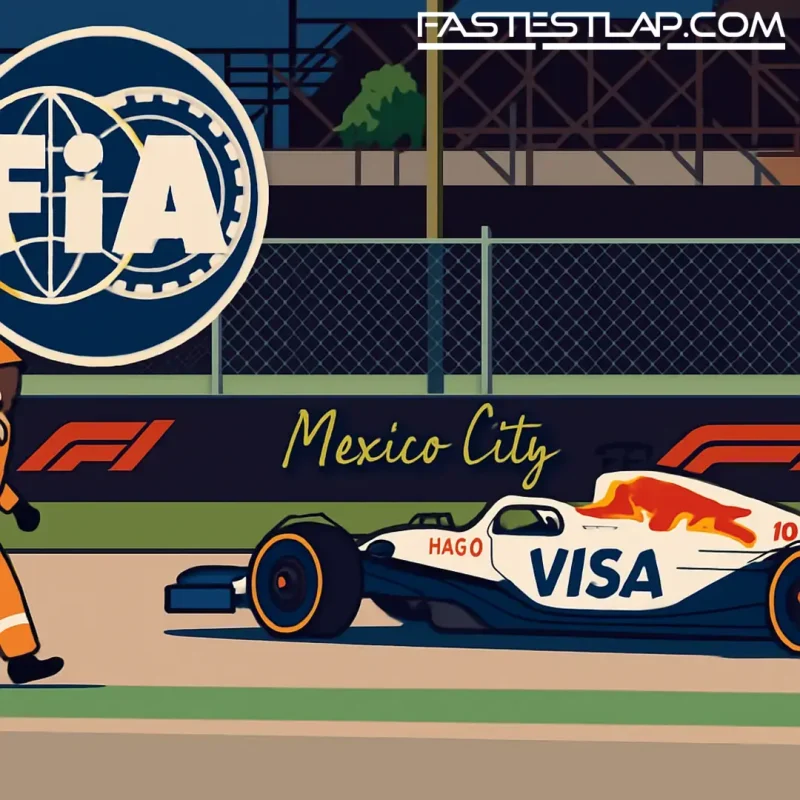
FIA backs Lawson after Mexico marshal near-miss, investigation ongoing
The FIA has moved to defend Liam Lawson after the Racing Bulls driver narrowly avoided two marshals on the racing line during the Mexico City Grand Prix, confirming telemetry shows he slowed appropriately under double yellows and “is not at fault.”
Lawson had just pitted for a new front wing after early contact with Williams’ Carlos Sainz when he rejoined and arrived at Turn 1 to find marshals sprinting across the track to clear debris. He jinked left, missed them by a heartbeat, and went straight onto the radio: “I could have f***ing killed them!” He retired not long after, still incredulous at what he’d witnessed.
“I’ve never seen that before,” Lawson told reporters post-race. “There’s obviously been a miscommunication somewhere. It can’t happen again.”
The governing body says it agrees with the sentiment. While stressing the probe isn’t finished, it issued an updated statement acknowledging the seriousness of the moment and outlining the scope of the review—pulling radio in multiple languages, syncing race-control calls, and digging into the timeline with the Mexican ASN (OMDAI) and Racing Bulls.
The FIA added important context of its own: race control had initially called marshals to the scene to collect debris, but that instruction was rescinded when Lawson dived into the pits. Somewhere between those two actions, the chain broke. The marshals still went, and the #30 RB arrived at exactly the wrong time.
Earlier this week, OMDAI published an unofficial explanation that effectively laid the blame at Lawson’s feet, arguing he’d been warned of double yellows and should have slowed significantly, even to the point of being prepared to stop, and suggesting onboard footage showed him taking his normal line through Turn 1 with marshals visible ahead.
That didn’t land well in the paddock, and the FIA has now pushed back. “Having analysed the telemetry from the incident, we can confirm that the driver of Car #30, Liam Lawson, slowed appropriately and reacted correctly to the double yellow flags… He is not at fault in this incident,” the statement read. The federation also reiterated the obvious: any scenario that puts volunteers in front of live cars is one it “never wants to see.”
Strip away the noise and this is a pure systems failure—one that will keep race control up at night. Mexico’s Turn 1-2-3 complex is frenetic at the best of times, with pit exit feeding straight into the braking zone, and once you’ve unleashed marshals onto hot asphalt, the margin for error shrinks to nothing. That Lawson didn’t collect anybody is down to instinct and luck.
The bigger question is procedural. When a call to deploy marshals is cancelled mid-flow, how is that change transmitted to the people on the ground—and how do you guarantee they’ve heard it before they step onto a live track? Every circuit has its own comms quirks and language layers; the FIA’s reference to reviewing “radio communications in multiple languages” tells you how messy this can get in real time.
There’s also the human side. Marshals are the quiet backbone of the sport—volunteers who do the hard, sometimes dangerous jobs week after week. They deserve systems that don’t put them in harm’s way and drivers who can trust that a double yellow doesn’t suddenly become a foot chase across the apex. The FIA’s closing thanks to the volunteer corps was more than polite boilerplate; it’s a reminder of the stakes.
Lawson, for his part, was measured once the adrenaline dipped. He said he understood marshals have a tough job, repeated that it must come down to miscommunication, and called the whole situation “pretty unacceptable.” None of that is controversial, and the FIA’s stance essentially mirrors it. The analysis will take time; the findings will be made public; and the expectation, as ever after a near-miss, is that procedures get tightened so nobody’s relying on miracles at 250 km/h.
Until the report lands, two things can be true at once: it’s right to resist a blame game before the facts are in, and it’s right to make clear that Lawson did what was asked under the flags. You can feel both truths in the FIA’s tone—firm on the driver, open-ended on the process.
The sport’s been through versions of this before and learned from them. Mexico 2025 should be another line in that playbook: clear signals, clean chains of command, and no grey area when boots are close to the racing line. The near-miss was dramatic. The fix needs to be boring—and bulletproof.