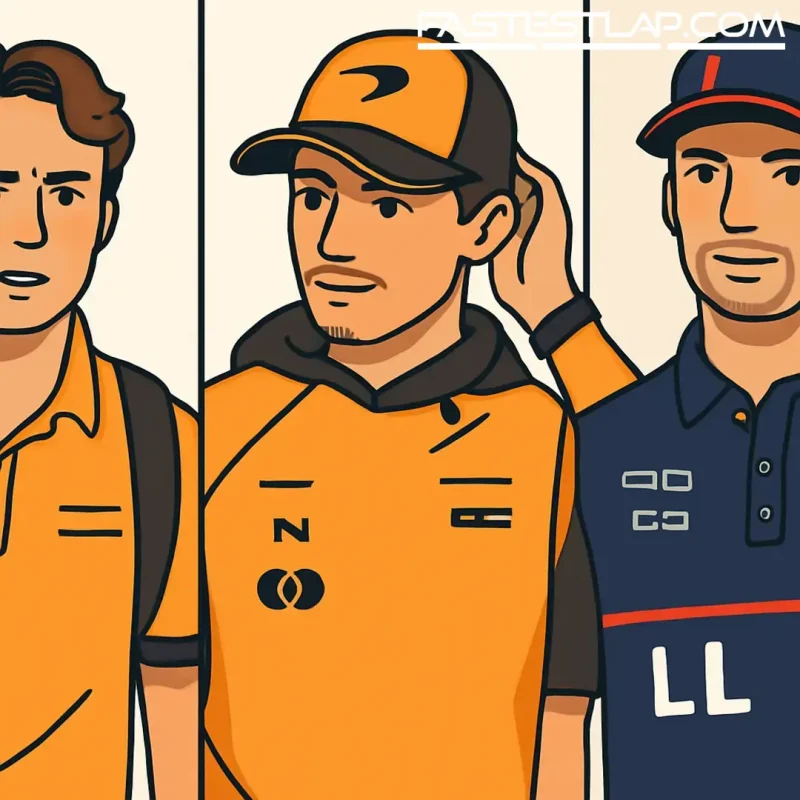
Title fight on a knife edge as engine penalties loom for Verstappen, Norris and Piastri
The championship may yet be decided not by a daring pass, but by a fresh set of control electronics. With four grands prix and a sprint still to run, Formula 1’s power unit allocation rules are tightening the screw on the three title protagonists — Max Verstappen, Lando Norris and Oscar Piastri — and the risk of a costly grid drop is very real.
This is the time of year when immaculate spreadsheets meet the grind of reality. Teams begin the season with a carefully managed pool of power unit components; by November, they’re juggling mileage, temperatures and luck. For 2025, the FIA allows each driver four internal combustion engines, four turbochargers, four MGU-Hs and four MGU-Ks across the campaign, plus two energy stores and two control electronics. Exhaust systems are capped at eight. Step over the line and the penalties bite: the first breach of a component is an automatic 10-place drop, every subsequent breach is five places, and once you rack up 15 places in a weekend you’re bound for the back of the grid.
Plenty have already paid the price this season. Lewis Hamilton, Yuki Tsunoda, Fernando Alonso, Pierre Gasly, Franco Colapinto, Oliver Bearman, Isaac Hadjar and Liam Lawson have all taken their medicine. So far, the three title contenders have largely kept their powder dry — but their margin for error is vanishing.
Of the trio, Verstappen is the one walking the thinnest line right now. He’s burned through seven of his eight permitted exhaust systems, leaving him one more failure away from a 10-place penalty with the finish line in sight. McLaren’s pairing? Piastri and Norris are each sitting on just three exhausts used, a gulf that gives Woking a bit of breathing room on that front.
The more pressing issue for everyone at the sharp end is that Verstappen, Norris and Piastri are all understood to be at the cap on the core items: the ICE, TC, MGU-H, MGU-K, plus the two-per-season energy store and control electronics. One crunching crash or a terminal engine hiccup, and they’re staring down a grid drop at the next round — unless their teams are willing to plug in a high-mileage unit from earlier in the year and live with the performance compromise.
That’s where this gets tactical. If you know you’ve got to take a hit, you do it on a track where overtaking’s possible and tyre degradation can open doors. You also stack components on the same weekend: if you’re starting at the back, you may as well bank a new turbo and fresh MGU-K while you’re there to shore up the pool for the final push. Sprint weekends complicate the calculus further, with parc fermé kicking in earlier and limited practice mileage to bed in hardware. Lose a session to a gremlin and suddenly your hand is forced.
For Red Bull and Verstappen, that fragile exhaust allocation will shape how aggressively they run the car in practice and traffic. Exhaust usage is a blend of mileage, vibration and heat — and while you won’t find anyone admitting to babying the car in a title run-in, engineers can and do protect components with mapping and set-up choices. The trade-off is performance. One over-zealous kerb strike or a heat spike in dirty air could be the trigger that sends the No. 1 car down the order on Sunday.
McLaren’s picture is cleaner on the exhaust front, but not rosy everywhere else. Norris and Piastri are also perched on the limit across the major power unit elements, so the safety net is no larger. The upside for them is optionality: with eight exhausts to spend and only four race weekends left, they can afford to lean harder if the title arithmetic demands it.
We’ve seen championships swing on these margins before. A 10-place drop for any of the three would tear up the grid on Saturday night and force a damage-limitation run that could be as decisive as any pole lap. And if someone tips over the 15-place mark? Back of the grid, elbows out, and a long afternoon of risk management in traffic — the last thing any title hopeful needs.
Everyone will swear they’re not thinking about penalties. Don’t buy it. In the back of every strategist’s head is a live spreadsheet: which unit has what mileage, what temperatures did it see in the last sprint stint, which track offers the least brutal recovery from P17. The drivers will keep swinging; the teams will keep counting. Somewhere in that tension lies the 2025 world champion.
For now, the scoreboard’s clean. But one failed exhaust, one fried control electronics, and the title fight gets a whole lot messier — and that might suit the chaser more than the chased.