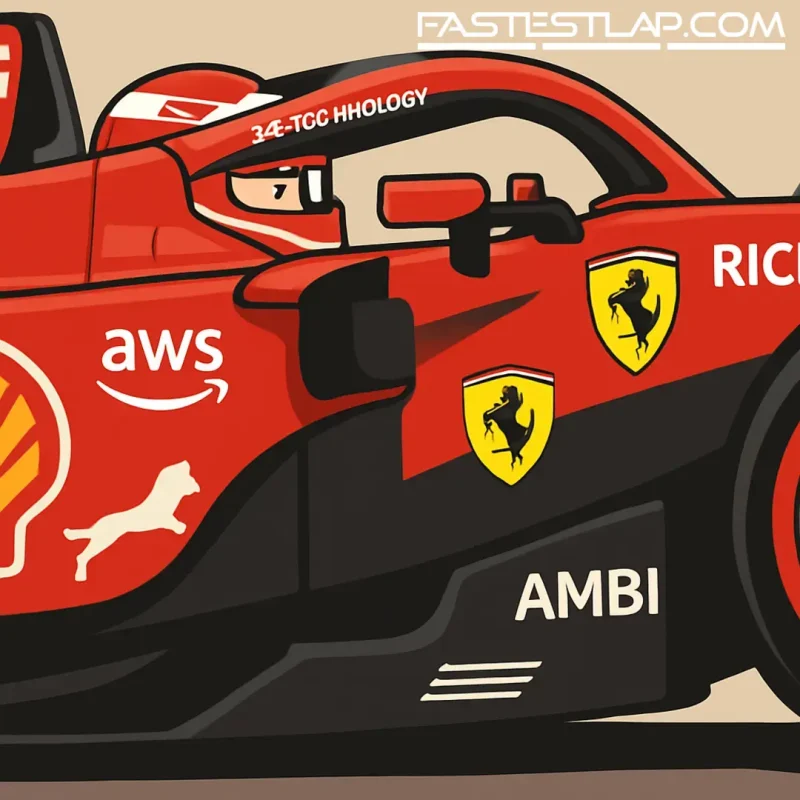
Ferrari primed for pushrod rear in 2026 as Project 678 takes shape
Ferrari looks set to flip the script on its suspension philosophy for Formula 1’s new ruleset, with Italian reports indicating Maranello will return to a pushrod rear layout for its 2026 car, codenamed Project 678.
That would mark the first pushrod rear on a Ferrari since the F10 of 2010 — the Alonso/Massa machine that nearly prised the title away from Red Bull. It’s a notable turn after years of sticking with a pullrod rear, a choice shared only with customer team Haas through the current ground‑effect era.
The timing tracks. F1’s 2026 overhaul arrives as a double reset: 50% electrification, fully sustainable fuels, and active aerodynamics, plus a step away from the current underfloor dominance via a smaller diffuser. In that landscape, Ferrari’s long‑running rear pullrod, prized for packaging under big floors, becomes less of a no‑brainer. A pushrod can simplify packaging around the gearbox and offer different levers on anti‑squat and rear‑end support — valuable when load shifts wildly with active aero. The Italian outlet Auto Racer says Ferrari has made its call.
Layer in the people story. Enrico Cardile, who steered recent chassis concepts, left for Aston Martin late last year. Loïc Serra arrived as technical director in October 2024 with a reputation built on vehicle dynamics. Team boss Fred Vasseur was open that Serra inherited a mostly sealed 2025 design; 2026 is where his fingerprints start to show. If Ferrari is committing to a pushrod rear, you can bet Serra’s been central to it.
It’s not as if the current car has forced a wholesale rethink. The SF‑25 made a late‑season step, with Charles Leclerc banking podiums in the United States and Mexico, and those results reportedly dialled back how radical the suspension changes needed to be for 2026. But a philosophical switch at the rear is still a big move — and a clear statement about where Ferrari thinks performance will live in the next cycle.
There’s engine intrigue too. In Italy, the whispers are that Ferrari’s 2026 power unit is “revolutionary,” built around an aluminium‑alloy cylinder head and a closely guarded intake concept after a bold steel head idea, linked to outgoing ICE boss Wolf Zimmermann, was shelved over reliability concerns. As ever with Ferrari, local media has a habit of getting the broad strokes right months out. Caution on specifics; interest very much piqued.
The context is impossible to ignore. Ferrari hasn’t won a world title since the 2008 Constructors’ crown, with Kimi Räikkönen the Scuderia’s last Drivers’ champion in 2007. The 2010 near‑miss happened with a pushrod rear. No one in Maranello needs reminding — least of all a driver pairing like this.
For 2025, Ferrari fields Charles Leclerc alongside Lewis Hamilton, a blockbuster line‑up that’s already delivered as a storyline and, at times, on the stopwatch. However the intra‑team balance shakes out over the rest of this season, Project 678 will be built to a very specific brief: give two of the grid’s sharpest qualifiers a predictable, planted rear axle that they trust in the big braking zones and during the aero‑state swings that active systems will introduce. If the new car emerges with cleaner packaging and a calmer platform through yaw and ride change, the payoff will be obvious on Saturdays and Sundays.
It’s also a tidy bit of symmetry. Ferrari moved to a pullrod front for 2025, following Red Bull and McLaren’s successful trend. If the rear goes pushrod in 2026, Maranello ends up with the same split layout most rivals have favoured at various points in the hybrid era — but tuned for a very different regulatory world. The point isn’t to copy; it’s to choose the right kinematics for a car that won’t be ruled by a mega diffuser anymore.
None of this guarantees Ferrari cracks 2026 out of the gate. New engine maps, energy deployment strategies, and the practicalities of active aero will shuffle the deck. But the direction is clear: Ferrari wants a car that’s less beholden to underfloor trickery and more compliant across the operating window. Returning to pushrod at the rear is a logical lever to pull.
The signs from Maranello suggest this isn’t change for change’s sake. It’s a calculated move, guided by a reshaped technical team and informed by the gains — and limits — of the SF‑25. Project 678 won’t be the only car under wraps before the private shakedowns begin, but it might be the one everyone’s craning to see first.