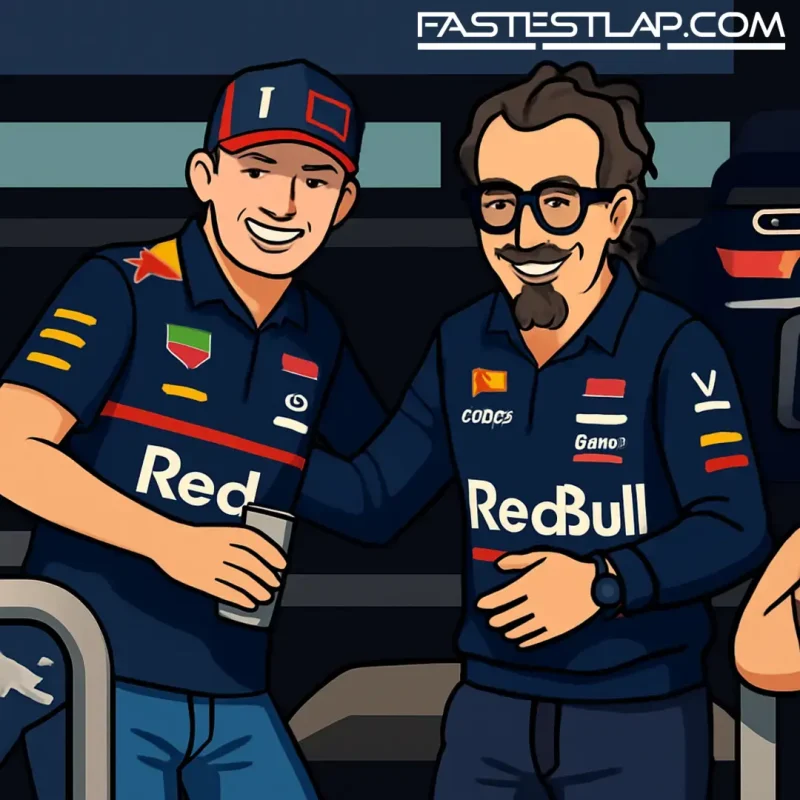
Laurent Mekies laughs about it now, perched on the Red Bull pit wall next to the very driver who blew up F1’s rulebook. But when Max Verstappen arrived in 2014 as a 17-year-old phenom with a Super Licence in his pocket, Mekies’ first job at the FIA was to make sure no one else could do the same.
Back then, Mekies had just stepped away from the team garage — Arrows, Minardi, Toro Rosso — into a senior safety role at the federation. Verstappen was days removed from Formula 3 and headed straight for Toro Rosso in 2015. It was a leap that electrified the sport and irritated its lawmakers in equal measure.
“Don’t tell Max, but it was actually the other way around,” Mekies joked on Red Bull’s Talking Bull podcast, pushing back on the suggestion he helped Verstappen get to F1. “I joined the FIA as he got his licence at 17, and the very first thing Jean Todt told me was: this can’t happen again. People won’t understand why you can’t drive on the road but can race a Formula 1 car. Build a better system.”
That directive set off the most significant tightening of the pathway to F1 in modern times. The FIA’s Super Licence criteria were reworked to introduce a points-based ladder and a firm age threshold. In simple terms: earn it, don’t shortcut it.
It’s no small irony that Mekies, now Red Bull team principal and working lockstep with Verstappen, was once the architect of the guardrails intended to prevent another Verstappen. He’s not pretending otherwise. “Max was so outstanding that he forced the system to evolve,” he said, adding with a grin that it’s “probably best” Verstappen doesn’t dwell on the fact Mekies’ first act was to make his route harder for everyone else.
The rules born from that moment are still the framework today. Drivers must reach 40 Super Licence points over three seasons across approved junior categories and be at least 18 years old to race in F1 — with scope for rare exceptions. The aim wasn’t to shut the door on young talent, but to make the climb clear, consistent and, crucially, earned over time.
And the system does flex when the talent is undeniable. Red Bull junior Arvid Lindblad received a one-off exemption earlier this year to run FP1 at the British Grand Prix a month before turning 18 — a reminder that the FIA can make exceptions without blowing holes in its own process.
Verstappen’s arrival, of course, changed more than the regulations. It changed how teams think about prodigies. The rush from F3 to F1 is gone; the urgency to prove readiness through Formula 2 (or comparable success) is not. The junior pipeline has become a proving ground rather than a launchpad. That suits most within the paddock, especially those who remember the industry-wide intake of breath in 2014.
For Mekies, the story has come full circle. The former FIA man who authored the stricter licensing era now runs the team built around the driver who triggered it, and the pair are chasing more silverware in 2025. There’s an amusing symmetry there: Verstappen made the system grow up; Mekies made sure it stayed grown up.
If there’s a takeaway, it’s this. Verstappen didn’t just barge into F1 at 17 — he forced it to define what “ready” really means. And the person tasked with drawing that line now shares a pit wall, a radio channel and a common goal with the guy who prompted it all. That’s Formula 1 in a nutshell: talent pushing boundaries, institutions tightening them, and everyone meeting again at the front of the grid.