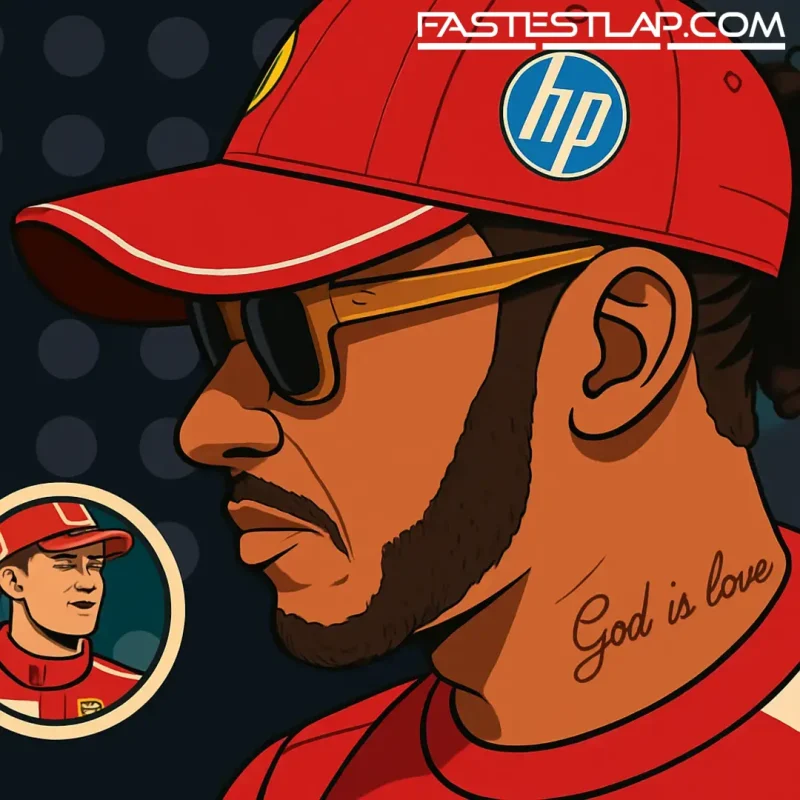
‘Give Lewis the keys’: Ex-Ferrari mechanic says Hamilton can be Maranello’s next Schumacher — if they truly listen
Francesco Cigarini has seen Ferrari at its best. He was on the floor when Michael Schumacher, Jean Todt and Ross Brawn turned Maranello into an unstoppable machine, a benchmark that still looms over everything the Scuderia does. And from that vantage point, he’s adamant: Ferrari should let Lewis Hamilton lead the team’s technical direction — even if the stopwatch currently favors Charles Leclerc.
Speaking to Fanpage.it, the former Ferrari mechanic described the Schumacher era as a pact. Total trust. Everyone pulling in the same direction. Everyone accountable when it went wrong. That culture, he says, can be rebuilt around Hamilton — but only if the seven-time champion’s voice carries real weight inside the factory.
“Lewis brings knowledge and organization typical of highly structured British teams,” Cigarini said, arguing that Ferrari’s decision to sign a multiple world champion should be about more than billboards and replica shirts. “The question is how much weight the team really gives to what he says. If he suggests something and isn’t listened to because ‘Leclerc is faster,’ it becomes a vicious circle: the driver doesn’t feel part of the technical management.”
It’s the sharp end of a delicate balance Ferrari has been trying to strike all season. Leclerc is the homegrown spearhead, operating at an elite level and, on balance, delivering more of the headline Sundays. Hamilton, in his first year in red, is still embedding — but he’s also the most decorated driver on the grid and a veteran of Formula 1’s most dominant modern project.
The temptation, when one driver is outscoring the other, is to let the data do the talking and steer development toward the quicker car. Cigarini warns against that trap. His argument is long-term: build the platform Hamilton is asking for and both drivers will cash in, Leclerc included.
“Leclerc is very fast and more used to driving on eggshells,” he said. “Hamilton is strong, but he needs a more solid car. If you listen to him, you can improve in the long term. It takes time, as was the case with Schumacher and Todt. I would put my full trust in Lewis, even if the stopwatch isn’t rewarding him today. And Leclerc will also benefit from this.”
Cigarini’s reference points aren’t nostalgia for nostalgia’s sake. Ferrari’s golden run — six straight Constructors’ titles from 1999 to 2004 and five successive Drivers’ crowns for Schumacher from 2000 to 2004 — wasn’t built overnight or on raw speed alone. It was method, structure, and relentless alignment between the driver leading development and the leadership backing his calls. When that trust solidified, the results followed as a matter of course.
Hamilton knows that playbook. He lived it at Mercedes through the hybrid era. That doesn’t mean Ferrari should become Mercedes dressed in red; it means there’s a process worth mining. The pitfall is cultural: if the team’s internal compass still points toward whoever is quickest this month, Hamilton’s experience — in setup direction, in tire behavior, in how you develop a car window rather than a one-lap trick — risks being treated as a nice-to-have rather than the spine of the project.
There’s also the human layer. Drivers can smell when their input moves the needle. If the feedback loop turns into a cul-de-sac, commitment inevitably dulls. That’s the “vicious circle” Cigarini hints at, and it’s why his advice is blunt: pick the leader of the project, empower him, and don’t flinch when the early graphs wobble.
Ferrari doesn’t need to choose a favorite son to do this. It needs to choose a philosophy. Let Hamilton define the blueprint, and let Leclerc — one of the sharpest operators on the grid — exploit it. If the car’s foundation becomes more predictable and robust, Leclerc’s speed won’t be blunted; it’ll be amplified.
There’s a romance to the idea of Hamilton as “Schumacher 2.0,” sure. But Cigarini’s point is far more pragmatic. In a sport where cycles are measured in seasons, not Sundays, the biggest win Hamilton can deliver in red might be the one fans don’t see. Not a lunge into Les Combes, but a shift in how decisions are made in Maranello — the kind that outlasts a driver and restores a team.
Ferrari signed Hamilton for the drives, yes, but also for the doctrine. Now comes the hard part: trusting it.