Vettel’s verdict on Aston Martin: the pantry’s full, but can Newey cook?
Sebastian Vettel knows what a well-stocked F1 operation looks like, and he’s convinced Aston Martin’s shelves are groaning. New factory, brand-new wind tunnel, a world champion in the car, a Honda power unit inbound, and Adrian Newey now elevated to team principal from 2026 while retaining his managing technical partner brief. On paper, it’s a title bid waiting to happen.
But Vettel’s point is simple: ingredients don’t win championships—execution does.
Speaking on the Beyond the Grid podcast, the four-time champion sounded intrigued rather than swept away by the hype around 2026’s reset. The new rules shrink the cars, cut weight, introduce active aero, and flip the power balance to a roughly 50/50 split between combustion and electric. It’s the kind of clean-sheet moment that can shuffle the deck in a single winter. Vettel’s not ruling out surprises.
“I think there’s more than one dark horse next year because you don’t know what’s going to happen with the regs and how teams will interpret them,” he said. “Then there’s always the argument the strongest team now will have the strongest chance of succeeding with the big rule change because they have the strongest organisation. You could argue McLaren is a favourite.”
He didn’t stop there. The power unit will matter, a lot. Honda returns as a full works partner with Aston Martin just as the regulations demand far more from the electrical side of the hybrid. That’s a technical minefield. It’s also the sort of problem Aston has invested heavily to solve.
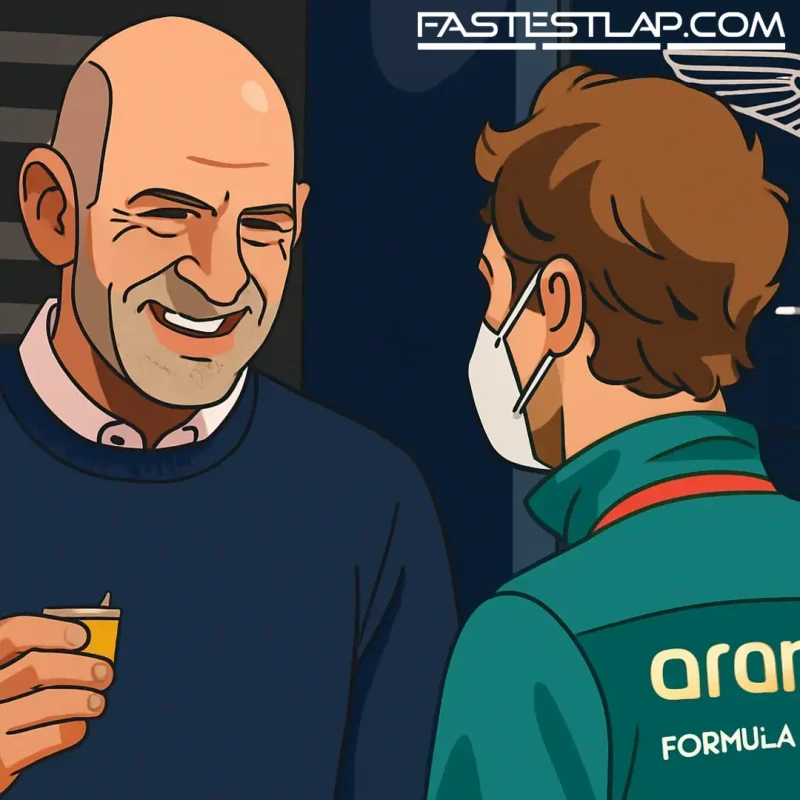
Vettel’s seen the plan from the inside. He finished his F1 career at Silverstone, right as Lawrence Stroll took the long view and signed the checks for real infrastructure: the state-of-the-art campus, the simulator program, the wind tunnel that took years to commission, and a recruitment drive that brought technical heavyweights into the fold. Newey was the headline, of course, joining as managing technical partner earlier this year and now, in a notable twist, taking on the team principal job from 2026 while Andy Cowell moves into a chief strategy officer role.
It’s an unusual structure, and potentially a telling one. Newey’s authority across both the competitive and organisational fronts could strip away the committee thinking that sometimes bogs teams down during big regulation shifts. Or it could test the bandwidth of the most celebrated designer of his generation. No one doubts Newey’s taste for fresh regulations—few have capitalized on them like he has—but the team boss title adds a new layer to the challenge.
“The ingredients are there,” Vettel said. “They’ve been there for a while, but you see also how hard it is to make it click. I mean, 2023, they had a fantastic open to the season and then struggled a little bit towards the end and then ’24 and ’25 was difficult for them. So yeah, the resources are there, the people are there—why not?”
That’s the paradox of Aston Martin right now. The project is undeniably serious: Fernando Alonso’s speed and experience, Lance Stroll’s stability within the team, Honda’s return, and a technical department empowered by infrastructure that didn’t exist a few years ago. Yet the past two seasons have been a reminder that having the pieces and fitting them together are two different sports.
The 2026 rules will reward integration more than any recent change. Active aero demands a chassis that talks to its wings in real time. The split-hybrid emphasis tees up the energy management race all over again. And packaging around the new power unit could dictate who’s fast on lap one of the new era versus who spends six months unpicking compromises. That’s where Aston’s bet on continuity—Newey setting the design philosophy while also setting priorities across the organization—might pay off.
Vettel’s hedge about McLaren is also fair. Big rule changes usually favor the best-run outfits, and McLaren’s execution since its turnaround has been relentlessly tidy. But that’s exactly why Aston’s opportunity is real. If the baseline is strong—and if Honda lands a competitive power unit early—the team doesn’t need miracles, just a car and process that let Alonso and Stroll cash the cheques the factory keeps writing.
So, can they make it click? It’s the only question that matters now. Aston Martin has built the platform, hired the star architect, and aligned itself with a works engine partner tailored to the new rulebook. The rest will be decided in a handful of wind-tunnel hours, thousands of simulation runs, and a winter where one wrong assumption can cost half a season.
Vettel’s verdict, delivered with the calm of someone who’s seen both sides of a rebuild, probably nails it best: the promise is undeniable. The proof starts in 2026.