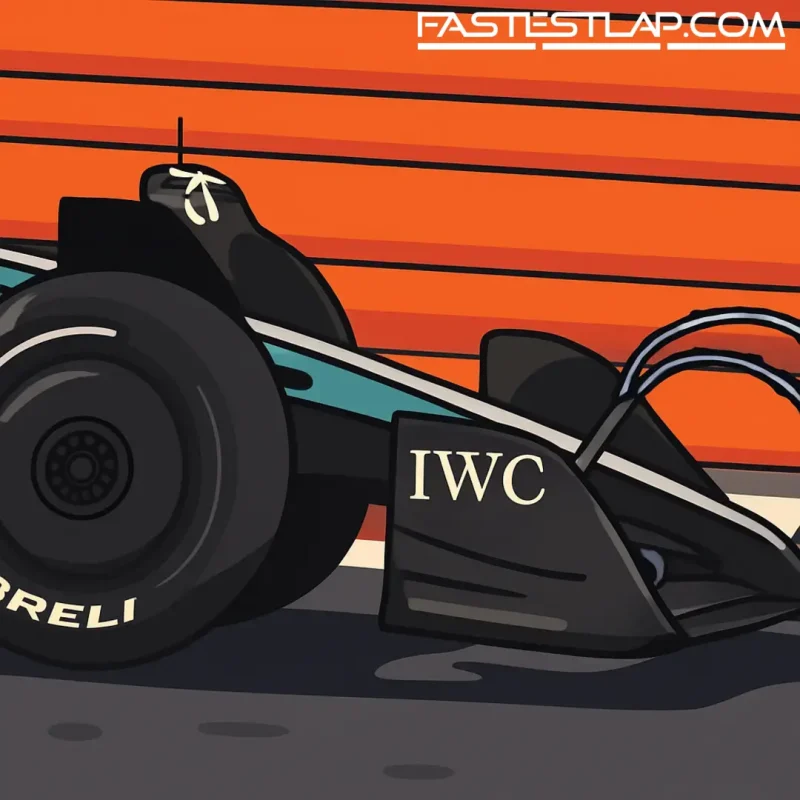
Mercedes lifts the lid on active aero with rough-and-ready front wing in Abu Dhabi
If you were looking for elegance, Tuesday morning at Yas Marina wasn’t it. If you were looking for a glimpse of F1’s 2026 future, Mercedes gave you exactly that.
As post‑season testing got underway, the Silver Arrows rolled out a mule car sporting a very basic active front wing — a chunky, workmanlike assembly with tell‑tale plumbing peeking out from the nose. No carbon art piece here, just a test rig designed to answer questions fast. Early running was handled by Kimi Antonelli, logging laps while engineers watched the data feed more than the trackside cameras.
This was the headline act of a broader exercise across the pit lane. All 10 teams split their day between a conventional 2025 car for a young driver program and a specially adapted mule built to mimic elements of the 2026 rules. With F1 marching toward smaller, lighter cars and active aerodynamics, Pirelli needed real-world numbers for its next‑gen tyres. The FIA opened the door accordingly: fit the active systems, switch the modes, and let’s see what the tyres do.
Mercedes obliged. The front wing featured two moveable flaps, designed to work in concert with an active rear wing so the car stays balanced whether you’re hunting downforce through the long-radius stuff or slicing drag down the straight. You could spot the hydraulics and control hardware feeding the flaps via the nose — not pretty, but you don’t wear your best suit to a workshop.
The point wasn’t lap time. It was about correlation: how does the aero map change with each setting, how does the platform behave as you roll from corner to straight, and how cleanly can you blend those states without unsettling the car? That last bit will be the dark art of 2026. The fastest teams won’t just have the slippiest wings — they’ll have the smartest control strategies, the smoothest transitions, and the best understanding of how tyres react when the car’s aero attitude is no longer a fixed target.
Word in the paddock was that Ferrari planned to wheel out a tidier, more production‑ready take later in the day. Different philosophies already, and that tracks. Some teams want to learn everything with obvious, modular hardware. Others prefer to test what they actually intend to race. Both approaches have merit at this stage; neither gives much away to the cameras.
The theme across the day was cooperation with a purpose. Pirelli’s brief isn’t trivial. The 2026 concept will shed downforce in some conditions and harvest more in others, with active aero trading load and drag more dynamically than we’ve seen in the hybrid era. That changes heat profiles, slip angles, and how quickly a tyre recovers. Give the tyre supplier a moving target and they’ll ask for moving data — hence the FIA’s green light for active systems on these mules.
Mercedes’ choice to run openly “unfinished” hardware says something about where the gains are. Packaging can come later; behavior comes first. If the balance shift from high-downforce to low-drag trim is abrupt, the driver feels it instantly. If it’s progressive, you can start building the control logic around it. And the front wing is linchpin territory — it sets the stall for everything behind it. Get the front‑rear handshake right now, and you’re ahead when the real cars hit the track.
It’s also worth noting the human element. Whoever’s in the cockpit today — youngsters on the 2025 cars, development drivers or race regulars on the mules — they’re learning a new rhythm. In 2026, the right thumb might matter as much as the right foot. Managing energy, deploying active aero, and preserving tyres will be a fresh choreography. You don’t teach that in the simulator alone.
As for lap charts and stopwatch heroics? Forget it. The intriguing stuff was in the garage: long runs in one mode followed by sudden shifts to the other, engineers overlaying aero maps like onion skins, and plenty of chin‑scratching over how to stop the front from “speaking a different language” to the rear mid‑corner. That’s the puzzle everyone needs to solve before the rulebook flips.
What did we learn? That Mercedes is happy to be first-mover even if the kit looks agricultural. That Ferrari’s camp is keeping its powder dry for a neater reveal. And that active aero, which once sounded like marketing fluff, is about to be the sport’s new battleground — not just wings flapping for straight-line speed, but finely tuned balance control that could make or break tyre life and race craft.
The beauty of days like this is their honesty. No sponsor gloss, no grand narratives. Just engineers using ugly parts to chase beautiful solutions. If you squinted at Mercedes’ nose this morning, you didn’t see crude. You saw ambition stripped of vanity — and a team trying to figure out tomorrow before anyone else does today.