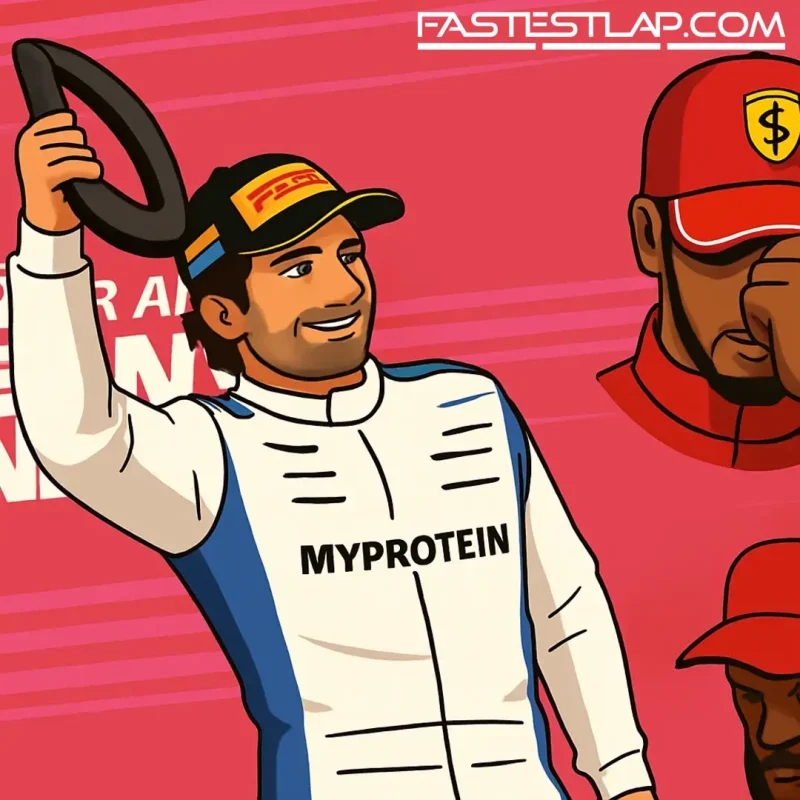
Carlos Sainz didn’t take the Williams seat to spite anyone. He took it to prove something. And as 2025 wrapped, the numbers told a neat little story: two grand prix podiums for Sainz in a blue car most had written off, and none for the seven-time champion who replaced him at Ferrari.
That contrast bubbled plenty of social media chatter, but Sainz isn’t interested in point-scoring off Lewis Hamilton’s worst season for top-three finishes. He’s far more interested in the validation that came with Baku and Qatar — and the way it silenced the noise around his move.
“When I announced I was going to Williams, some people felt sorry for me,” Sainz admitted in an interview with Marca, recalling the sideways looks after Ferrari cut him loose even before last season had begun. He arrived for the Abu Dhabi 2024 post-season test in a white helmet and a clean slate, and got to work. A year later, the haul looks decisive: Williams rose to fifth in the Constructors’, with Sainz scoring 64 points and Alex Albon 73. For a team that’s spent most of the past decade stuck near the bottom, that’s not a step — it’s a leap.
This all unfolded as Ferrari endured a grey year. No grand prix wins for Charles Leclerc, no podiums for Hamilton, and fourth in the Constructors’ Championship on 398 points. McLaren, with Lando Norris and Oscar Piastri at the sharp end, set the standard — proof again that timing and machinery make champions. Sainz knows it. He’s been around long enough to understand that your shot can come at unusual moments.
He also knows what it feels like to be overlooked. Coming off that gritty win in Australia last season just 13 days after an appendectomy, he took meetings up and down the paddock. Red Bull and Mercedes weren’t biting. His choices narrowed: Audi’s long game, or Williams’ bet on momentum and a 2026 reset. He chose the underdog — and then dragged it onto the podium.
Baku was savvy, opportunistic Sainz: patient early, incisive late, reading a race that ebbed and broke in the tricky middle phase. Qatar was cleaner — a platform result built on pace and discipline. Throw in a Sprint podium in Austin and you’ve got a driver who didn’t need a scarlet car to stay relevant.
None of that means he’s writing revisionist history about Ferrari. Asked whether they might miss him, he wouldn’t bite. The door closed without drama. He’d rather think about the colleagues and tifosi he left behind than the what-ifs. And that’s consistent with how he’s navigated the whole saga. There’s no gloating over Hamilton’s tough year. No victory laps. Just a quiet “this is what I thought we could do” and a nod to a squad that gave him the tools and let him lead.
The bigger picture? Williams looks like a team that used 2025 as a springboard. Its execution sharpened, its car behaved, and its drivers — as different as they are in approach — kept the scoreboard ticking. In a compact midfield where one bad weekend can erase three good ones, climbing to fifth says something about systems being put in place and trusted.
Sainz’s aim doesn’t change. He wants the big one, and he’s not putting an expiry date on it. If the right car turns up when he’s 34 or 36 or 40, he’ll take the fight. Norris and Piastri showed this year that a title shot is about alignment as much as talent. Sainz has been around long enough to be ready when fortune finally points in his direction.
That’s the other headline here. Beneath the warm-and-fuzzy tale of the guy who bet on Williams and came away with silverware sits a driver who, once again, did the basics brilliantly: tire whispering when it mattered, aggression when the window opened, and a knack for staying out of the chaos that undid others. It’s not as loud as a title tilt, but inside a paddock that tends to notice the same things the public misses, it buys you respect — and leverage.
He didn’t take joy in someone else’s struggles. He took satisfaction in his own choices paying off. And as F1 tips into another rules revolution, that mindset might prove as valuable as any wind-tunnel upgrade.