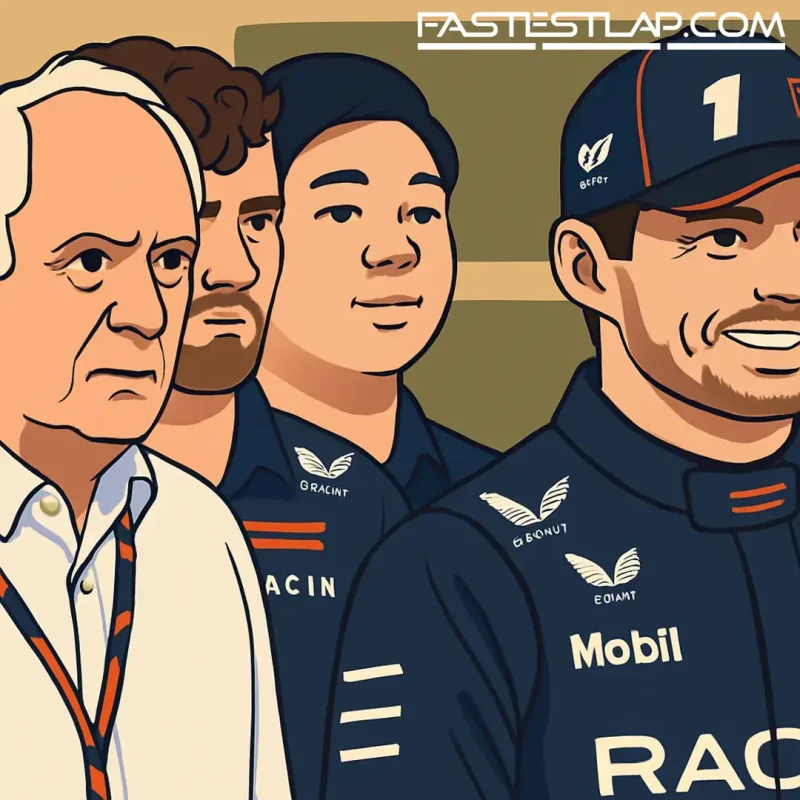
Helmut Marko’s last Red Bull act was a phone call, and of course it was to Max Verstappen.
After more than two decades shaping the company’s driver programme and serving as the ever-blunt consigliere in Milton Keynes, Marko has stepped away. He told Austria’s ORF he broke the news in Dubai on the Monday after Abu Dhabi — an ad‑hoc decision sealed at a pre-arranged championship dinner where he sat down with Red Bull’s Oliver Mintzlaff, with Thai shareholder representation present. There was talk of a compromise. Marko wasn’t interested. “If we were going to do it, we had to do it completely.”
Verstappen was meant to be in the room, but missed the dinner due to flight issues. So Marko called him the next day. “It wasn’t a normal conversation,” he said. “There was a certain melancholy in the air.” Verstappen, still only in his mid‑20s but already a multiple world champion, told him he never could’ve imagined this much success. The sentiment hung there. It felt like the end of a chapter for both of them.
The timing is unmistakable. Red Bull’s 2025 campaign ended in a gut punch, with Lando Norris edging Verstappen to the title by two points in Abu Dhabi after a season that swung like a pendulum. Marko says the nadir came around the Dutch round, when Red Bull trailed by 104 points; the team then mounted a comeback he called “unique,” only to fall short at the last strike. “Although this comeback was unique, it was still a very bitter disappointment,” he said. “Even if we had won, it would have been a good reason to leave. But now, in hindsight, because we lost, it’s also a good point.”
There’s been noise in the background for months. Relationships shift when power shifts, and Red Bull’s have shifted dramatically this year. Laurent Mekies replaced Christian Horner mid‑season as CEO and team boss, ushering in a different kind of management culture in Milton Keynes. Marko’s ties with Mintzlaff and Mekies had frayed, according to paddock chatter, though the official line from Red Bull GmbH is simple: Marko chose to walk away.
He didn’t walk away from Max. If anything, the Verstappen connection is what he lingers on. Marko’s eye for talent is Red Bull folklore — the early calls on Sebastian Vettel and Verstappen frame two dynasties — but he admits Verstappen was the “closest” driver relationship of his career. It evolved from raw speed and sharp elbows into something that doesn’t need policing. “With each passing year, Max became faster, more mature, better,” Marko said. “To this day, I can’t see an end to this development, even though he is already the best driver.”
That’s the piece that will define what comes next. Verstappen stays at Red Bull into 2026, but for the first time since he arrived he’ll do it without Marko in the garage, at the motorhome table, or on the end of a corridor with a raised eyebrow. The Dutchman once made it clear he valued Marko’s presence as a pillar. Now he heads into new rules, new power units and a fully in‑house Red Bull engine project without the man who first pushed the button on his F1 career.
Marko, typically, doesn’t sugarcoat Max’s transformation. He remembers the early “silly things,” the flashes of temper, the elbows out so wide they sometimes caught people in the paddock. Then came the refinement. “The more successful he became, the simpler his approach became,” Marko said. “He hardly ever has any lapses or outbursts. He leads a team and can lead it the way he does.”
It’s easy to romanticise farewells in Formula 1, but the sport rarely does tidy endings. This one isn’t messy so much as it is blunt — a decisive exit after a near-miss title and a year of internal reconfiguration. It marks the close of the most influential partnership of Verstappen’s career and, arguably, the most quietly powerful figure Red Bull has had behind the scenes.
Marko’s legacy will be debated in team hospitality units for weeks, usually over a double espresso and with a knowing grin. He didn’t just spot talent; he accelerated it, sometimes ruthlessly, often ahead of schedule, occasionally at high cost. The scorecard is impossible to argue with: world titles banked, careers made, and a competitive identity at Red Bull that outlived eras and egos.
As the team pivots to 2026 and its fully autonomous manufacturer era, Verstappen remains the constant. The dynamic around him will look different — by design. Whether that’s liberating or destabilising is a story the next season will tell. For now, the image that lingers is of that call: a mentor and his driver, both aware they’ve reached the end of something rare. The trophies will stay polished either way. The connection, Marko says, was the closest he’s ever had. And in F1, that might be the one thing you can’t replace.