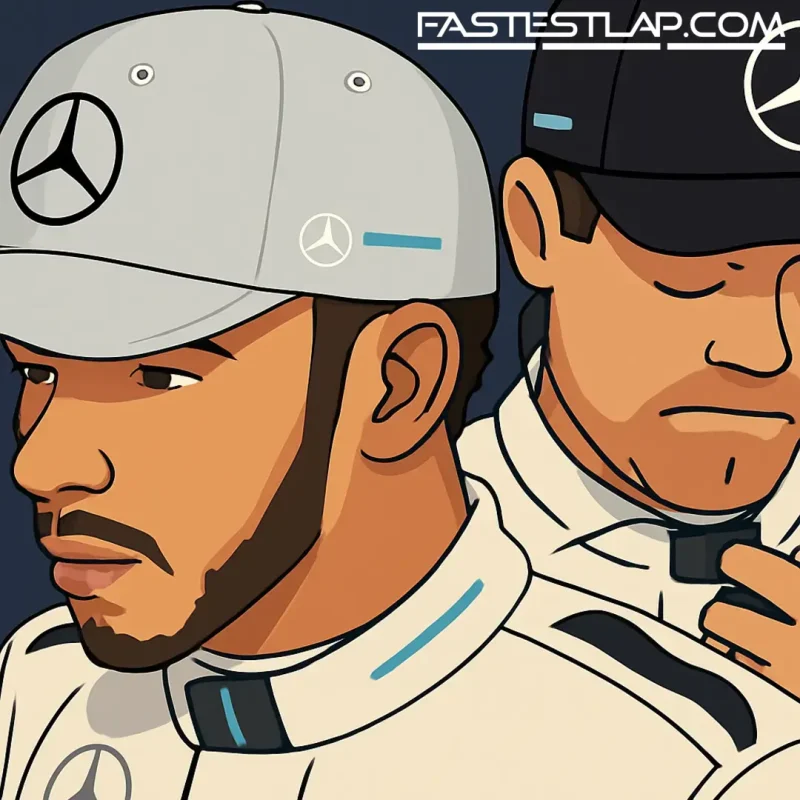
Rosberg says the Barcelona clash sent a 360k bill to both Mercedes drivers
Nearly a decade on, the most infamous 600 meters of Mercedes’ hybrid era is still cashing in stories. Nico Rosberg has revealed that his opening-lap collision with Lewis Hamilton at the 2016 Spanish Grand Prix didn’t just detonate the Silver Arrows’ Sunday; it dented both drivers’ bank accounts to the tune of 360,000 each.
Speaking on Sky F1, Rosberg explained that his Mercedes deal included a very specific deterrent to friendly fire: if the teammates wiped each other out, they paid for it—literally—half and half. “I even had a contract I had to sign which said that if ever we crash as teammates, we split the bill, 50/50,” Rosberg said. “We shared the Barcelona bill. It was 360,000—I remember that. That was just me. That was painful.”
It was a new twist to a story every F1 fan knows by heart. Rosberg and Hamilton arrived at Mercedes together in 2013, childhood friends stepping into a juggernaut that would soon define an era. By 2014 the gloves were off. Hamilton swept the titles in 2014 and 2015; Rosberg struck back in 2016 as their rivalry tightened like a violin string.
Barcelona was the flashpoint. Hamilton lost the rear as he tried to reclaim the lead from Rosberg on Lap 1, speared across the grass and into the sister car. Both silver cars were parked in the gravel before Turn 4, and a cold war inside the garage grew a fresh layer of ice. The team lost a haul of points and, as it turns out, the drivers lost more than just pride.
It’s not hard to see why a clause like that existed. Mercedes were steamrolling championships, but the only thing that could reliably stop them was themselves. A financial sting adds edges to the internal rulebook. Whether it changes behavior is another matter: in the heat of wheel-to-wheel combat—especially when the championship is at stake—drivers calculate risk with their visor down, not a contract clause in mind.
Martin Brundle put it bluntly on Sky. F1’s fundamental tension, he argued, is baked in: drivers are hired hands and solo acts all at once. “You work for a team… But you race as an individual, and you perform as an individual, and that is why it comes to blows,” he said. In other words, you can’t engineer rivalry out of a sport that sells rivalry.
Rosberg’s arc remains one of the great shock twists in modern F1. He clinched the 2016 crown in Abu Dhabi after a season-long arm wrestle with Hamilton, then walked away days later. Hamilton, ever the metronome, answered with four straight championships from 2017 through 2020, bringing his tally to a record-equalling seven world titles.
The numbers on that Barcelona invoice have aged into folklore, a neat symbol of an era when Mercedes were so dominant the fiercest competition they faced came from opposite sides of the same garage. The team kept winning, the drivers kept pushing, and occasionally the bill landed where it hurt most.
If there’s a takeaway for today’s grid, it’s that teammate battles still make or break seasons. Contracts can put fences around behavior, but nothing alters the fact that the first person any driver desperately wants to beat is the other one in identical machinery. The cost—points, politics, sometimes 360k—comes with the territory.