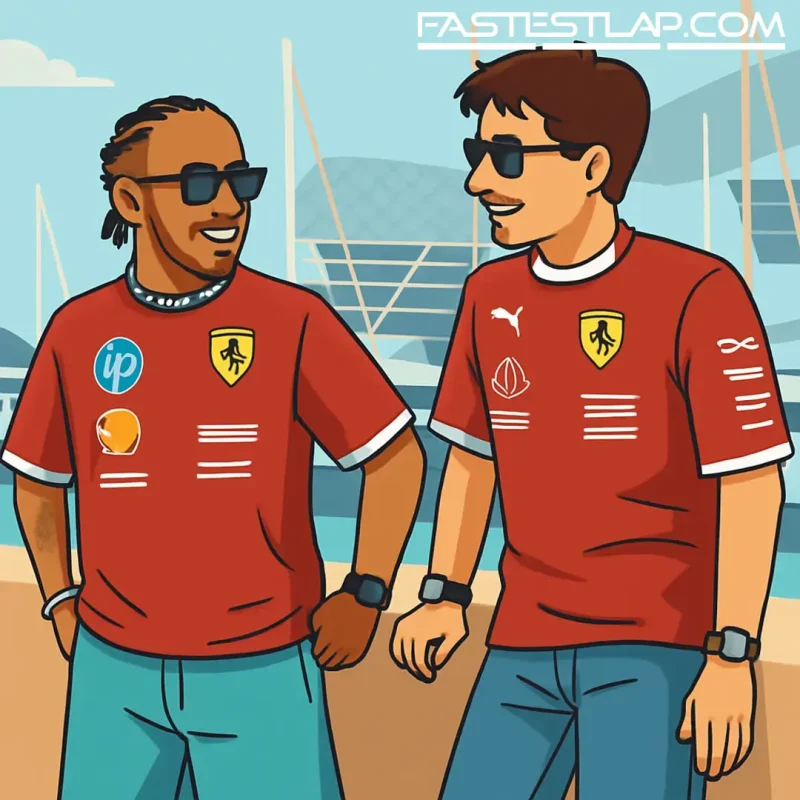
Leclerc isn’t Hamilton’s coach — and he’s fine with that
Ferrari hired Lewis Hamilton for 2025 with a single, obvious intention: titles. What it got instead was a year that looked and felt like a holding pattern. No wins, no Hamilton podiums, and a team that steadily shifted its gaze to 2026. In the middle of it all, Charles Leclerc was asked whether he’s been offering advice to the most decorated driver in Formula 1 history. His answer? That’s not his job.
“I don’t really have any advice to give him,” Leclerc said in Abu Dhabi, matter‑of‑fact rather than cold. The Monegasque has been embedded at Ferrari for eight seasons now; the rhythms of Maranello are second nature. He knows how long it takes for an outsider to click with Ferrari’s way of doing things — and Hamilton, after just a single year, is still very much in the acclimatisation phase.
“It’s a long process whenever you join a new team,” Leclerc added. “The processes are completely different… all of that still needs some time to get used to.”
Ferrari arrived into 2025 on the front foot after a stirring end to 2024 and the blockbuster Hamilton signing. Momentum is a fragile thing in Formula 1, though, and the SF‑25 never became the weapon it needed to be. The team’s development path was conservative, by design. With the 2026 rules overhaul looming large, Maranello reallocated resources, which meant fewer upgrades in-season and, at times, a car that asked as many questions of its drivers as it answered.
Leclerc handled that balance better. He put together a solid campaign, standing on the podium seven times and finishing 86 points clear of Hamilton by year’s end. “Personally, I’m quite satisfied,” he said. “You always try to improve from one season to the other, and I’m satisfied with the work. But the performances are not where they should be… we didn’t have that many upgrades, as we are focusing mostly on 2026.”
There’s no malice in Leclerc’s stance on helping Hamilton — just a reality. Elite drivers are self-contained projects, and there’s a limit to how much one can (or should) chaperone the other. Leclerc’s remit is to extract everything from his side of the garage and set the reference. Hamilton’s is to do the same his way. Advice isn’t the currency here; lap time is.
For Hamilton, the most frustrating detail will be the zero in the podium column. That’s not a number he’s accustomed to seeing, and it will gnaw at him through the winter. But there’s context. Ferrari’s car demanded a particular style to access its peak, and small mismatches in comfort can become big deficits when the field is this tight. The seven-time champion hasn’t forgotten how to race. He’s still blisteringly fast. He just needs a car that talks to him in a familiar language — and more mileage within Ferrari’s systems to make that conversation natural.
Leclerc doesn’t remember what it’s like to be the new guy anymore. Hamilton does, vividly. And in a year when Ferrari’s ceiling was capped and the long game was prioritised, those edges showed. That doesn’t mean the partnership is misfiring; it means the real judgment should probably wait until the rule reset arrives.
There were positives inside the cracks. Ferrari’s execution improved as the season wore on, and both drivers helped steer a team that, at times, had to prioritise consolidation over fireworks. “We reacted well as a team from the first race to the last,” Leclerc said. “What we are missing eventually is performance on the car. I hope that next year will be better.” Next year, of course, is 2026 — the start of the new era everyone in red is quietly targeting.
The bottom line: Leclerc won’t be giving Hamilton a masterclass, because Hamilton doesn’t need one. The work ahead is structural and collective — making sure the 2026 Ferrari gives both drivers a platform worthy of their names. When it does, nobody will be asking about advice. They’ll be asking who gets to the flag first.