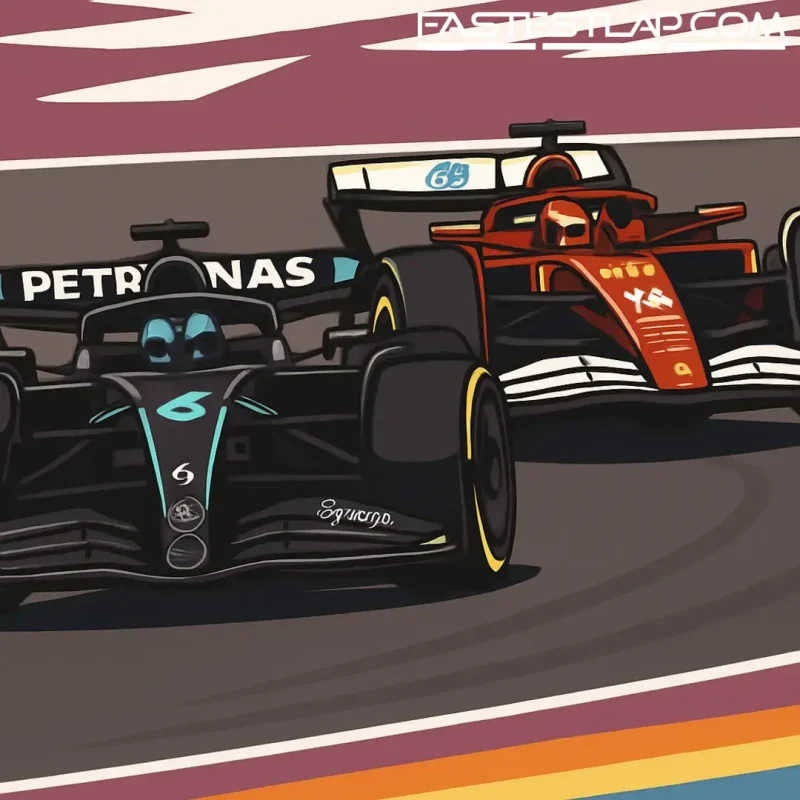
Russell and Leclerc draw a line under F1’s ground‑effect era: “We started in the wrong place”
The lights go out on F1’s ground‑effect cycle, and the scoreboard tells a blunt story: four seasons, two teams with titles. Red Bull set the early pace, McLaren stole the momentum late, and between them they split the silverware. Mercedes and Ferrari? Plenty of pace at times, but not enough on Sundays that mattered most.
As the paddock packed up in Abu Dhabi, George Russell and Charles Leclerc took a clear‑eyed look back at what went wrong—and what, crucially, might not matter a bit in 2026.
When this ruleset landed in 2022, the promise was closer racing through underfloor downforce. What it delivered first was bouncing. Ferrari burst out of the gates fast, Red Bull steadier and slimmer as the months wore on, and by mid‑season Max Verstappen and Red Bull had the measure of the field. The trend held—until McLaren’s surge toppled Red Bull in 2024, with Lando Norris denying Verstappen a clean sweep of drivers’ crowns in this era. Ferrari, quick and combative, still missed the constructors’ title by a whisker. In 2025, the balance swung again.
Asked where Mercedes fell short versus Red Bull and McLaren, Russell didn’t sugarcoat the opening chapter. “It’s been an extremely challenging set of regs,” he said. “And this second half of the year, Red Bull have been on a very high level. But if you’d asked me at the summer break, I’d have argued we were at a similar level to Red Bull.”
His diagnosis of the era’s arc was more about origins than upgrades. “We probably started in the wrong place and led ourselves down the wrong path, then had to revert. Red Bull, out of the blocks, had the least porpoising in ’22 and almost had a six‑ or eight‑month head start while we were working that out.”
That early homework gap defined a lot of what followed. Others ricocheted too—Aston Martin flared then faded in 2023; McLaren spent the first months of that season in the wilderness, then found something “pretty spectacular,” in Russell’s words, and never looked back.
There were wins to celebrate—Russell took victories in Canada and Singapore in 2025—but not enough of them. And the Brit doesn’t see a straight line between these bruises and what comes next. “I don’t think this regulation is really going to have any impact on the next set of regs, because the issues are going to be totally different.”
Leclerc’s Ferrari finished 2025 without a victory, a stark contrast to the knife‑fight pace it showed a year earlier. His read was layered—and a touch weary. “There’s not only one reason,” he said. “In the beginning of ’22, we actually started off quite strongly, but we were struggling with porpoising, where Red Bull had a very stable platform. They were quite a lot overweight, so as soon as they took off that weight, they were suddenly at the level where they’ve been since then.”
Ferrari’s priorities in the middle of this cycle also hurt the scoreline, if not the long game. “For last year, we focused very early on next year’s car,” Leclerc admitted, “which I hope is a bet that will be a winning one. But for sure, it had some influence from the last two thirds of the season where we’ve been struggling more than others because we didn’t bring that many upgrades.”
And then there’s the headache every technical director could recite in their sleep: correlation. The ground‑effect cars punished assumptions. “It’s been a generation of car that was very difficult to understand,” Leclerc said. “What worked back at the factory—everybody has been surprised once or more times that when you bring it on track, it doesn’t correlate exactly to what you were expecting. Other teams did better, especially McLaren and Red Bull.”
Strip away the quotes and you get a clear theme. The teams that controlled ride height and platform stability earliest built a runway of performance and understanding. Those who didn’t, chased their tails or made bold pivots mid‑stream. When correlation is fickle, every upgrade is a coin toss.
The temptation is to treat 2026 as a hard reset—and on paper, it is one of the biggest: new chassis concepts, new power unit rules, new aerodynamic balances to find. Russell’s point stands, though. This won’t be a simple carry‑over of underfloor secrets and bounce‑fixes. The next puzzle is different.
Will the same organizations win the start? History says head starts matter, and operational excellence travels well. But the past four seasons also proved that catching up isn’t impossible when you find the right concept—just ask McLaren.
As for the final word on the ground‑effect era, it reads like a race debrief. Red Bull nailed the fundamentals early and banked wins. Ferrari flared, then wrestled the beast. Mercedes climbed out of a cul‑de‑sac and still found peaks. McLaren solved the riddle late and turned it into titles. Everyone learned the hard way that what’s true in the tunnel can lie to you at 300 km/h.
Now the stopwatch gets reset. And while 2026 won’t reward nostalgia, it will reward teams that remember the cost of starting in the wrong place.