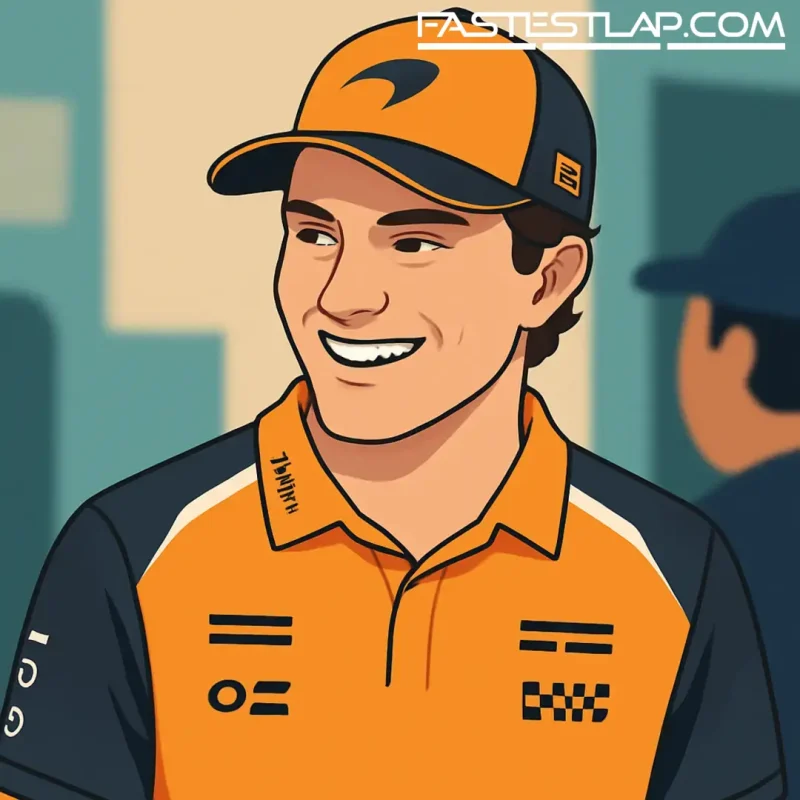
Oscar Piastri’s poker face isn’t an accident. It’s homework.
The McLaren driver has built a reputation for sounding like he’s ordering a flat white over the radio while wheel-to-wheel at 300 km/h. Cool, clipped, almost emotionless. That’s not who he is off-camera, he says — not entirely, anyway — but it is something he’s learned to be.
“There’s been a conscious effort to not get too fired up,” he explained recently, before adding that the trick is keeping enough emotion in to still care, to still bite. Finding that balance took time, and it started long before Formula 1.
Piastri left Melbourne for Europe at 14, chasing the same impossible dream every karting prodigy chases — except he actually stayed. He and his dad did the early months in the UK together, then the elder Piastri flew home and Oscar moved into a boarding house. That’s a brutal age to grow up fast, let alone on the other side of the planet, without the familiar safety net. So he built one.
He learned to compartmentalise. He learned to keep a lid on the spikes — the sting of homesickness, the pressure of results, the noise around a young driver trying to make it. Strip the emotion out of the day-to-day, he figured, and you give yourself a better shot at the bigger picture. If he was going to make it, Europe was non-negotiable. The choice, he says, became simple: feel everything, or focus on the goal.
“I wasn’t exactly keen on boarding school at first,” he admitted. “But in the end, it was like living with mates. It took my mind off racing when I needed it.” Somewhere along the way, in the school corridors and shared kitchens, he met his partner, Lily, who’s been part of the story ever since. “She’s been there from the start,” he says. “Growing up together in this crazy world has been really nice.”
What the public sees now is the polished version of that survival skill. Piastri’s radio tone rarely cracks, and his interviews are measured. That doesn’t mean the cupboard’s bare inside; it just means he’s selective about what gets out. The fire shows up where it matters — in the braking zones and under floodlights — not on the pit straight with a mic in his face.
The recognition piece is a newer layer he’s still getting used to. “At the track you expect it,” he says. “But when you’re in the supermarket and someone asks for a photo, or says, ‘Is that really you?’ — that’s still a bit strange.” His friends, the ones who don’t turn up at many races, get a kick out of it. He treats it like another part of the job to manage. A little distance helps.
On the grid, the 23-year-old is now beyond the “rookie with promise” label. He’s a Grand Prix winner, a proven front-runner, and — crucially for Woking — a reliable second half of one of F1’s sharpest line-ups. McLaren have kept Lando Norris and Piastri together for 2025, an axis that gives them continuity, speed and a genuine internal yardstick. Check the 2025 entry list and you’ll see them right there, in papaya, still partnered up for another swing.
If you want a read on Piastri’s approach, look at the details: the way he doesn’t overdrive when the car isn’t there, the economy of his radio chatter, the lack of theatre after big results. He’s not playing to the gallery; he’s building a career with the kind of composure that tends to age well in this business. It’s personality as performance tool — a front born in school dorms and junior paddocks that now underpins a top-tier F1 career.
None of that makes him robotic. In the garage, he’s known to be quick with a dry line and more human than the monotone suggests. But on Saturdays and Sundays, when the margins are razor thin and the stakes are far from abstract, the calm is deliberate. It’s the armour he put on a decade ago and never really took off.
Fame? He’ll tolerate it. Pressure? He’ll ration it. Attention? He’ll park it until the visor’s up. The rest of the week, he gets to be the other Oscar — the one his teammates, engineers and friends see.
And when the lights go out, the version you hear is the one he needs to be. Quiet. Precise. Unflustered. Not because he doesn’t feel it, but because he learned, long before McLaren and long before trophies, that keeping your head straight is sometimes the quickest way to the front.