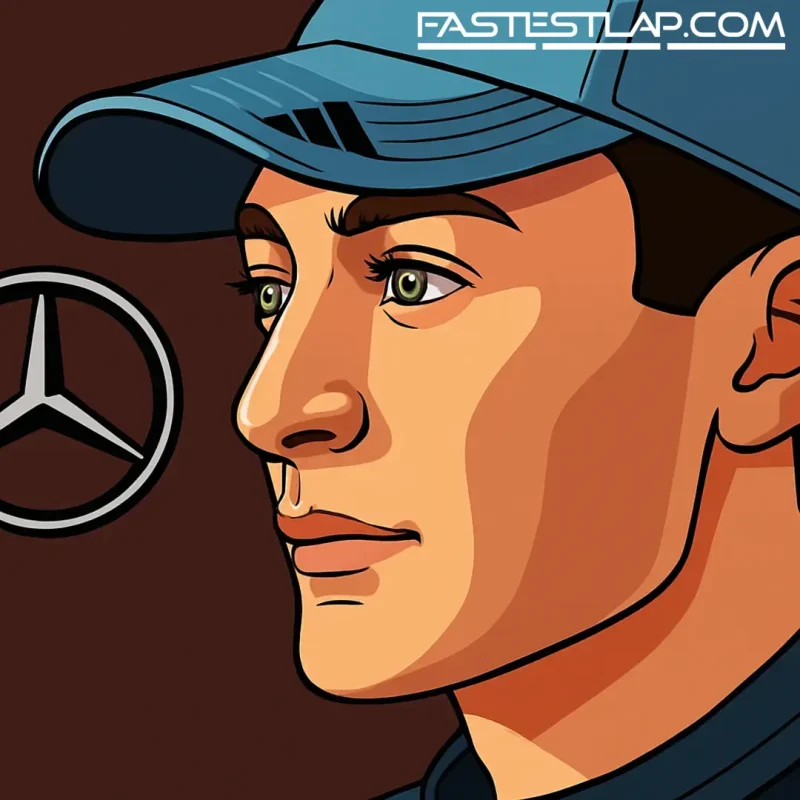
George Russell has put pen to paper with Mercedes for the long game — but don’t mistake that for blind faith in Brackley’s next masterplan. With F1’s 2026 reset closing fast, the Brit is talking up the signs without falling for the hype.
“I’d be a fool to bet all my money on Mercedes,” he said, drawing a neat line between belief and certainty as the sport heads for its biggest rule overhaul in a decade.
This is the pivot point. From 2026, Formula 1 shrinks and sharpens: smaller, lighter cars, active aero front and rear, and power units that split their output roughly 50/50 between electrical energy and a sustainable fuel-fed internal combustion engine. It’s the kind of reset that can redraw the competitive map overnight — and naturally, it’s sent plenty of eyes toward Mercedes, the benchmark brand from the last time F1 went hybrid.
Russell can see why. “Next year’s aerodynamic rules are closer to what we had in the era before, when Mercedes dominated the field,” he told Auto Motor und Sport. That era needs no introduction: the Silver Arrows owned the 2014–21 hybrid cycle, collecting eight straight Constructors’ crowns and seven Drivers’ titles. If there’s a team that knows how to ace a clean-sheet regulation set, it’s the one with that in its rear-view.
It’s also the team Russell has doubled down with after a standout 2025 campaign. He heads toward the new ruleset sounding like a driver who wants to turn consistency into a first title challenge — but he’s not trading nuance for nostalgia. He’s lived the peak and trough of these regulations with Mercedes and knows 2026 won’t be a simple rerun of 2014.
“Mercedes has been the benchmark in this area for many years,” he noted of the power unit side. That’s a fair reading of history, and a reason why the paddock chatter keeps drifting back to the three-pointed star when people sketch out their early 2026 pecking orders. But as Russell added, you only truly know once the cars roll. A blank rules sheet can hide a thousand traps, and nobody knows who’s stepped in what until testing unwinds.
Toto Wolff isn’t rushing to paint a rosier picture either. Mercedes reached this crossroads having never quite tamed the current ground-effect regulations. If you were expecting booming predictions, the team principal’s tone was notably restrained.
“It’s super difficult to predict,” Wolff said to media including PlanetF1.com. “We set ourselves targets that we are on track to meet, but whether those targets were set ambitious enough, and whether those targets have been set in the right place in terms of priorities, the future will show.”
He did indulge in a little memory lane — back to winter 2013–14, when Mercedes ran a full car dyno before anyone else and quietly knew it had something special. “The engine was more reliable than it seemed with the other people,” Wolff recalled. Testing started and Mercedes simply… ran. Day one, day two. Laps on laps while rivals coughed and spluttered.
But the boss was quick to stress those days aren’t a template. The field is tighter now, information travels faster, and there are more proven operations near the front. Even if Mercedes nails its homework, it won’t be lapping a fractured grid the way it did a decade ago.
That’s before you consider the cast list. The 2026 power-unit roster reads like a heavyweight card: Mercedes, Ferrari, Honda, Audi and Red Bull-Ford. The latter’s an intriguing tie-up in its own right, the former three need no gloss, and Audi’s works entry adds yet another properly resourced player to the arms race. On the team side, the grid is set to expand to 11 with Cadillac’s arrival, a rare growth spurt at the top of motorsport.
So what do you do if you’re George Russell? You embrace the ambiguity. Publicly, he’s threading the needle: confident about Mercedes’ direction, realistic about the unknowables, and not shying from the pressure that comes with a fresh sheet of paper. Privately, he’ll know this is the moment he signed up for — the chance to be the driver who leads Mercedes into whatever the next era becomes.
There’s no shortage of optimism in Brackley that the path they’ve taken is the right one. There’s also a welcome absence of hubris. The last time the sport flicked the switch on a new technological age, Mercedes walked through an open door and slammed it behind them. In 2026, that door is revolving — and the queue to get through first is longer than ever.
If Mercedes’ past is a compass, it points in a promising direction. The present, and the first laps of 2026, will tell us whether it’s calibrated for where F1 is heading next. Russell’s not betting the house. He’s just making sure he’s holding the keys when it matters.