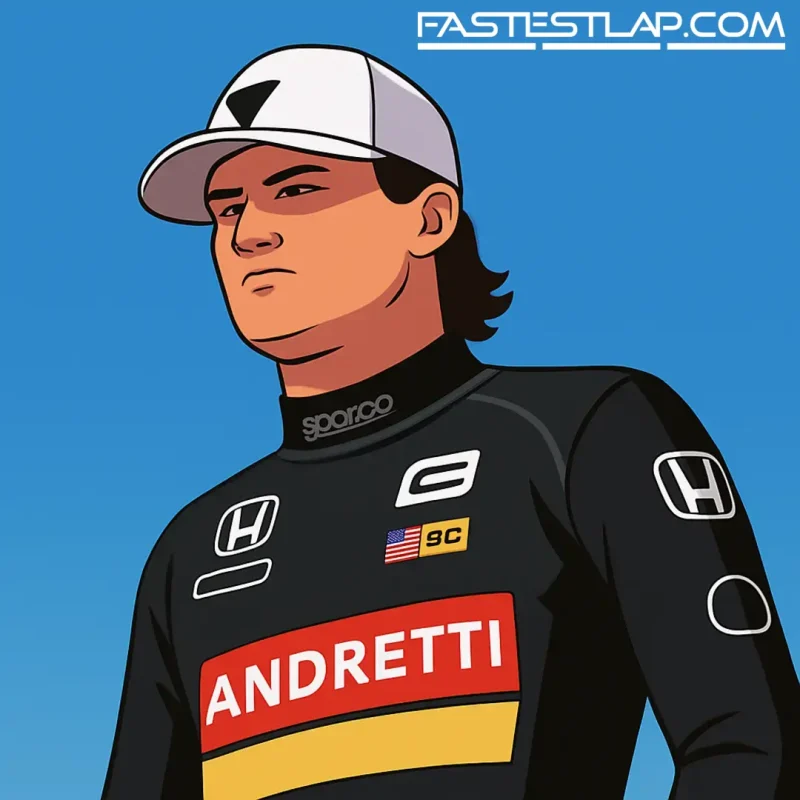
Colton Herta’s big reset: IndyCar star drops into F2 with Hitech to chase F1 shot
Colton Herta is taking the long way to Formula 1. The nine-time IndyCar race winner will step away from American open-wheel to race in Formula 2 in 2026 with Hitech, doubling as Cadillac’s first F1 test and reserve driver as he tries to force the door open on a grand prix career.
It’s a bold play and not without risk. Herta’s been close before—caught up in the aftershock of Michael Andretti’s aborted Sauber move, then hovering around Red Bull’s second team before Super Licence math stopped it dead. Now, at 25, he’s betting on Europe’s toughest feeder series to do what politics couldn’t: convert talent and reputation into points, licences and leverage.
There’s plenty to recommend him. F2 boss Bruno Michel likes what he sees in the toolbox: race craft baked in by years of wheel-to-wheel combat, maturity beyond the average rookie, and yes, a little Dallara familiarity doesn’t hurt. IndyCar and F2 cars aren’t cousins, but they do share a family tree—same constructor, similar single-make philosophy, and a premium on adaptability.
“He’s been racing a lot,” Michel has said, pointing to Herta’s experience as a clear advantage over the usual teenage arrivals. Expect Herta to be strong in traffic, sharp in race management, and comfortable leaning on instinct when the tyres go away and the strategy turns messy—F2’s happy place, in other words.
The flip side is everything that makes F2 such an unforgiving school. The weekend is compressed to the bone: one 45-minute practice session to learn a car, a track, a tyre, and then it’s straight into qualifying and the Sprint/Feature grind. There’s limited official testing by design. Pirelli rubber asks different questions to IndyCar’s Firestones—how you wake the tyre up, how you live with it, how you keep it alive when the clock’s at two to midnight. The circuits themselves will also demand quick study. Today’s F2 grid tends to arrive fully briefed after a year or two of modern FIA Formula 3; Herta, whose early Formula 3 experience pre-dates the current ladder, won’t have that same scaffolding.
He’s not pretending otherwise. As he put it recently, this is “back to school” territory: resetting fundamentals—braking shape, brake release, throttle pick-up—and learning the dark arts of Pirelli management that separate F2 contenders from highlight reel merchants. The car may look familiar from a distance; it won’t feel it from the cockpit.
What makes this compelling is the context. Cadillac’s path into F1 presents Herta with a rare, visible runway—one that wasn’t there during those earlier near-misses. If he can stack Super Licence points and prove he can live at the front of F2, he positions himself as more than a marketing play. He becomes the obvious option.
Hitech is no small detail either. The team knows how to win in this category, and it’s run a variety of driver profiles—hard-charging rookies, late bloomers, and everything between. Herta’s job is to arrive as the finished product in the places that count (race reads, restarts, pressure moments) and as a sponge in the places that don’t carry over from IndyCar (tyres, quali prep, parc fermé constraints).
There will be culture shock. F2 can be brutally procedural: parc fermé tightness, two races per weekend, reverse-grid dynamics, impound headaches, and a calendar that punishes anyone who takes a session to warm up. It doesn’t care that you’ve led the Indy 500. But it rewards high IQ racing and composure, two things Herta’s carried since he first bowled into the big leagues as a teenager.
The stakes are obvious. A strong F2 campaign could turn him from “almost” to “inevitable.” A middling year would leave him where he’s been—everyone’s favourite hypothetical. That’s why the choice to step “down” from IndyCar to the junior ladder is both jarring and perfectly logical. It’s the shortest route to the one thing he hasn’t had: an undeniable, points-backed case the FIA will sign off on.
This isn’t a vanity tour. It’s a calculated gamble from a driver running out of patience with near-misses. If it pays off, Herta becomes the headline act of a new American chapter in F1. If it doesn’t, it won’t be for lack of courage.
Either way, the F2 paddock just got a jolt. And everyone on the 2026 grid will have circled one name long before Bahrain.