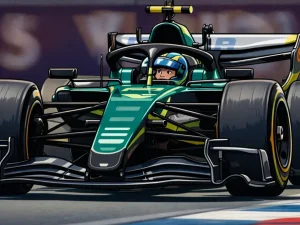
Cadillac’s first F1 track run is imminent — the latest sign that the once-Andretti-led project is properly moving from pitch deck to pit lane. And if Pat Symonds has his way, the “centre of gravity” of the operation won’t stay in Britain for long.
What began as Michael Andretti’s bid to join the grid has matured into a full-fat General Motors works effort under the Cadillac banner, set to arrive in 2026 with Graeme Lowdon as team principal and Dan Towriss’s TWG Motorsports running the show on GM’s behalf. The opening act will be as a Ferrari customer team, before GM rolls out its own power unit in 2029 — the moment the group becomes truly autonomous in Formula 1.
For Symonds, now executive engineering consultant to the programme, the phase one blueprint is pragmatic: use Europe to get racing, then build America into the beating heart. Right now, the chassis and race team orbit Silverstone, the aero work runs through Toyota’s wind tunnel in Cologne, and Cadillac has taken on an industrial site near the Northamptonshire circuit to keep logistics tight.
But the heavy-lift plan clearly lives stateside. In Fishers, Indiana — just outside Indianapolis — GM is putting up a vast 420,000-square-foot manufacturing hub. In North Carolina, near Charlotte and Concord, the power unit project is being tooled up in a new facility, backed by GM’s technical capabilities in Warren, Michigan. Simulator work, software and tyre science are already anchored in Charlotte.
“We’re building it out of the UK of necessity — that’s where the skills are — but we’re transitioning the core to the U.S.,” Symonds explained on the Autocar podcast recorded in late 2025. “Indianapolis will take on the production that currently sits in the European supply chain. A new simulator is going in there. It’s exciting. It’s difficult. It’s a challenge.”
It’s also a deliberate point of difference. Haas opened the modern American chapter in 2016, but their model spreads across Kannapolis, Banbury and Dallara in Italy, with Ferrari supplying engines. Cadillac wants to do the thing in-house — eventually, almost entirely on American soil — and that’s not nothing in a sport where winning hardware is almost exclusively born in British and Italian postcodes.
The timeline is staged. Rapid-response manufacturing for fast-turn parts — front wings, floors — is likely to remain in the UK initially. Concept design, too, will sit in Britain for a while. But production will cross the Atlantic “reasonably soon,” Symonds said, with a permanent UK capability retained for agility. The next big call: wind tunnel. Cadillac rents Cologne for now, but the intention is to build one in the U.S. Cost-cap era or not, the math is persuasive. “These things use a lot of electricity, and electricity is about a third of the price in the USA than it is in the UK,” Symonds noted.
There’s a bit of romance baked into the mission, too. America’s F1 win column is thin — and thinner still if you’re strict about “American-built.” Dan Gurney’s Eagle, constructed in California, triumphed at Spa in 1967. John Watson’s Penske won Austria ’76 under a U.S. licence, but the car was made in Dorset. That’s the company Cadillac wants to keep: an American-built grand prix winner in the modern era.
They’re not just building a team; they’re building a destination. In Fishers, the footprint includes the hotel next door. The idea is to make the campus a draw for North American F1 fans who now have three races to choose from and an appetite the sport hasn’t seen on these shores in decades.
The hiring curve hasn’t been smooth everywhere. Symonds admitted the UK operation fell shy of its end-of-year recruitment targets, citing long notice periods that slow the churn. In America, it’s the opposite: short notices, faster onboarding, stronger momentum on the commercial side.
None of it guarantees lap time, of course. 2026 brings a sweeping reset with new chassis and a leaner-than-expected power unit formula, and Cadillac will turn its first laps next year as a Ferrari customer. That early test is more proof-of-life than statement-of-intent — a systems check, a mileage grab, and a first read on how this transatlantic machine actually operates under pressure.
Still, the ambition’s clear enough you can see it from 30,000 feet. A Cadillac on the grid in ‘26. A GM V6 in the back by ‘29. A workforce tilting west, a wind tunnel planned for U.S. soil, and production moving to Indiana as quickly as the logistics allow under the cap. Haas opened the door. Cadillac’s trying to kick through it.
If that first track day goes to script, it’ll be the quietest part of the whole story: an F1 car circles, numbers flow, engineers nod. The noise comes after — when the scale of GM’s intent meets the weekly grind of a world championship. And we’ll find out soon enough whether the sport’s next American chapter is just well-funded optimism, or the start of something that makes history blush.