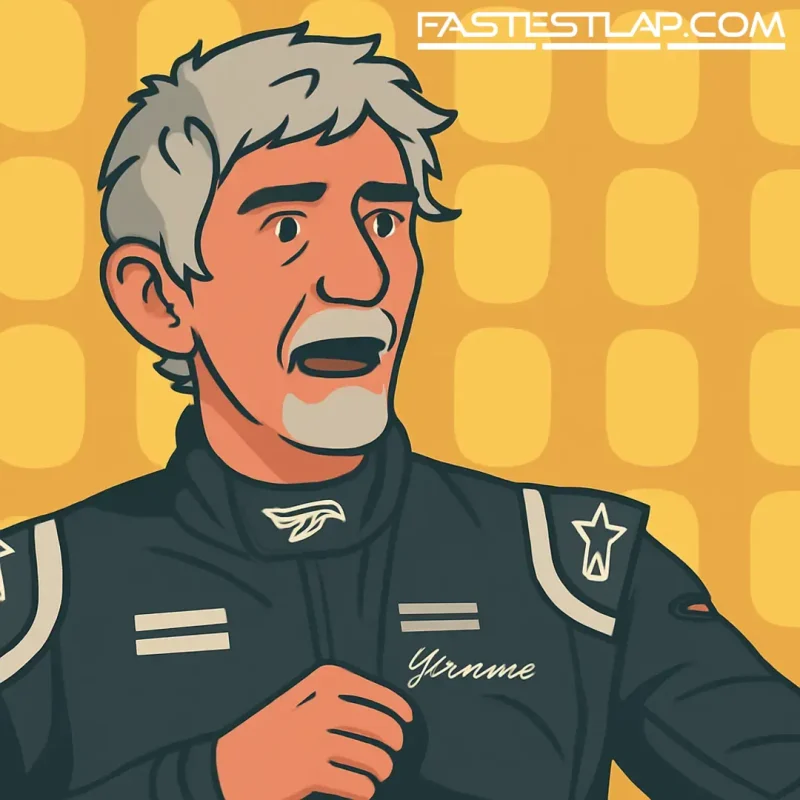
Damon Hill still smiles when he tells the story. Back in his Formula 3000 days, long before the Williams overalls and a world title, René Arnoux marched up to him, fuming. One of Arnoux’s protégés had been wronged in battle—crashed into, or something close enough—and the Frenchman let Hill have it: “You’re the worst driver I’ve ever seen in my life!”
Most drivers would shrivel. Hill filed it under “compliments.”
He relayed the moment on the Stay on Track podcast, making it clear he never wore the insult as a bruise. If anything, it adds to the curious arc of his career: the late starter who hopped off bikes, ground his way through junior single-seaters, made his Formula 1 debut in 1992 and crested as the 1996 World Champion. Not bad work for a guy Arnoux allegedly couldn’t stand to watch.
Hill says he’s perfectly happy he raced when he did. No nostalgia fever, just a sober appreciation for an era that suited his style. “I think I was very happy to have driven when I did,” he said. He wouldn’t wind the clock much earlier, though those brutish early ground-effect cars—dangerous as they were—still hold a fascination. He got a taste of that old-school bite when he hustled an early Williams around the Jeddah street circuit, Sky F1 overalls and all. The venerable DFV V8? “A nice little motor,” he shrugged. But the V10 Renault that powered his prime? “Absolutely brilliant.”
It’s Hill at his most Hill: equal parts self-deprecation and sharp perspective. He’s never pretended he was the last of the late brakers. What he does claim—and did during his time in blue and white—is an ability to feel a car, steer development, and extract pace the old-fashioned way. He talks about “my little skillsets, my very special little toolbox,” and you can hear the quiet pride in how he worked with tyres, setups and balance.
By 1999, he felt the sands shift. Engineers began pointing more at laptops than lap charts, and the authority of the steering wheel started to share the room with lines of data. “We’re going to set up the car according to what we see on the data,” he recalls being told. “And I remember thinking to myself, ‘Well, what do I do?’”
It’s not a dinosaur’s grumble so much as a line in the sand. Hill’s from a generation that asked the car questions and expected answers to come through the seat, not a delta. So when today’s drivers key the radio to ask, “What’s the plan?”, he winces a little. He’d prefer to hear the driver tell the team what the plan is.
None of which is to say the current crop isn’t up to it. This is just the latest bend in the river. And there’s a bigger one coming: 2026. Active aero, sharper energy management, different demands on how you carry speed, save charge, and attack. It’ll reward the sharp, pragmatic minds and punish those who can’t choreograph races as fluidly as they can nail a qualifying lap.
Hill sees that too. The future asks drivers to blend instinct with information, not pick a side. The trick will be voicing the plan while also absorbing the stream of data that can make or break a stint. The cockpit has never been louder; the greats will find the quiet in it.
If that sounds like an elegy for a simpler time, it isn’t. Hill’s a realist, and he’s also proof that motorsport has room for reinvention. The rider-turned-driver turned pundit still slips behind the wheel for a blast when a producer asks and a circuit’s willing. He came off that Jeddah run looking like he’d been for several rounds with the street furniture. That’s part of the charm. He doesn’t need the stopwatch anymore. He just wants to feel the thing.
And as for the “worst driver” tag? You could slap it on a world champion only if you believe that motorsport’s full of strange little ironies. Hill’s happy to wear it. He knows where he ended up. Arnoux probably does too.