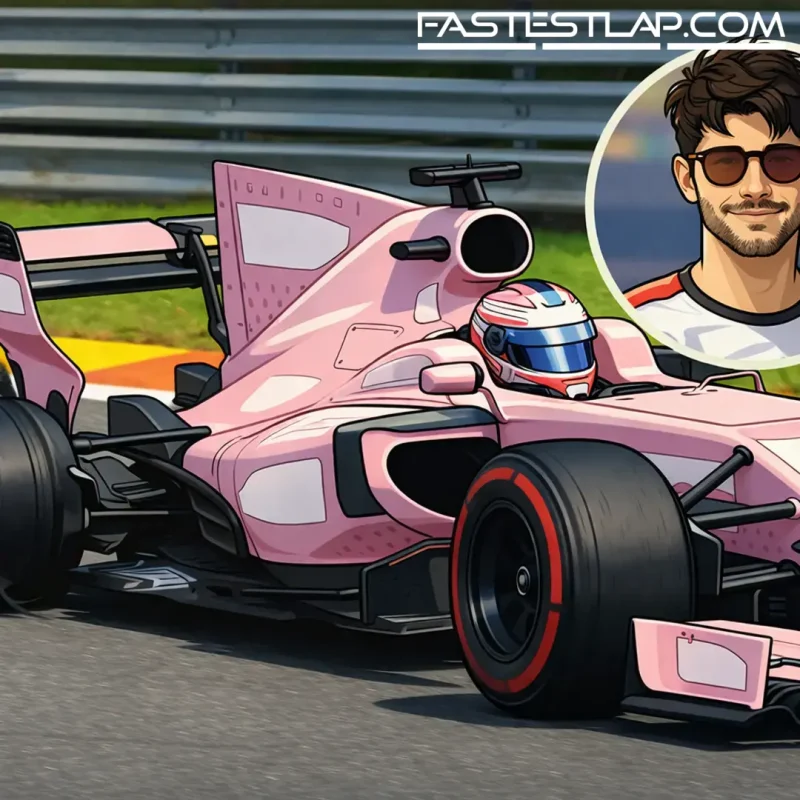
Esteban Ocon’s never been one to pretend the sharp edges weren’t there early on. But almost a decade after Force India’s 2017 civil war, he’s now willing to admit what neither he nor Sergio Perez would say at the time: some of it was on him.
Speaking on F1’s *Off The Grid*, Ocon looked back at a season that did two things at once. It turned Force India into the best of the rest — fourth in the Constructors’, points almost everywhere, a genuinely slick midfield operation — and it also produced a four-act teammate feud that felt like it might blow the whole thing up by September.
Ocon arrived mid-2016 at Manor and couldn’t buy a point in nine races with a backmarker. Force India in 2017 was a different world: a proper car, a proper chance, and a teammate who’d already built a reputation as one of the grid’s most reliable midfield operators. Perez was in year seven; Ocon was effectively starting his first full campaign with everything that comes with it — expectation, scrutiny, and that internal panic every young driver knows: if you don’t land a punch early, you can spend years being labelled the slower one.
“Yeah, it was a lot of pressure,” Ocon said. “I was racing against someone very experienced… probably the most consistent [midfielder].”
He admitted he began 2017 “clearly on the back foot”, then found his feet and ended up in the situation that creates the most trouble inside a team: two cars running nose-to-tail, every weekend, for real points. “We were racing very closely,” he said, and the line that follows is the key one because it’s the closest you’ll get to an apology without him explicitly calling it that.
“There were moments where I did mistakes,” Ocon conceded. “There were moments where I don’t feel it was necessarily my fault.”
That’s about as honest as driver retrospectives tend to get, particularly when the other party is still very much part of the story in 2026. Perez is back on the grid with Cadillac, and while it’s not a straight rerun of Force India, the paddock has a long memory for feuds that once lit up the midfield.
Back then, the flashpoints came in four chapters: Canada, Hungary, Azerbaijan and Belgium. Canada and Hungary were the kind of friction you see in a team where both sides are convinced they’re the one being wronged. In Montreal, Perez’s move cost Ocon a position to Sebastian Vettel and prompted Ocon to warn it could have “left us both out”. In Budapest, they banged wheels on lap one — another example of how quickly their relationship drifted from “robust teammates” to “this is personal”.
Then came Baku.
Azerbaijan 2017 was the incident that crystallised the dynamic: Ocon squeezed Perez towards the wall at Turn 2, breaking Perez’s front suspension and ending his race. Ocon took a puncture and dropped to the back but clawed his way to sixth. Perez didn’t hide what he thought of it.
“What happened today is totally unacceptable for the team,” he said at the time, calling Ocon “over aggressive” and adding: “I think he didn’t have any logic.”
It’s easy to forget now, looking back with the benefit of mature soundbites, just how toxic that sort of language is when it comes from the established driver towards the rookie. It doesn’t just criticise a move; it questions the other guy’s judgement as a racing driver. From there, everything becomes a score-settling exercise, whether either wants to admit it or not.
Spa, four races later, was the inevitable sequel. This time it was Ocon on the receiving end as Perez squeezed him in wheel-to-wheel fighting, with contact and a brush with the wall. Both survived, but Perez tried it again later in the race and this time it went wrong in the most expensive way: Ocon lost his front wing, Perez lost a wheel. Ocon limped home ninth; Perez ended up classified 17th after retiring.
Ocon’s fury that day was unfiltered: “He was risking our lives. He risked my life. He is supposed to be a professional driver but he is not acting like it.” Perez, for his part, pointed straight back to Baku: “Tension started when he put me in the wall.”
The most revealing part of Ocon’s 2026 reflection isn’t that he now admits fault — drivers say that when the heat has gone — it’s that he frames it as the cost of trying to establish himself. “I was very young. I was inexperienced. I wanted to push hard and show people what I was capable of.”
That’s the bit any team principal will recognise: the internal teammate battle is rarely about the single corner where carbon fibre explodes. It’s about what each driver thinks the other is trying to take from them — status, future contracts, the team’s trust. The track is just where the argument becomes visible.
Ocon also acknowledged the bigger consequence, which Force India couldn’t afford at the time: “It cost the team points.” He singled out Spa as something that “shouldn’t have happened”, before widening it into a more general admission about his career. “I’ve made mistakes… but that’s how you learn from it.”
There’s still a little steel in the way he tells it. Ocon insists that even now he believes “the track is what matters the most”, but he also accepts that “things could have happened in a different way” — a subtle nod to the idea that racing hard doesn’t require dragging your teammate into your personal proving ground.
And despite everything, he insists the respect was real then and remains now. “With how much respect I had for Checo at the time, and I still have now, I would have preferred things to go in a different way.”
That final sentence says plenty about where both men are in 2026. Ocon is no longer the wide-eyed rookie looking to announce himself by taking on the established points machine next door. Perez, now part of Cadillac’s fresh start in a new technical era, isn’t the midfield gatekeeper he once was either — he’s a senior hire tasked with building something new.
But if they do find themselves fighting on track again this season — and with the grid in flux, it’s not hard to imagine Cadillac and the midfield regulars circling similar territory — there will be history in every inch they give, or don’t give, each other. The difference is that one of them, at least, sounds like he’s learnt where the line actually is.