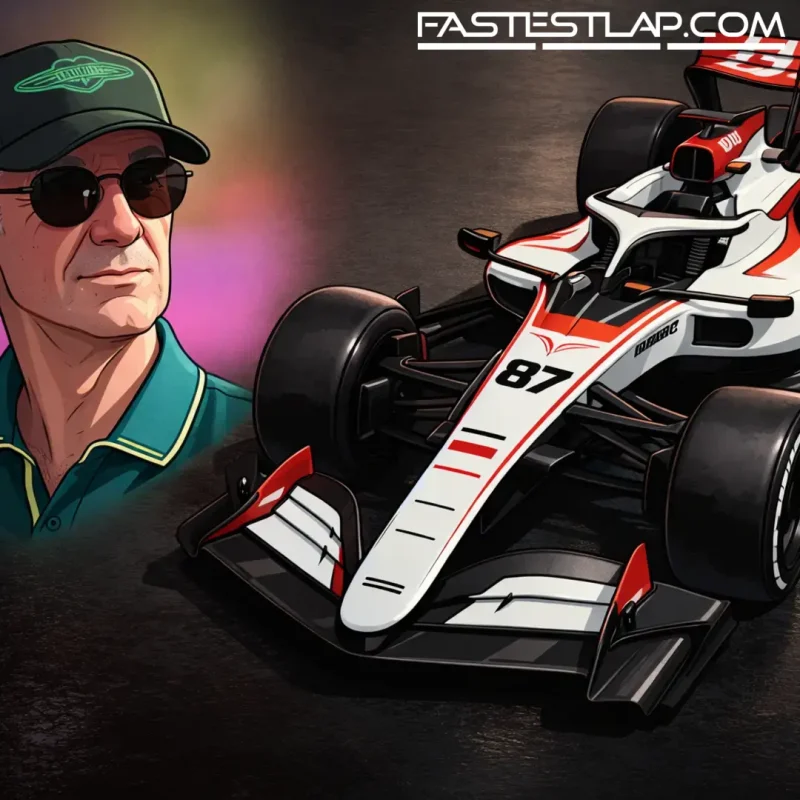
Haas might have been the last thing on most people’s minds in a week where everyone’s waiting for Barcelona to tell the truth, but the VF-26 reveal was a useful reminder of what this 2026 reset is really going to be about: less hype, more homework.
The American team’s new look is an evolution of the familiar white-and-black palette it’s leaned on for years, but the bigger change sits in the small print. Haas has moved on from MoneyGram as title partner and brought Toyota Gazoo Racing into a broadened relationship off the back of an existing technical arrangement. In a paddock obsessed with who’s “nailed the aero”, it’s a quietly significant signal that Haas is trying to widen its support network for a regulation set that’s going to punish anyone turning up under-prepared.
Ayao Komatsu didn’t bother selling dreams. With pre-season testing starting in Barcelona next week and Ferrari’s latest-generation hybrid power unit bolted in behind the driver, Haas’ team principal was blunt about what keeps him awake: getting on top of energy management and deployment. Not lap time. Not points targets. Just understanding the new machinery well enough not to trip over it.
“Before we go racing, and even testing, we need to get on top of energy management, that’s the huge one,” Komatsu said in Haas’ pre-season preview. “I don’t know if we all understand the full extent of the challenge because we don’t know what we don’t know.”
That last line will resonate up and down the pitlane. 2026 isn’t simply a downforce and weight shuffle; it’s also an era where the clever teams will treat power unit behaviour as a performance tool in its own right. The quickest car over a single lap might not be the easiest to race if its energy usage forces compromises corner-to-corner, and anyone who thinks they can just “sort that later” is likely to spend the opening flyaways firefighting.
Komatsu framed Haas’ early-season objectives in a way you don’t often hear in January: first master the power unit management, then worry about aerodynamic development. There’s an unglamorous wisdom to it. If the baseline isn’t robust, no upgrade package will save you when you’re giving away lap time because you’re chasing the wrong deployment map.
While Haas is talking about fundamentals, Red Bull has been shutting down a different kind of distraction. After GianPiero Lambiase missed two races in 2025 and the rumour mill did what it always does, there was speculation he could be tempted elsewhere. Aston Martin and Williams were both floated as possible landing spots. Those close to the situation have already made it clear he’s staying put as Red Bull’s head of racing, and Max Verstappen himself has now treated the whole thing with a kind of weary inevitability.
“He was always staying,” Verstappen said to Sky News, pushing back at the suggestion there was “never any question” over Lambiase’s future: “Not to me.”
In other words: the Verstappen–Lambiase axis remains one of Red Bull’s real competitive assets, and the team has no intention of letting rival projects—however ambitious—test the foundations of that relationship. With the sport about to lean hard into a new technical cycle, continuity in the engineering room is going to matter at least as much as what a CFD run says on a Tuesday night.
McLaren, meanwhile, did the most modern thing possible to mark a very old-school milestone: it posted a short clip confirming the MCL40 has been fired up at base ahead of its first running in Barcelona. It’s a simple step, but teams don’t tend to publicise it unless they’re confident the project has cleared an important internal gate. For all the noise that arrives with launches and liveries, the first fire-up is when a car becomes something other than a collection of ambitious CAD files.
If you wanted one story from Monday that hints at where this season might be won or lost, though, it wasn’t a paint scheme or a social post. It was the detail filtering out of Aston Martin about Adrian Newey “agonising” over suspension choices for the AMR26, as reported by AutoRacer.
Newey’s official role is team boss and managing technical partner, and the suggestion is that he delayed the final call on the suspension layout until as late as possible in development. Anyone who’s followed his career knows that’s not a throwaway subplot. Suspension is one of the few areas where a top designer can still buy a car a broader operating window—especially when the sport is about to encounter a fresh set of compromises.
Newey has been vocal before about how closely he gets involved in that part of the car; he revealed in 2022 that he personally designed the front and rear suspension on Red Bull’s RB18, and that attention to detail helped Red Bull avoid some of the worst of the porpoising that shaped the first ground-effect season. The AMR26 is a different puzzle, but the principle holds: if Aston Martin’s suspension platform gives it stability, confidence and consistent tyre behaviour across a range of conditions, it won’t just be quicker—it’ll be easier to develop.
That’s where the early narrative of 2026 is quietly forming. Haas is admitting the biggest gains may come from understanding the power unit’s “foibles” before anyone else does. Red Bull is keeping its most important human partnership intact. McLaren is moving from presentation to mileage. Aston Martin is letting Newey sweat the details that often decide whether a concept flies or falls.
Barcelona will still be full of the usual theatre—fuel loads, sandbag accusations, conveniently timed “minor issues”—but beneath it sits a more interesting reality. This season’s early winners might not be the teams with the prettiest launch content. They’ll be the ones who’ve already done the hard, slightly boring work that stops a new rule set from biting them.