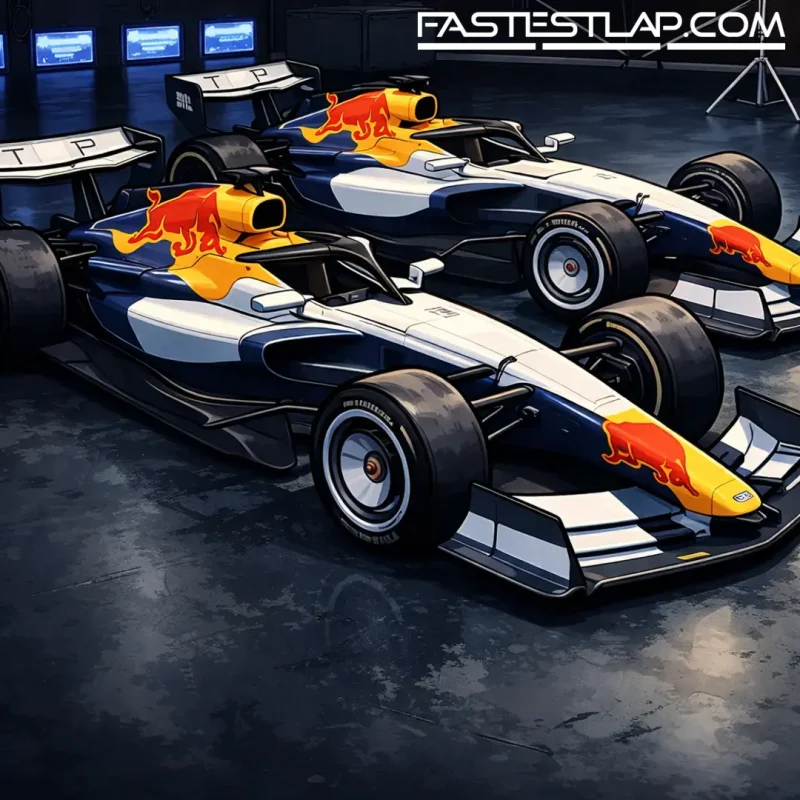
Racing Bulls will get its first real taste of life under the 2026 rules this week, rolling the VCARB03 out at Imola for a two-day run that’s as much about logistics and rhythm as it is about lap time.
The Faenza squad unveiled its new look at Red Bull’s splashy joint launch with Ford in Detroit last week, but the more meaningful part of the week comes back on home soil. Imola is close, familiar, and crucially it allows the team to start knitting together all the moving parts that make the difference between a clean first test and an early-season scramble.
The plan is split across two different regulatory allowances. Tuesday is scheduled as a ‘demonstration event’ — essentially the marketing-friendly category that still lets you run a current-year car, but only for a maximum of 15 kilometres. Two of these demonstration events are permitted per team across the season, so Racing Bulls will be dipping into that pot first.
Wednesday is the more substantial day: one of the team’s two permitted filming days for the year, which now allows up to 200 kilometres of running after the allowance was increased from 100. In other words, Tuesday is a systems check with a camera crew nearby; Wednesday is where you can start doing the proper “does this thing behave like it did in the simulator?” work, even if everyone will be careful not to call it that.
Both Liam Lawson and Arvin Lindblad are expected to get time in the cockpit across the two days, and that’s not a small detail. These early outings are when drivers re-calibrate their feel after the winter, but they’re just as valuable for the people behind the garage doors: the mechanics, the software engineers, the trackside crew who have to get back into the cadence of an F1 weekend without the pressure of official testing clocks and headline timesheets.
As ever for demonstration and filming days, the running must be done on specific Pirelli compounds supplied for the purpose — so nobody is sneaking in a meaningful tyre programme. But that doesn’t make the mileage worthless. Shakedowns are where teams try to avoid losing half a day in Barcelona because a sensor is unhappy, a cooling loop has an airlock, or a new component doesn’t quite fit the way the CAD model promised it would.
And that’s really the story here. With the sport stepping into a new rules cycle for 2026, Racing Bulls isn’t treating Imola as a cute photo op. It’s using every legal kilometre it can to make sure the VCARB03 arrives at the first official test with the basics already under control.
Official pre-season testing begins with a five-day event in Barcelona from January 26-30, and team principal Alan Permane has already laid down the reality of the early-season development race: it’s going to be frantic, and the car that appears in Spain won’t be the one that turns up in Melbourne.
“I’m pretty sure most people, us included, will [bring] an update [to Australia],” Permane said late last year. “The car we test with in Barcelona won’t be the car we take to Melbourne. I’m sure there’ll be a significant update.”
That’s not a throwaway line, it’s an admission of how brutal the timing window is when you’re trying to extract performance while also building enough parts that the whole programme doesn’t collapse under its own ambition. Permane framed it in the blunt terms engineers tend to use when they’re being honest: develop later and you’ll be faster — but you still have to manufacture, assemble, and validate what you’ve designed.
“We’ve known the regs for a while. We’ve been able to work on the car in the wind tunnel since January 1 [2025],” he said. “Now, we’re all faced with exactly the same problem.
“The later you develop your car, the faster it will be, in simple terms. You want to keep it in the wind tunnel as long as you can. You want to finalise the mechanical designs as late as you can.”
He also pointed to the knock-on effect of decisions teams make at this stage — the kind of chain reaction that defines modern car design. Packaging the engine, radiators and associated systems shapes the sidepods; sidepods influence the floor; the floor dictates a chunk of your downforce. You can’t treat any of it in isolation, and you can’t change one thing without paying for it elsewhere.
“The installation of the engine, with the radiator installation, all that has an effect on the sidepod installation, which has an effect on the floor, which has an effect on the downforce,” Permane explained. “Everything, everything you do is geared up for performance… Of course, we make it as difficult for ourselves as we can, because we want the maximum performance.”
That’s why these Imola kilometres matter, even when everyone pretends they don’t. A filming day is officially about content; in reality it’s a pressure release valve for an organisation that’s been building towards this moment since the wind tunnel doors opened for 2026 work. Every minute the car runs without complaint is one less uncertainty carried into Barcelona — and one more chance to spend the test learning, rather than firefighting.
Interestingly, Racing Bulls’ sister team Red Bull Racing won’t be doing a comparable shakedown. Red Bull’s RB22 is set to make its track debut during pre-season testing instead, leaving Racing Bulls to do the early running for the wider stable this week.
The numbers will be meaningless and the lap times irrelevant, but paddock people will still pay attention. Not because they’re expecting a pecking order to emerge at Imola in January — they won’t — but because in a new era, the teams that hit the ground cleanly tend to buy themselves breathing space. And breathing space, in 2026, is performance.