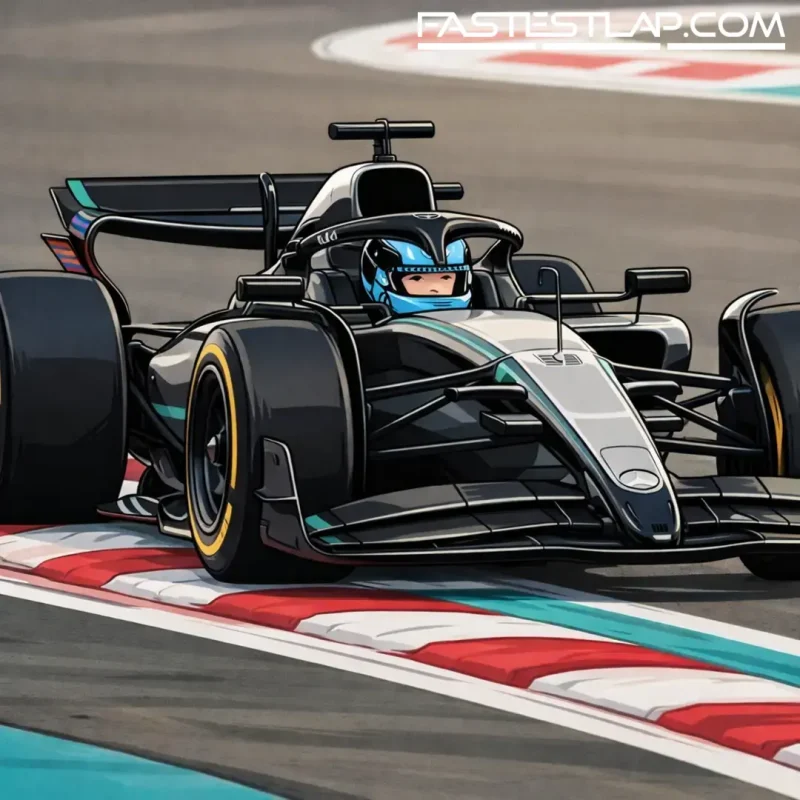
Mercedes is preparing to roll out the W17 on Thursday, but the car won’t be the only thing doing laps around the paddock conversation. The team is expected to confirm a significant new commercial partnership with Microsoft at the livery launch — a deal that, if the numbers being discussed are in the right ballpark, underlines just how aggressively the sport’s biggest brands are positioning themselves for F1’s new era.
Sky News reports Microsoft will be announced as Mercedes’ latest partner. Mercedes, asked for comment, declined. The broadcaster cites sponsorship industry estimates putting the agreement at around $60m per year, which would make it one of the heavyweight deals on the grid. On the same scale, it would sit behind Mercedes’ own reported $75m-a-season title arrangement with Petronas and Red Bull’s $100m-a-year partnership with Oracle.
In isolation, it’s “just” another logo and another press release. In context, it’s more revealing. Formula 1’s centre of gravity has been shifting toward big tech for a while — not only because the sport offers global reach and a modern image, but because teams now sell themselves as technology companies that happen to go racing. A Microsoft tie-up is the sort of partnership that fits that narrative neatly: massive enterprise credibility, deep pockets, and plenty of scope for a broader story than branding real estate on a sidepod.
Mercedes already has a crowded sponsor portfolio — more than 20 brands are listed as partners — and that matters. In today’s F1, stacking deals isn’t simply about being greedy; it’s about keeping flexibility. With budget caps governing spend on performance but not necessarily constraining how ambitious a team can be commercially, the game becomes: build a bigger machine off-track so you can run the sharpest one on it. More resource, more resilience, more ability to absorb organisational change without the whole project wobbling.
And Mercedes is in the middle of exactly that sort of change.
A chunk of Toto Wolff’s Mercedes shares was recently sold to cybersecurity company CrowdStrike, a move reported to have valued the team at more than £4.6bn. That number, more than any sponsor figure, is the clearest sign of where F1 teams now sit in the broader sporting landscape: less like traditional racing outfits, more like high-growth assets with global appeal.
The Microsoft deal talk also lands amid a busy commercial streak. Mercedes announced another new partner on Wednesday — digital finance service Nu — with Wolff leaning into the now-familiar language of shared “innovation” and “disruption”.
“Innovation and disruption are at the heart of everything we do and our partnership with Nu reflects those joint values,” Wolff said. “We have a shared commitment to pushing boundaries and finding smarter, more efficient ways to perform. We look forward to working together to drive such excellence through the partnership.”
There’s a reason teams increasingly speak like this: the sponsors they’re chasing don’t want to feel like passengers. Tech firms, finance platforms and cybersecurity companies want the association with performance, but they also want the impression of integration — that they’re part of the operation, not just paying for visibility.
Thursday’s launch will be the first proper public step of Mercedes’ 2026 campaign, with the team chasing a return to the top of the Constructors’ Championship for the first time since 2021. Yet the subtext to all of this is that Mercedes is shoring up the foundations as it tries to climb back. The sport’s reset and the competitive swings of recent seasons have made even the most decorated organisations feel the need to reinforce everything: staffing, structure, partners, and the public-facing identity.
On the technical leadership side, Mercedes has also confirmed the impending departure of Chief Design John Owens, who has been with the team since its return to the F1 grid. He’ll serve a period of gardening leave ahead of stepping away later this year. Engineering Director Giacomo Tortora will take over the role, with Deputy Technical Director Simone Resta overseeing the group. Mercedes thanked Owens for his contribution, calling out the “considerable role he has played in the team’s success.”
It’s a reminder that while the commercial headlines are booming, the competitive edge still relies on continuity — and on managing disruption when continuity isn’t possible. Big-money partnerships can stabilise a team through transitions; they can also raise expectations. A fresh Microsoft logo on the car won’t find lap time by itself, but it does signal that Mercedes intends to operate — and be perceived — as one of the sport’s superpowers again.
If nothing else, Thursday is shaping up as the kind of launch where the paintwork is almost secondary. The W17 will get the spotlight, but the bigger story may be what Mercedes is building around it.