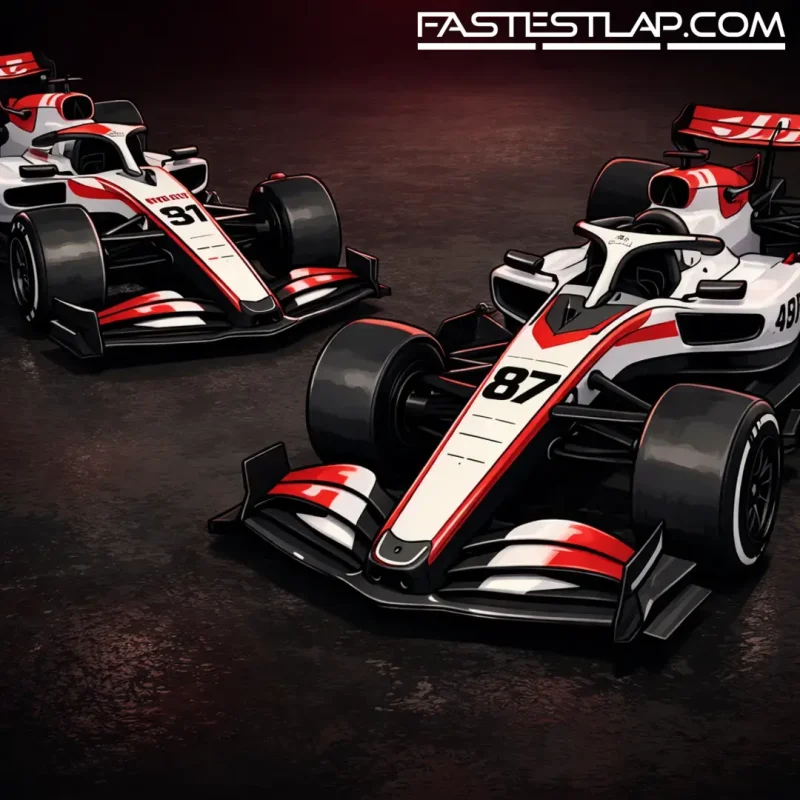
Oliver Bearman wasn’t pretending to have any answers when Haas rolled out its VF-26 livery. If anything, his message was a reminder of how little anyone can bank on as Formula 1 hits the reset button for 2026: there will be winners, there will be strugglers, and there will be teams that simply get it wrong.
He just hopes Haas isn’t one of them.
“It’s impossible to gauge where we’re going to be right now,” Bearman said at the VF-26 unveiling. “Everything I’m seeing from the team is positive, but we don’t know how we stack up, and we won’t know until qualifying in Australia.”
That uncertainty is the defining feature of this new era. F1 has moved on from the ground-effect ruleset that arrived in 2022 and shaped the competitive landscape through to last season. Now it’s active aero, smaller and lighter cars, and a new power unit formula built around sustainable fuel and a 50-50 split between electrical and combustion power. On paper, it’s the biggest regulation reset the sport has ever attempted — and the paddock knows what that usually means in practice.
Bearman’s point wasn’t that Haas is braced for catastrophe; it was that chaos is baked into the opening phase of any new technical cycle. The early ground-effect years provided a sharp lesson: some teams hit the target quickly, others spent months fighting a fundamental problem they didn’t fully understand. Porpoising, in particular, punished those who chased peak downforce without controlling the platform. Bearman expects 2026 to spring its own traps.
“Even then, I feel like in the first few races reliability is going to be playing a big factor,” he said. “There are going to be teams and people making mistakes with these new regulations. It’s going to be tough to establish a true pecking order.”
That line about reliability is easy to skim past, but it’s where the first part of this season could be decided. With brand-new chassis concepts, active aero systems and a radically different power delivery profile, the opening races won’t just be about outright pace. They’ll be about which teams can finish weekends cleanly while everyone else is still discovering what breaks, what overheats and what the software doesn’t like.
For Haas, the timetable is already intense. The team heads to Barcelona shortly for a five-day, behind-closed-doors test at the Circuit de Barcelona-Catalunya starting January 26. They’ll be allowed to run on three of those five days — a limited but valuable chance to rack up mileage before the wider circus convenes in Bahrain for official pre-season running on February 11-13 and again on February 18-20.
There’s a particular edge to this moment for Bearman too, because it’s his first time stepping into a genuine regulation change as an F1 driver. Rookies often talk about learning tracks, tyres, procedures — the usual steep curve. But a full reset removes the comfortable reference points the established names lean on. In a strange way, it can flatten the field psychologically even if it doesn’t ultimately flatten it on the stopwatch.
“These changes are the biggest in the history of Formula 1,” Bearman said. “That is a huge deal of excitement for me. I’m heading into a regulation change for the first time in my life, really.”
He contrasted it with last year, when he felt there was at least an underlying sense of what the car could be if the team got it into its operating window — and, crucially, a sense of where it should sit in the midfield fight. That’s gone now.
“That lack of knowledge heading into 2026 is good and bad,” Bearman admitted. “On one side I feel like we can really have an impact straight away, but also it’s horrible not knowing. I would like to skip forward six months to see where we are, but I’m going to be giving it everything to make sure that where we are is as high up as possible.”
It’s an honest snapshot of the paddock mood at this stage of a new era: excitement laced with dread. Everyone says their numbers look “positive” in the factory. Everyone has reasons to believe they’ve interpreted the rules well. But until Australia, it’s theory against theory — and even then, the opening flyaways may not tell the full story if early-spec parts, cautious engine modes and reliability triage skew the picture.
For Haas, there’s also a practical reality: a smaller operation can’t afford many false starts. In a stable ruleset, you can iterate your way out of trouble. Under a reset this large, the wrong concept can box you into a season of compromises. Bearman’s “teams and people making mistakes” line lands because it isn’t just a warning about performance; it’s a reminder of how expensive a misunderstanding can be when the entire sport is learning in real time.
And that’s what makes 2026 compelling before a single lap has been properly timed. The order we think we know has been wiped away. The early races might not crown the fastest car so much as the best-prepared organisation — the one that turns up with speed *and* keeps it on the road, with systems that work, parts that last and a driver pairing that can absorb a few messy Fridays without spiralling into panic.
Bearman, at least, sounds clear-eyed about what’s coming. The temptation in January is to talk yourself into certainty. He’s not doing that. He’s looking at a season where the field could swing race-to-race, where reliability could be worth more than a tenth, and where the first real “pecking order” might not arrive until the sport has already been thrown into the deep end.
Haas will learn quickly whether its optimism is justified. So will everybody else.