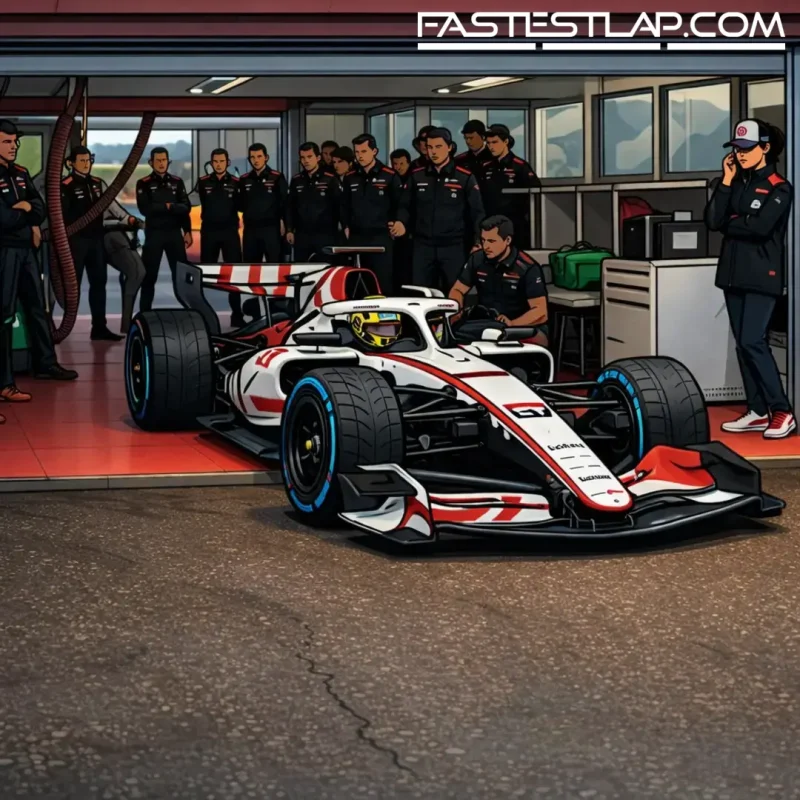
Haas has ticked off the first, quietly significant milestone of its 2026 campaign: the VF-26 has turned a wheel in anger.
The team rolled its new car out at Ferrari’s Fiorano test track on Friday, leaning on the practical benefits of its customer relationship with the Scuderia to get an early systems check done before the paddock packs up for Barcelona. Oliver Bearman handled the debut laps, with Esteban Ocon on hand as Haas began the familiar pre-season routine of verifying that what was signed off in design offices actually behaves like a race car when it meets asphalt.
There’s always a temptation to overread these early shakedowns — the lap times mean nothing, the running is tightly controlled, and teams are typically chasing the unglamorous basics: sensors agreeing with one another, hydraulics behaving, gearshift and clutch mapping in the right postcode. But for Haas, this first outing carried an extra layer of subtext, because 2026 is the year its external relationships get more complicated on paper.
The American team is entering the start of a title partnership with Toyota’s Gazoo Racing division from this season, a development that inevitably raises eyebrows in a sport obsessed with “who’s really aligned with whom”. Haas’ technical backbone, however, remains tied to Ferrari, and the team has been at pains to emphasise that Toyota’s expanded involvement isn’t an attempt to elbow into Ferrari’s space.
Team principal Ayao Komatsu has been blunt about it: Ferrari is the foundation, the relationship doesn’t change, and the workstreams are being kept cleanly separated. His explanation late last year was telling, not just for what it said but for what it implied about the politics of modern F1 partnerships — Toyota’s chairman Akio Toyoda, Komatsu revealed, asked early on whether Ferrari would be comfortable with the arrangement. That’s the reality for a team like Haas: you can broaden support, but not at the cost of unsettling the supplier that makes the operation viable.
In Komatsu’s words, Toyota isn’t stepping into areas where Ferrari already collaborates. Instead, the intent is to carve out contributions in parts of the regulations where Ferrari can’t (or won’t) assist because it’s a direct competitor. It’s a neat, carefully drawn map — and also a reminder that in 2026, with a fresh rulebook reshaping the grid, “non-overlapping” partnerships are going to become their own engineering discipline.
As for the running itself, Haas didn’t specify whether the Fiorano outing counted as a full filming day — which would permit up to 200km — or a shorter demonstration run capped at 15km. Either way, even the briefest distance is enough to flush out the kind of issues that can derail a schedule: a cooling problem that appears only at speed, a sensor that reads clean in the garage but throws nonsense once vibration loads up, or an innocent-looking assembly detail that becomes a time-sink when you’re trying to make a Barcelona test plan stick.
Haas released imagery from the session showing Bearman pulling away from the Shell-branded Fiorano garage on wet tyres, surrounded by mechanics in that familiar pre-run choreography. Wet running at this stage isn’t about “performance” in any meaningful sense; it’s about staying out of trouble, keeping the car in one piece, and giving the engineers a controlled environment to build confidence in the basics.
Bearman’s role is also worth noting. Heading into his second full season in Formula 1, he’s now doing the work that matters long before qualifying laps and race stints: bedding in processes, setting reference points, and feeding back on drivability and systems behaviour when the car is still more question mark than weapon. It’s the sort of day that doesn’t generate headlines in March, but can save you weeks in April.
Next stop is Circuit de Barcelona-Catalunya, where teams have a five-day window from January 26–30 to complete up to three days of running apiece. For Haas, the Fiorano laps are less about showing anything and more about removing reasons not to learn quickly once the proper work begins. In a year where everyone is adapting to new demands and new priorities, getting those first kilometres done without drama is its own small victory — and a sensible way to enter what’s shaping up to be a politically and technically delicate season for a team balancing two heavyweight connections while trying to keep its own identity intact.