If you wanted a neat snapshot of what Formula 1 looks like heading into 2026, Sunday did the job: senior figures manoeuvring for influence, teams quietly rewiring key roles, and the new rules already showing their teeth in the most revealing place of all — a low-key shakedown video.
The biggest tell, though, is how quickly the grid is starting to behave like the regulations have already landed.
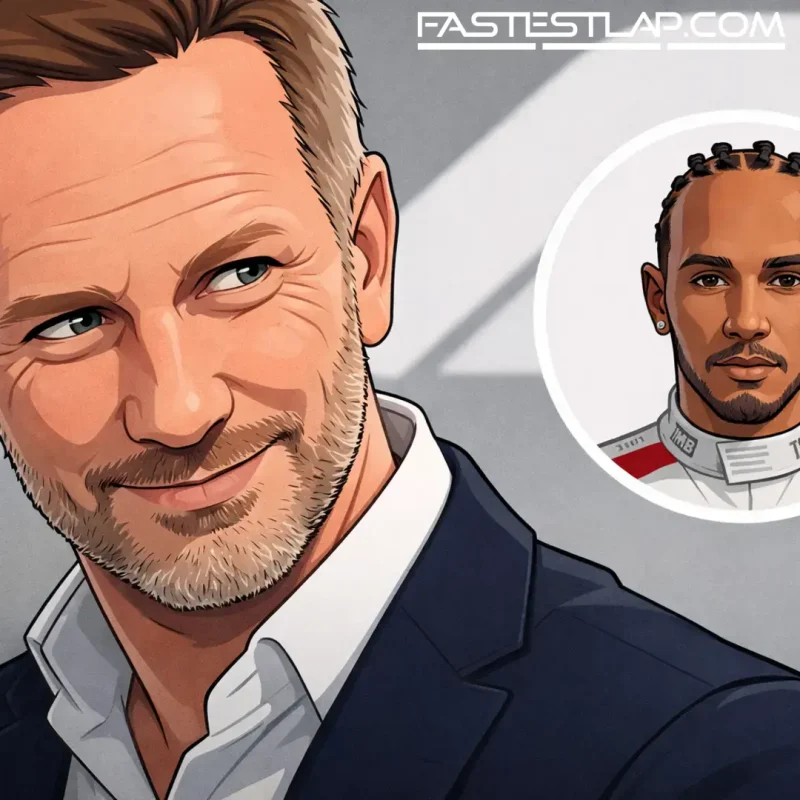
Alpine, for one, isn’t even pretending this winter is just about lap time. The team has confirmed Christian Horner has expressed an interest in buying a stake in the Enstone operation, which is about as loud a signal as you can send without holding a press conference and wheeling out a term sheet.
Horner’s departure from Red Bull during the 2025 season left one of the paddock’s most influential operators suddenly unattached, and Alpine is the obvious landing zone if he wants back in with real leverage rather than a ceremonial role. A stake is the point: it’s not just a job, it’s ownership-level clout — the kind that reshapes internal politics, budgets, and long-term direction. And if a return is indeed not immediate, that only adds to the intrigue: buying in is a different rhythm to being hired, and these things rarely move at the pace of a rumour cycle.
Elsewhere, Ferrari’s own reshuffle has created the sort of vacancy that matters more than most fans realise. Lewis Hamilton will have a new race engineer this season after Ferrari moved Riccardo Adami into a different role for 2026, and the name now being floated as the favourite is former McLaren performance engineer Cedric Michel-Grosjean.
Michel-Grosjean worked on Oscar Piastri’s car in 2025 and left McLaren at the end of that year; he’s currently on a career break. If Ferrari do land him, it reads like a very modern Ferrari move: go hunting for someone steeped in a recent, well-regarded engineering culture and plug that expertise directly into the sharp end of the garage. For Hamilton, the race engineer relationship is never just “radio chat” — it’s the in-car extension of how a team thinks under pressure. With new technical regulations and a new environment, Ferrari can’t afford any acclimatisation lag longer than it has to be.
And then there’s the part everybody can actually see: the cars beginning to behave differently.
Footage from Ferrari’s shakedown has shown Hamilton experimenting with active aerodynamics, pressing the button — literally and figuratively — on what’s being billed as one of the headline changes for 2026. Moveable front and rear wings are now part of the landscape, enabling a switch between low- and high-downforce configurations over a lap.
On paper, it’s about optimising straights and corners. In reality, it’s going to be about discipline and decision-making: who deploys it cleanly, who uses it at the right moments, and who builds a car that doesn’t feel like two different machines depending on wing state. The best teams will make the transition seamless; the rest will spend half a season chasing balance shifts and tyre behaviour that change not only with speed and fuel, but with aero mode.
This is why those little clips matter — not because a shakedown proves performance, but because it shows what teams are prioritising first. Ferrari’s early focus on Hamilton getting comfortable with the system tells you they understand the biggest gains might come from how quickly driver and car learn each other’s new language.
The new era is also why Aston Martin’s AMR26 is being talked about like an event rather than a car launch. It’s the first Aston Martin designed by Adrian Newey, and the first tied to the team’s new technical partnership with Honda. It’s hard to think of a more loaded combination for a regulation reset: Newey’s reputation for finding structure in chaos, Honda’s return to the centre of a works-style project, and a team that’s been building towards a moment where it needs to stop being “ambitious” and start being brutal.
We’ll get a clearer read when the AMR26 breaks cover on February 9, but the anticipation itself is the story — because 2026 is the kind of season where the first strong concept can become a year-long stranglehold.
Not all of Sunday’s noise was technical or political, though. Pierre Gasly has found himself having to explain intent after a social media post meant as a tribute to Michael Schumacher. Gasly shared a skiing photo on Schumacher’s 57th birthday earlier this month, wearing a Marlboro-branded red jacket with a resemblance to Schumacher’s Ferrari-era race overalls. The response was predictably charged, and Gasly has said he did not intend to cause offence.
Schumacher, of course, hasn’t been seen in public since his severe head injuries in a skiing accident in December 2013 — context that makes anything adjacent to his image, even accidentally, feel emotionally loaded in a way the internet doesn’t always handle with much grace or nuance.
Put all of it together and you get the picture: the 2026 grid is already taking shape, not just through lap times but through who’s positioning themselves to control the next cycle. Horner circling Alpine isn’t paddock gossip — it’s power seeking a platform. Ferrari’s engineer hunt isn’t admin — it’s about building a new operational spine around Hamilton. Active aero isn’t a gimmick — it’s going to rewrite how drivers manage a lap and how teams design the car that drives it.
It’s January, and already it feels like the season has started.