Formula 1’s 2026 reset finally moved from drawings and launch-day soundbites to something more useful on Monday morning: real cars, real laps, and the first messy hints of who’s interpreted the new rules cleanly — and who hasn’t.
Barcelona hosted the opening day of a five-day pre-season “shakedown” test run behind closed doors, with teams permitted to take part on three of the five days. Seven of the 11 squads were expected to run on day one, and the roll call of absentees immediately shaped the story. McLaren and Ferrari had already said they wouldn’t appear on Monday, while Williams confirmed it won’t run at the circuit at all as it continues pushing for “maximum car performance”, instead leaning on a suite of tests that includes a virtual test track programme.
Aston Martin’s situation remained unclear, with the team understood to be starting its pre-season later, though no firm detail had been put in the public domain by the team itself.
That left a slightly skewed first snapshot of the new era — but still a revealing one. Mercedes, Audi and Alpine were among the early movers, all heading out as the pit lane opened at 9am. Mercedes, in particular, wasted no time turning the first lap of the new regulations into a statement.
Kimi Antonelli logged the first benchmark of 2026 with a 1:31.772, and while nobody in the paddock will pretend an installation-phase time means much, the subtext was obvious: Mercedes arrived ready to run a proper programme from the first minute. That matters in this kind of rules change. When everyone’s still checking sensors, bedding brakes and validating cooling, the teams that can quickly graduate from “does it work?” to “does it work well?” tend to be the ones that spend February learning rather than firefighting.
Unofficial timing from trackside sources suggested Antonelli kept edging the number down as the morning built, reaching a 1:22.3 by the second hour. Franco Colapinto and Gabriel Bortoletto slotted in behind, though the spread — nearly three seconds across the top three at that point — said more about different run plans than any genuine pace order.
The early running wasn’t without the familiar winter-test interruptions. Colapinto drew the first red flag of the new era when he stopped at the Turn 1/Turn 2 exit, before getting going again after a brief pause. Later, Audi suffered a stoppage of its own: Bortoletto halted at the apex of Turn 10, with the team describing it as a “technical issue” under investigation.
Those moments are easy to shrug off, but they’re rarely meaningless in a brand-new technical cycle. Reliability gremlins in January don’t automatically translate into failures in March, yet they do tend to steal time from the one resource teams can’t buy: mileage while the car is still young enough that every lap teaches you something.
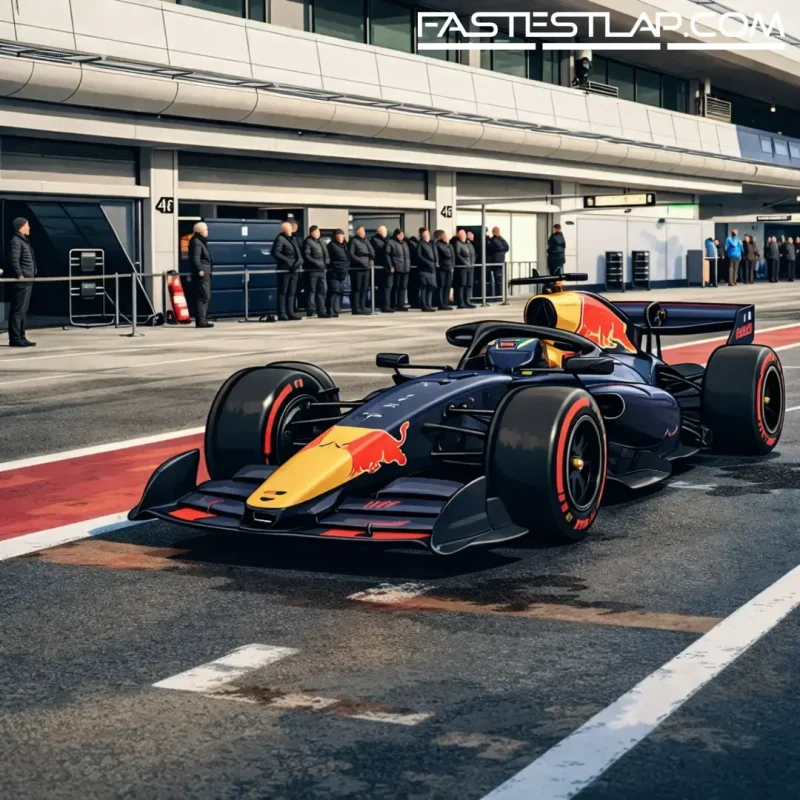
Red Bull’s morning, meanwhile, looked like the opposite: start quietly, then turn up the dial once the basics are ticked off. Isack Hadjar began with what were effectively installation laps after Red Bull chose not to do a pre-test shakedown, leaving the RB22 to complete its first proper systems checks in public view. For a while, he was buried down the order — again, a meaningless detail in itself — before the pace arrived in a rush.
By the third hour he’d climbed to third, behind Antonelli and Liam Lawson, and shortly before the lunch break he simply took over at the top. A 1:20.494 knocked Antonelli off P1 by more than a second and a half, then Hadjar trimmed it again to a 1:20.300 before producing the morning’s headline time: 1:18.835.
In cold conditions, on early-day tyres and with every team running their own undisclosed fuel loads and test items, it’s still not a “Red Bull is fastest” declaration. But it *is* a sign the car is responding when pushed, and that the integration work is far enough along that Hadjar can step beyond housekeeping laps into something resembling performance running. For a driver debuting at Red Bull in a new era, that’s the kind of first day you want — get the laps in, and when the engineers ask for a quick reference run, you can give them one.
It also framed an early, intriguing contrast. Mercedes looked organised from the first green light, steadily building its programme and gathering baseline data — exactly the sort of disciplined start you’d expect given the paddock’s pre-test assumption that it could begin this regulation cycle strongly. Red Bull, by comparison, looked like it was willing to spend a little longer on the “does it behave?” phase, then flip straight into “how quick is it?” once the car’s under it.
Behind them, there were laps for Racing Bulls, Haas, Cadillac and the rest of the running contingent, with Valtteri Bottas sitting P7 in the Cadillac at one stage as the timing spread stretched and shrank with each team’s varying plan. With so many heavy hitters not on track, the day one order carried the usual winter asterisk — but the underlying message was clearer than the timesheet: the teams that got on top of their new packages quickly were already freeing up time to explore performance.
The morning ended with teams mixing in practice starts before an unofficial lunch, with Hadjar reported to be the quickest in that phase ahead of Antonelli and Colapinto. Driver swaps weren’t confirmed by the teams at the time, leaving the afternoon’s running order uncertain.
Day one, then, delivered exactly what the first day of a new F1 era is supposed to: a little noise, a couple of stoppages, and just enough pace to start the paddock rumour mill turning — with Red Bull and Mercedes emerging as the early names worth watching, even this soon.