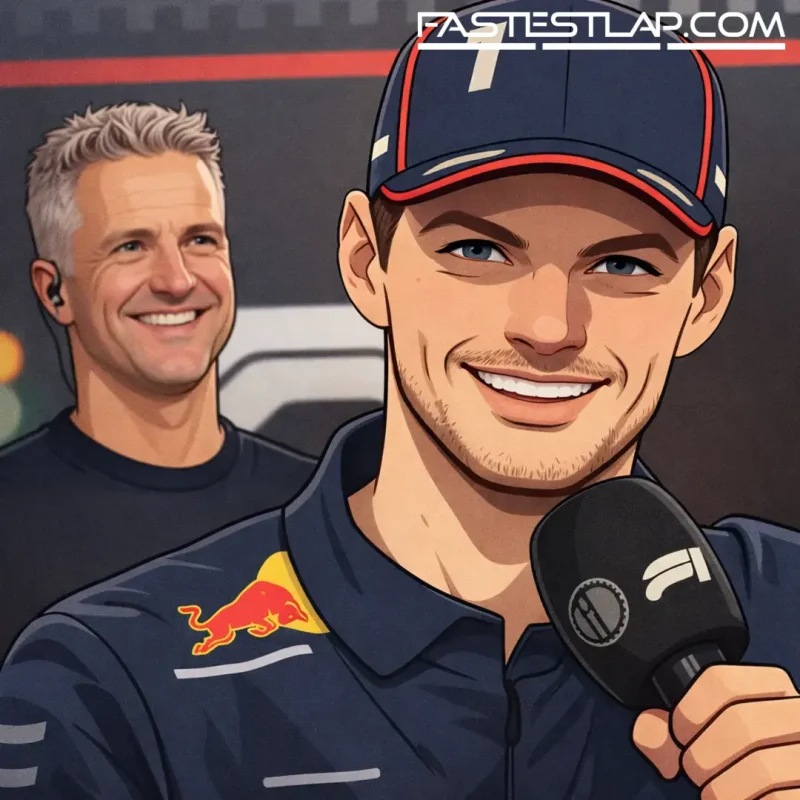
The Verstappen-to-Mercedes chatter has become a kind of background noise in Formula 1 — the sort of rumour that never quite dies because it’s just plausible enough to keep everyone talking. And yet, on the eve of 2026’s full-scale reset, Ralf Schumacher isn’t buying the idea that Max Verstappen ends up in silver, even if he and Toto Wolff get on well away from the microphones.
Schumacher’s read is less about contracts and more about chemistry. In his view, a friendship doesn’t automatically translate into a functioning working relationship — not when Verstappen has spent years embedded in a Red Bull structure that’s been built around him, and not when Wolff runs a tighter, more traditionally corporate ship.
“I still can’t see Verstappen and Wolff truly clicking,” Schumacher said on the Backstage Pit Lane podcast. “For some reason, it just doesn’t quite fit.”
It’s a pointed comment because, on paper, the logic for revisiting Verstappen’s future is obvious. Yes, he’s contracted to Red Bull through the end of 2028. Yes, he tried to stamp out the speculation last year when it reached fever pitch.
“I think it’s time to basically stop all the rumours,” Verstappen said ahead of the summer break. “For me, it’s always been quite clear that I was staying anyway.”
But 2026 isn’t just another season. It’s the season. New chassis rules. New power unit philosophy. The sport’s direction of travel changing in one hit — smaller and lighter cars than 2025, active aerodynamics via movable front and rear wings, and power units running fully sustainable fuel with a 50-50 split between electrical and combustion power. Everyone is starting again, but not everyone is starting from the same place.
For Red Bull, the stakes are particularly sharp because this is the first year the team will race its own in-house power unit project in conjunction with Ford. That’s not a footnote; it’s the entire story. Laurent Mekies has already stressed the team isn’t “naive” about the size of the challenge, especially when the opposition includes manufacturers with decades of engine experience and established infrastructure.
That’s why Verstappen’s name keeps getting dragged into hypothetical seat swaps. The idea isn’t that he’s itching to leave; it’s that a dramatic swing in competitiveness would force a decision point. Schumacher effectively concedes that much, saying it only becomes a real topic “if, for whatever reason, the car stopped working.” And in 2026, “the car” is inevitably shorthand for the whole package — and particularly the engine side of it.
The part Schumacher is less convinced by is the landing spot. Mercedes is the easy headline because Wolff has long been an admirer and because Mercedes has, historically, been the place drivers go when they want the most complete operation. But Schumacher suggests the fit isn’t that simple, especially when Verstappen’s Red Bull setup comes with freedoms that matter to him — including the latitude to race GT3 machinery and even take on the Nürburgring 24 Hours.
That detail matters because it gets to what Red Bull has offered Verstappen beyond lap time: autonomy, trust, and a sense that the team bends around the driver rather than the other way round. Schumacher describes it as a “home environment”, adding that by the end of last year Verstappen “felt extremely comfortable” and that “you genuinely get the sense that it has become a single unit.”
In other words: even if another team can offer a fast car, can they offer that?
Schumacher throws a couple of alternatives onto the table — McLaren and Aston Martin as teams that would “do everything” for Verstappen if they had the chance and a seat free. That’s not him reporting movement so much as acknowledging a reality: there are only a few organisations in the modern grid with the resource and ambition to reshape themselves around a generational driver at short notice.
But he keeps circling back to the same conclusion. Red Bull, in its current form, is uniquely tailored to Verstappen, and he doubts Verstappen would trade that for a change of scenery unless he had to. “The team is basically his,” Schumacher said. “You just have to say it as it is.”
That line will raise eyebrows, but it’s also hard to argue with the broader sentiment. Red Bull has given Verstappen the platform to become a four-time world champion, and it has shown repeatedly that it will prioritise his needs — competitive and personal — without the internal friction that tends to surface when a team has multiple gravitational centres.
So if you’re looking for a more realistic read of where this all goes, it probably isn’t about secret meetings or coded quotes. It’s about the first few months of 2026 and what the new Red Bull-Ford package looks like when the lights go out. If it’s right, the noise fades again. If it isn’t, then the paddock’s favourite “what if” stops being entertainment and starts becoming agenda.