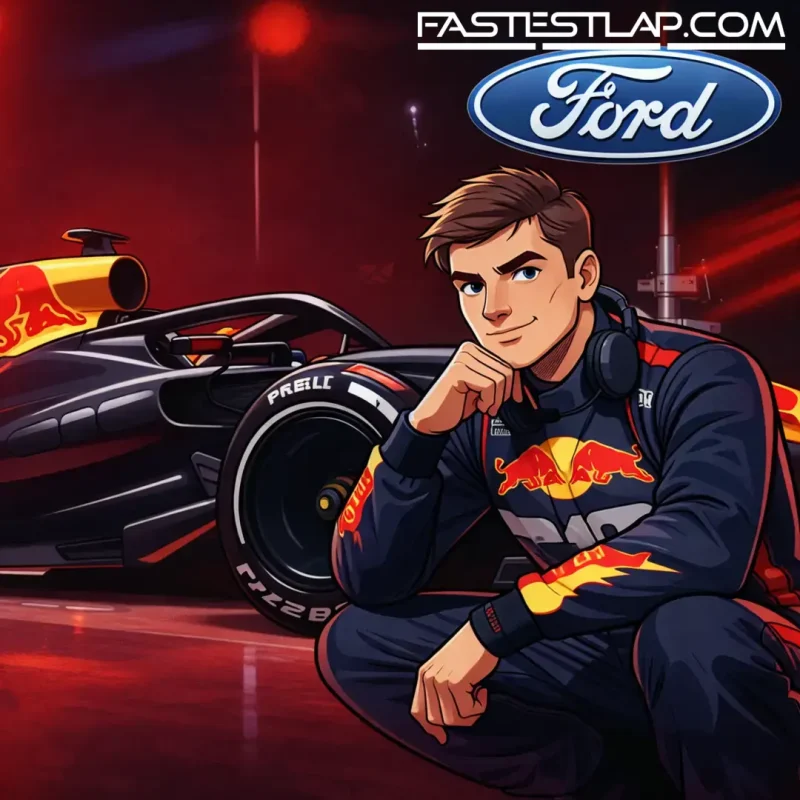
Red Bull has finally pulled the covers off the RB22, and while the livery reveal in Detroit was staged to give Ford its moment, the more interesting story sits under the bodywork. For the first time, the Milton Keynes operation is turning up to a new regulations cycle with a power unit built in-house — and everyone involved is going out of their way to manage expectations about what “year one” is going to look like.
The RB22 will run the first RBPT-Ford package, the product of a Red Bull Powertrains programme launched in 2022 and now arriving on the grid in 2026 as the sport enters its next era. It’s also a major cultural shift for a team that, even through its championship years, has always had an external engine partner to lean on. This time the integration, the accountability and the blame game — if it comes to that — all live at the same address.
Laurent Mekies, now overseeing both the race team and the powertrains arm after Christian Horner’s departure, has been careful not to sell a fairy tale about instant supremacy. The message is essentially: judge the trajectory, not just the first lap.
“You will have to bear with us a little bit,” Mekies said as he described the scale of building an engine manufacturer from scratch. The subtext was obvious. Red Bull has done plenty of hard things quickly over the years, but producing a front-line F1 power unit on a new rule set isn’t a “just add resources” job.
He pointed to the nuts-and-bolts reality of the project: a factory built on what was “a field”, dynos installed, a large workforce assembled in short order, and a partner in Ford that’s providing more than a badge on the cam cover. It’s a reminder that while Red Bull has long been the paddock’s sharpest operator when it comes to execution and development pace, power unit programmes don’t bend to marketing deadlines.
What Ford brings — and Red Bull is openly leaning into this — is manufacturing muscle that can compress timelines in a sport where the calendar is unforgiving and iteration speed often decides who wins the early regulation arms race. Mekies framed it as a “time-to-race business”, noting that Ford’s advanced manufacturing capabilities are already being used on some of the “most critical parts” of the engine, with the promise of turning complex components around faster than traditional routes would allow, without compromising the quality threshold RBPT is chasing.
That point matters because new-engine teething problems rarely come from one catastrophic blind spot; they come from a thousand small ones. The ability to prototype, validate and rework at speed is the difference between a minor headache and a season-defining weakness.
Ben Hodgkinson, RBPT’s technical director, put it even more plainly: Ford has helped fill gaps, both in expertise and in processes, during the frantic build-up phase. When he started at RBPT in 2022, Ford wasn’t part of the picture. By the time the American manufacturer signed on in early 2023, the facility was taking shape and the first engine had already run — which Hodgkinson took as a vote of confidence in what RBPT had managed to build in barely a year.
The partnership, he explained, has included getting Ford staff on site and tapping into techniques such as direct metal laser sintering — effectively a way to bypass some traditional casting limitations and accelerate part production. For a new entrant trying to establish its own supply rhythm, that sort of capability can be invaluable, especially when the final details of packaging and reliability are still being chased.
There’s a key date looming too: the new unit is set to be homologated with the FIA on March 1. Anyone who’s lived through past engine freeze politics will know what that means. You want as few unknowns as possible before the paperwork locks in your baseline. Speed of manufacture is one thing; speed of learning is the bigger prize.
Ford, of course, isn’t doing this purely for the romance of F1. CEO Jim Farley has been explicit that the “tech transfer” is central, particularly in areas that map onto where road cars are heading: software control, hybrid systems, high-discharge batteries, predictive failure analysis and the digital tooling that has increasingly become the sport’s true competitive battleground.
Farley’s pitch also leaned into brand credibility — not in the lazy “win on Sunday” cliché, but in a very Ford-specific way, tying racing to the company’s off-road image and customer base. For Red Bull, that kind of strategic alignment is convenient: it keeps Ford invested when the inevitable early bumps arrive.
Because bumps will arrive. Mekies didn’t hide from that, either. He acknowledged that matching outfits with decades of accumulated knowledge — he referenced the depth of organisations like Mercedes’ HPP and Ferrari — is not a realistic day-one expectation for a company still in its infancy. Hodgkinson may carry Mercedes pedigree, but even the most accomplished individuals can’t shortcut the institutional memory that defines the established engine giants.
“It would be foolish and naive to think that, from the first day, you are going to be at the same level as people who have been doing it for 90 years,” Mekies said.
That’s not a plea for sympathy — it’s a pre-emptive calibration of the narrative. Red Bull has rarely asked the paddock for patience in any area, and when it does, it’s usually because the realities are harsher than the fan-facing story. The interesting question isn’t whether RBPT-Ford will arrive perfect; it’s how quickly it can close the loop between track behaviour, dyno correlation and manufacturing response once the season starts.
The bolder part of Mekies’ message was what came next: that Red Bull and Ford believe they’ll “eventually come out on top”. That’s a long-term promise in a sport that rarely grants anyone the luxury of slow starts — especially not a team that’s used to racing at the front. The RB22 and its RBPT-Ford engine won’t just be measured against rivals. It’ll be measured against Red Bull’s own standards, and the expectation — spoken or otherwise — that this team is supposed to land on its feet.
If the first few months are “full of learning”, as Mekies put it, the rest of the grid will try to make sure that learning is as painful as possible. That’s Formula 1. Red Bull knows it. Now it has to prove it can out-learn everyone else with an engine programme that’s finally its own.