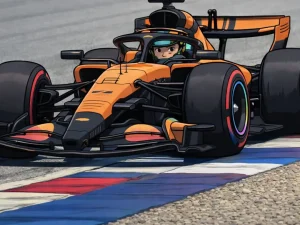
Max Verstappen isn’t in the business of handing out public endorsements lightly, which is why his backing of Isack Hadjar lands with a bit more weight than the usual pre-season platitudes. As Red Bull steps into 2026 with an all-new ruleset, a brand-new in-house power unit programme developed alongside Ford, and a fresh face in the second seat, Verstappen’s message has been straightforward: Hadjar has earned this shot — and the grid might not look the way we think it will.
Hadjar’s promotion follows what’s been described inside the Red Bull ecosystem as a “glowing” rookie campaign at Racing Bulls, enough to convince the team to reshuffle again and move on from Yuki Tsunoda. That decision alone tells you Red Bull believes there’s a narrow window in 2026 where the usual assumptions don’t necessarily apply. New chassis. New engines. New operating parameters. And a team learning the realities of its own power unit for the first time in F1.
That’s the context in which Verstappen was asked by Swiss outlet *Blick* whether the clean-sheet nature of 2026 could actually help Hadjar — not just by lowering the usual learning curve, but by reducing the familiar Verstappen advantage of having years of Red Bull-specific reference points. Verstappen didn’t dismiss it.
“Why not?” he said. “After a great first season with Racing Bulls, he deserves a chance with Red Bull. And with the new rules, there are sure to be surprises, so we may see some new names at the front.”
The interesting part isn’t the nicety about Hadjar “deserving” it — drivers say that sort of thing all the time. It’s Verstappen acknowledging the potential for “surprises” and “new names” in the mix. Coming from the sport’s most reliable barometer of performance, that reads like a quiet admission that nobody can fully game out where this reset is heading, especially with so many variables changing at once.
For Hadjar, the timing matters. The second Red Bull seat has become a notoriously harsh environment in recent seasons, with Verstappen setting a benchmark that’s been described in the paddock as less a target and more a trap. When the team has a clear front-runner and the car behaves in a particular way, the expectation is immediate: adapt now, deliver now, stop the bleeding. That can make a young driver’s first months feel like an extended audition rather than a proper bedding-in period.
But 2026 alters the psychology of that garage. Development direction will be fluid early on. Driver feedback becomes proportionally more valuable. Even Verstappen — with all his experience — is still starting from zero in terms of the new-era car’s behaviour and the new power unit’s characteristics. In theory, that’s the opening Hadjar needs: not to “match Verstappen” in a straight line from day one, but to carve out credibility through rapid learning, calm execution, and being useful to a team that’s trying to understand its own machinery.
There’s also the Ford-backed power unit story sitting underneath all of this. Red Bull’s first season running its own engine project isn’t just a technical pivot; it changes the internal pressure dynamics. When you’re no longer a customer of an established supplier, there’s less comfort in assuming reliability, drivability and upgrade cadence will simply be “handled”. Every weekend becomes part performance exercise, part systems validation, part long-term project management. A driver who can absorb complexity and keep the operating window tidy is suddenly worth more than just raw lap time.
And Red Bull clearly believes Hadjar can cope with that.
Before he departed, Helmut Marko — speaking on the *Beyond the Grid* podcast — didn’t just give Hadjar a polite recommendation. He framed him as something much bigger: a potential title winner. Marko’s reasoning was familiar to anyone who’s heard him talk about “special” drivers over the years: speed arrives quickly, even when the environment is unfamiliar.
“Yes,” Marko said when asked if Hadjar has what it takes to win championships with Red Bull. “Simple example, most of the circuits are new for him, and after three laps, he’s competitive… I followed Michael Schumacher very closely, and also Ayrton Senna. They all had it. They didn’t need 50 laps, or how many tests. They come, poof, and they are there.”
It’s classic Marko — dramatic, binary, and designed to elevate a prospect into the Red Bull mythos before he’s even turned a wheel in the senior team’s new car. But it also speaks to the attribute that matters most in 2026: speed of understanding. When regulations change this much, “fast learner” stops being a compliment and becomes a competitive tool.
Hadjar has already offered a small hint of that, topping the unofficial times from Day 1 of five at the Barcelona 2026 shakedown test. Nobody sensible will build a season forecast from a single early testing sheet — especially one described as “unofficial” — but it does underline the one thing Red Bull will be watching: can he get on top of the fundamentals quickly, without the spiral of overdriving and overthinking that has swallowed others in that second seat?
That’s the line Hadjar has to walk. Red Bull doesn’t need him to be Verstappen. It needs him to be effective: close enough to be strategically relevant, consistent enough not to sabotage Sundays, and sharp enough to contribute while the team’s new technical package matures.
Verstappen’s approval doesn’t guarantee anything — it never does at Red Bull — but it’s a useful early signal. In a season he’s already predicting could throw up “surprises”, Verstappen seems to think the newest driver to take on the Verstappen challenge has at least earned the right to try. In 2026, that might be the most realistic starting point anyone gets.