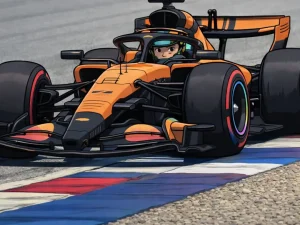
Barcelona’s second morning of behind-closed-doors running was supposed to be the calm before Tuesday afternoon’s forecast rain. Instead, the weather arrived early and turned the Circuit de Barcelona-Catalunya into something far more useful than a lap-time theatre: a rare, private stress test for brand-new 2026 machinery.
With most teams keeping their cards close and information leaking only in scraps, the session still managed to throw up a couple of telling snapshots. For a spell, it was just Max Verstappen and Charles Leclerc circulating as the track swung from dry to damp to properly wet — the kind of conditions that immediately expose whether a car is fundamentally predictable, and whether early software, energy deployment and traction behaviour are in the right postcode.
Verstappen’s morning began with a brief interruption. Not long after the pit lane opened at 09:00 local time, he was reported to have triggered a short red flag. Early whispers of smoke around the Red Bull didn’t last; the more mundane version that filtered through was that he’d simply dipped into the gravel. In January running, with unfamiliar cars and new systems being exercised, that sort of moment is less “drama” and more a reminder of how fine the line is when teams are still mapping out basic responses and procedures.
If there was any theatre, it came from how quickly the weather tightened the field. Rain had been expected later in the day, enough that Mercedes and Haas had already opted out of Tuesday’s running, with teams limited to three of the five days. Haas, at least, had flagged that wet conditions could hang around for much of the week. It just showed up sooner than anyone wanted — or, depending on your point of view, sooner than anyone dared hope.
Once the rain started to fall midway through the morning, the private test suddenly offered something teams can’t plan for. Leclerc and Verstappen both went back out to sample the wet tyres on these new-generation cars, and the lap times — unofficial, of course — told their own story about the track’s swings. Leclerc was said to have logged a best of 1:46 on full wets, then as conditions improved, a 1:37.501, with unconfirmed talk of a 1:32 as the surface continued to come back towards something usable.
Earlier, in the brief window before the rain truly set in, the numbers being passed around had Leclerc at a 1:20.8 with the track green, and Verstappen rejoining him out there as the two effectively had Barcelona to themselves. You treat any timing from this sort of test with caution — no one outside the garages has the full picture of fuel, run plans, engine modes or tyre intent — but the more interesting angle is simply that both drivers kept running when the track turned awkward. That’s where the teams learn the most, and where driver feedback is at its sharpest.
Leclerc’s morning workload was also the heavier of the two, with unofficial sources putting him at 45 laps, while Verstappen completed 24. That split could mean any number of things at this stage: different test items, different priorities, or simply the different ways teams like to structure early mileage when the weather is doing half the work of varying the conditions for you.
The other paddock note that cut through the fog was a nod towards early reliability. Mercedes’ George Russell had singled out Ferrari and Red Bull for praise on that front, and even in a session featuring a gravel-triggered red flag and a rapidly changing circuit, the fact both cars kept circulating once the rain arrived is a small but meaningful data point. In early 2026 running, “it works and it keeps working” is still the first victory of any new cycle.
There was also the odd flavour of secrecy hanging over the day. With this test run privately and the usual access heavily restricted, reports even suggested helicopters monitoring the circuit — a fitting image for a week where everyone wants information, and almost nobody wants to be the one providing it.
Barcelona will inevitably produce more whispers than certainties as the week goes on. But Day 2’s morning already underlined what matters most right now: not who’s quickest on a clean lap, but who looks composed when the script gets rewritten by something as simple as rain arriving a few hours early.