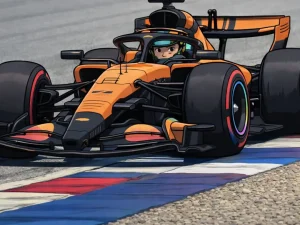
Barcelona’s January shakedown has barely offered more than a few cropped photos and the odd grainy clip, but it’s already served up the first proper “hang on, what’s that?” detail of the 2026 cars. Look closely at the wing mirrors and you’ll spot it: flashing yellow lights, perched at the back of each mirror housing, strobing away like a miniature marshal post.
It’s an easy thing to miss amid the bigger headline changes — the smaller, lighter chassis, the active aero, and the new-era power units running a 50-50 split between electric and biofuel. But in the real world of racing, where visibility can go from fine to frightening in half a lap, the mirror lights might become one of those low-key tweaks everyone ends up appreciating once the season gets properly messy.
The FIA has mandated the additional lights under Article 14.3.3 of the 2026 Technical Regulations, with one required on each side of the car. The purpose, according to FIA single-seater director Nikolas Tombazis, is straightforward: make a car more detectable when it’s broadside to traffic in poor conditions.
His example will resonate with anyone who’s watched modern wet-weather F1: spray reduces reaction time to almost nothing, and the most dangerous moment isn’t always the initial mistake — it’s the second car arriving with no warning. If a driver spins and ends up perpendicular to the racing line, the traditional rear rain light isn’t doing much for the people approaching; it’s pointing the wrong way. The side lights are designed to fill that blind spot, giving oncoming drivers a clearer cue that there’s a car sitting sideways in front of them.
Tombazis framed it as part of a wider safety package baked into the 2026 reset. Alongside the mirror lights, he pointed to a significantly strengthened roll hoop, tougher side-impact requirements, and a front nose that must better withstand lateral impacts without detaching — a detail that, if nothing else, reflects the FIA’s ongoing obsession with preventing secondary hazards once a crash has already started.
All of this is arriving in the middle of what Tombazis described as the most extensive regulations change the sport has ever attempted in one hit: power unit rules and chassis rules rewritten at the same time. The FIA’s pitch is clear enough — nimbler cars, closer racing, a step forward on sustainability, and another notch up in safety standards.
For now, the mirror strobes are just a curiosity glimpsed in spy shots from a five-day shakedown at the Circuit de Barcelona-Catalunya, running from 26 to 30 January. Teams are allowed three of those five days on track, and the running is closed to media and the public, which only guarantees the internet will treat any leaked footage like the Zapruder film.
But there’s a telling subtext here. When a regulation cycle is this ambitious, the big-ticket items inevitably dominate the conversation and the political bandwidth — active aero philosophy, weight targets, energy deployment, the whole “will it race?” debate. Small safety additions like this tend to be what actually make life easier for drivers in the moments that matter, without touching performance or spawning yet another grey-area arms race.
In other words: nobody’s going to win a championship because their mirror lights are brighter. But someone might avoid a truly nasty accident because they saw a flash of yellow through the spray half a second earlier than they otherwise would have. And in a sport that still lives with the knowledge that the next freak scenario is always out there somewhere, that’s about as compelling a reason as any to bolt a couple of LEDs to the mirrors and call it progress.