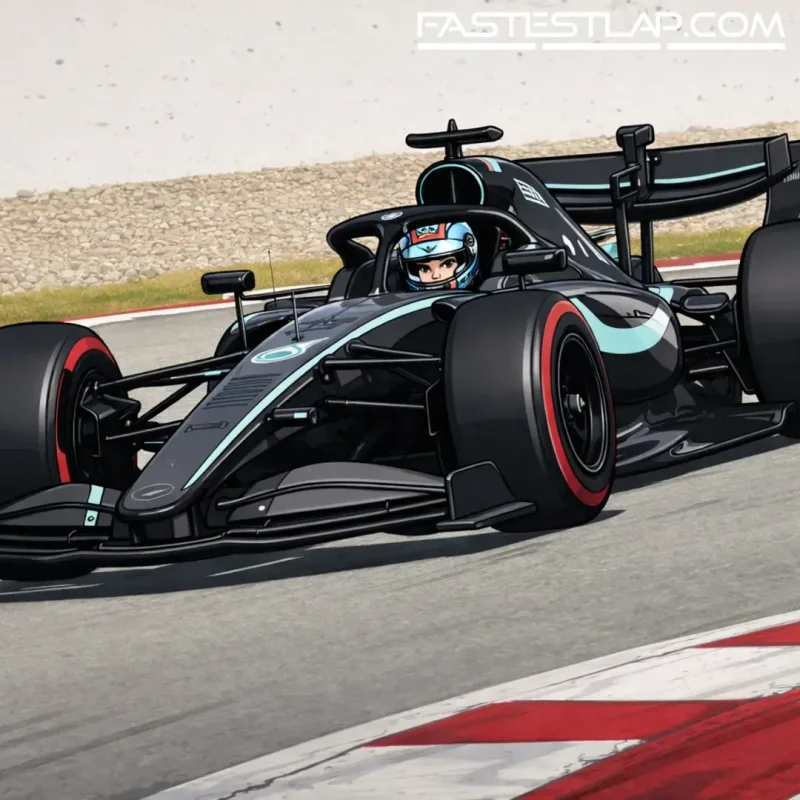
Barcelona was meant to be the first proper glimpse of Formula 1’s 2026 revolution: new chassis, a wholesale rethink of the power unit philosophy, and the sport’s biggest manufacturers rolling out hardware they’ve spent years modelling, simulating and arguing over. Instead, the opening collective test has played out like an exclusive trackday that just happens to feature the most advanced racing cars on the planet — and the paddock’s decision to keep it that way says as much about modern F1 as it does about the rules.
This five-day running at the Circuit de Catalunya was baked into the 2026 regulations as an extra allowance, a recognition that teams are bedding in a very different power unit package, with electrification pushed to a 50/50 split with the internal combustion engine. It’s also arrived after a shortened off-season that has put everyone on the back foot, compressing build schedules and raising the stakes of simply getting the car to fire up, leave the garage and stay running.
So the teams pushed for a private collective test, got it, and then moved quickly to control the flow of information. Originally the plan was even tighter — no photos, no video — until reality intervened. Locking down a whole circuit perimeter and the airspace above it is one of those ideas that sounds feasible in a meeting room and collapses the moment someone points out the nearest public road. The compromise landed at a small daily quota: each team can release up to six images of the car, plus a handful more of garage life, and a short social clip.
That’s why the first two days have felt oddly muted for a sport that normally monetises every heartbeat. Live timing briefly slipped into view, then vanished. Anyone hanging around hoping to “accidentally” learn something has been briskly encouraged to leave by security. The FIA and FOM are present, but this isn’t their show: the circuit is hired by the participants, and the session sits outside the usual competitive weekend framework. In pure governance terms, the teams are well within their rights to run in near silence.
The question is whether they should.
There’s an obvious scar tissue here. The last time F1 turned the engine page in a big way — 2014 — the first test became a public theatre of breakdowns, red flags and awkward optics. When you’re introducing complex hybrid systems, the odds of something embarrassing happening in front of cameras increase sharply, and manufacturers don’t enjoy explaining why their shiny new product just stopped on a straight. In 2026, with the sport vastly more visible than it was back then and with major OEM brands baked into the narrative, it’s easy to see why the instinct is to keep the messy early work private.
But here’s the twist: it hasn’t been that messy.
Despite the secrecy, enough has leaked — and enough is simply visible from the mileage totals people are whispering about — to make it clear the apocalypse scenario hasn’t arrived. Ferrari’s new power unit logged 198 laps on day one between Haas and Cadillac, while the fresh RBPT package in the Red Bull and Racing Bulls cars managed 195 laps. For a first hit-out in a new era, that’s not “limp out of the garage and die”; that’s three race distances’ worth of running while engineers learn their systems, validate correlations and start to push through the first real reliability cycles.
Day two sounded even healthier on that front. Ferrari reportedly covered more than 500 kilometres split between Charles Leclerc and Lewis Hamilton. Red Bull put another race distance on the board, and likely would’ve gone further but for a couple of incidents: Max Verstappen finding the gravel in the morning and Isack Hadjar hitting the barrier later on. Yes, there have been stoppages and red flags — there always are at this stage — but the larger story is that these power units are racking up serious mileage remarkably early.
And that is exactly why the hush-hush approach feels like a slightly missed opportunity.
F1 sells itself on engineering. The 2026 cycle is not just a fresh aero rulebook; it’s a philosophical shift in how performance is produced and managed. Teams and manufacturers have, by the sound of it, delivered cars that work, run, and complete substantial programmes without turning the week into a comedy of delays. In another era, the sport would have been eager to show that off, because it speaks directly to competence — not just speed.
Instead, the achievements are trapped in the fog of “trust us, it’s going fine”, drip-fed through controlled imagery and the occasional unofficial detail that escapes anyway. That’s not merely about fan service. It’s about confidence. If the sport wants the 2026 rules to land as a bold step forward, the first on-track evidence should feel like a statement, not something you have to piece together from lap counts and half-glimpsed photos.
There’s also a practical irony to all this. The curtain doesn’t prevent people in the paddock from tracking what matters — who’s running, who isn’t, and roughly how much. It mostly prevents everyone else from seeing a new generation of cars in anger at a circuit that’s perfect for it. By the time the second Bahrain test arrives — the first with full media access and live timing — Barcelona will already be old news. The narrative will reset to lap times, short runs, sandbag accusations and the usual febrile pre-season guesswork.
Maybe that’s the point. Maybe the teams have decided they’d rather save the spectacle for when the timing screens are on and the garages are open, and in the meantime they want calm, controlled days to solve early headaches without a headline hanging over every glitch. That’s defensible — especially with a compressed winter and a fundamentally different power unit balance to bed in.
Still, there’s something faintly unsatisfying about watching Formula 1 step into a new era and immediately draw the blinds. If the first two days are any guide, the sport might have been able to take a rare victory lap before the racing even begins — and remind everyone that when it’s asked to reinvent itself, it can actually deliver.