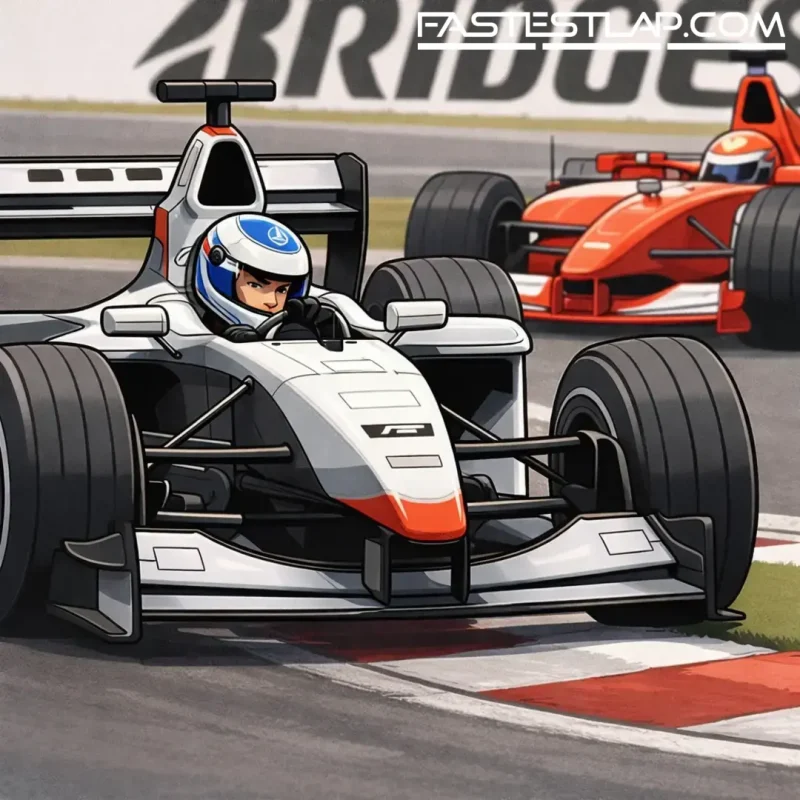
Mika Häkkinen has never been shy about backing himself, and he isn’t about to start now.
On the High Performance podcast, the double world champion looked back on his rivalry with Michael Schumacher in a way that felt refreshingly unvarnished: enormous respect for the driver across the garage, total clarity about what he thought his own strengths were — and a refusal to get dragged into the theatre that so often surrounded Schumacher’s fiercest title fights.
Asked about studying Schumacher, Häkkinen described doing what all elite drivers do when they’re trying to find the last fraction: following closely, reading the lines, watching steering input, trying to understand the “why” rather than simply the “what”. The conclusion, delivered with a grin and a laugh, was pure Häkkinen.
“It was nothing too special,” he said. “I think I was a little better.”
Pressed on whether he really meant that, he didn’t blink. “Oh absolutely, of course!”
It’s the kind of quote that can be made to sound like pure provocation if you want it to, but in context it lands differently. Häkkinen wasn’t dismissing Schumacher’s greatness — he called him an “incredible racing driver” — he was describing a very specific kind of greatness. Not magic tricks. Not mystical feel. Brutal efficiency, physicality, and an ability to make a car do what he wanted through force as much as finesse.
Häkkinen’s view of Schumacher is centred on how he loaded the car, how he used tyres and suspension, how physically strong he was in extracting performance. Add that to Schumacher’s thinking and balance sense, Häkkinen said, and you get “amazing” control. The admiration is obvious, even if it comes wrapped in a racer’s instinct to believe — genuinely — that in the head-to-head he had the edge.
What’s more interesting, though, is where Häkkinen draws the line between himself and the other drivers who ended up in Schumacher’s gravitational pull. In his telling, their dynamic worked because it stayed almost stubbornly narrow: race hard, keep the noise out.
“Let’s fight on the track,” Häkkinen said, “Let’s leave the bullsh*t out of this.”
That matters, because Schumacher’s reputation — fairly or not, depending on which incident you’re discussing — has always included the psychological angle. The sense of a driver who would find leverage anywhere: in the room, in the media pen, in the margins of what was acceptable when the visor came down. Häkkinen’s response to that idea was essentially a shrug. If Schumacher tried “mind games”, he said, it didn’t work. He was too anchored by his own confidence in McLaren, his management, and himself.
And then there’s the moment Häkkinen returned to as the origin story for how he understood Schumacher’s racing philosophy: Macau, Formula 3, 1990.
It’s a crash with a long tail in junior single-seaters lore, but Häkkinen’s recap was crisp and vivid. Two heats, combined times. Häkkinen wins the first heat with Schumacher second; Schumacher wins the second heat and leads, with Häkkinen tucked in behind knowing that, on the aggregate, he’s still in position to take the overall victory if he can stay close.
Macau, as he put it, is “unbelievable” — a long street circuit where the walls always feel slightly closer than you remembered. On the last lap, Häkkinen says Schumacher made a “silly mistake” in a high-speed corner that opened the door. The overtake, he insists, was going to be easy. Then came the movement.
Häkkinen described Schumacher looking in the mirror and turning “a little bit” of steering. The contact was with Schumacher’s rear tyre, and Häkkinen was off. The frustration is implicit — he’s describing a win slipping away — but his point wasn’t to relitigate blame. It was to explain the decision he made afterwards: not to waste energy trying to change Schumacher.
“I could go absolutely bananas… but I thought, what is going to change?” Häkkinen said.
From there, Häkkinen widened the lens. Schumacher, he argued, had “quite a few problems” with other drivers — he named Damon Hill, Jacques Villeneuve and David Coulthard — and could be “sometimes not fair”. In Häkkinen’s mind, the endless discussions, the public blame games, the attempt to reform Schumacher through pressure or outrage, were simply pointless.
So Häkkinen chose a different approach: focus on his own job, don’t turn it into a verbal war, and keep the contest contained within the boundaries of the track. He believes that’s where the respect grew, and it’s hard to argue with the outcome: Schumacher later called Häkkinen the best opponent he ever had.
There’s a nuance here that gets lost when rivalries are flattened into highlight reels. Häkkinen isn’t claiming he and Schumacher were soft on each other — he even notes they “played little tricks” — but the key line is the last one: “we didn’t touch.” For two drivers who operated at the sharp end of an era defined by fine margins and sharper elbows, that’s not nothing.
In 2026, with modern F1 so relentlessly documented and psychologically picked apart in real time, Häkkinen’s recollection feels like a window into a more private kind of competitive relationship. Not friendlies, not politics — just two drivers who understood exactly what they were dealing with, and decided that the only place worth settling it was at 300km/h.