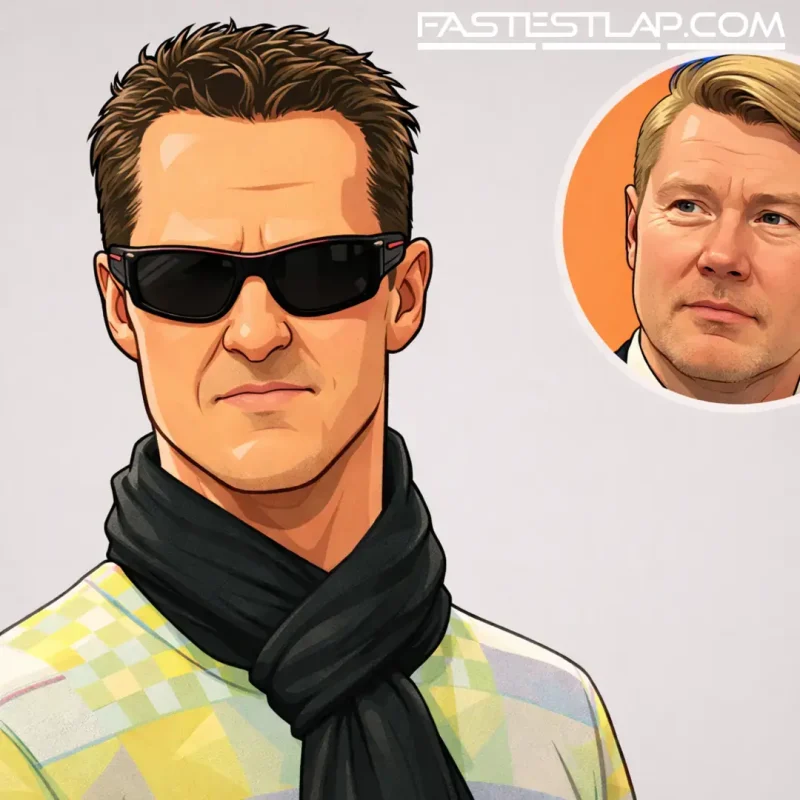
Mika Häkkinen has never been one for melodrama, which is partly why his reaction to Michael Schumacher’s 2013 skiing accident still lands with such weight. On the *High Performance* podcast, the two-time world champion didn’t reach for grand statements about fate or legacy. He went straight to the detail that would terrify any racer who’s lived through it: a head injury, the clock ticking, and the brutal importance of oxygen.
Häkkinen said he was “shocked” when the news broke, not simply because it happened to Schumacher — an era-defining rival who, for a stretch, felt indestructible — but because it instantly dragged him back to Adelaide in 1995.
That weekend remains one of those moments that even hardened paddock veterans still describe in a quieter voice. In qualifying for the Australian Grand Prix, Häkkinen’s McLaren suffered a left-rear puncture. The car snapped, hit the kerb, launched, and arrived in the tyre barrier at around 200kph. The Finn suffered a fractured skull and needed immediate, life-saving intervention trackside, including an emergency tracheotomy performed by intensive care specialist Jerome Cockings. Against the odds, Häkkinen recovered and was back on the grid when the 1996 season began, by then at Albert Park.
So when Schumacher — newly retired for the second time after his 2010–12 Mercedes return — fell while skiing on 29 December 2013 and struck his head on a rock, Häkkinen didn’t see a celebrity headline. He saw the one kind of injury that strips away bravado and reputation in seconds.
“Yeah, I remember that day. I just couldn’t believe it,” Häkkinen said, recalling when he first heard what had happened.
What follows is less a commentary on Schumacher the sporting figure and more a window into the psychology of elite drivers once the helmets come off for good. Häkkinen spoke about the natural assumption that once you’ve done the hard part — the risk, the travel, the pressure, the constant negotiating with danger — the rest of life opens up.
“All that hard work, all that success, like everything is in the right place, and it’s time to now enjoy your life,” Häkkinen said, listing the post-career possibilities: business, storytelling, doing nothing at all, simply being with family. The point wasn’t that Schumacher “deserved” a quieter life as a reward. It was that retirement is supposed to be the moment you finally stop calculating the margins.
Then, in Häkkinen’s telling, the floor drops away.
He admitted his mind went immediately to the mechanics of the trauma. Having suffered a head injury himself, he understood the stakes in a way that bypasses the comforting generalities outsiders tend to reach for.
“I knew that way, sh*t, if you stay with too long time without oxygen, that’s definitely a bad thing,” he said.
He also made a stark, practical observation that would resonate with anyone who’s watched drivers put faith in engineering: ski helmets and F1 helmets aren’t the same universe. “It’s not exactly a level of Formula 1,” Häkkinen said — not as a criticism, but as a reminder that protection is specific to the threat it’s designed for.
The broader emotion in Häkkinen’s account isn’t fear for a champion’s public image. It’s fear for a family that didn’t sign up for the aftermath. Since Schumacher’s accident, updates have been tightly controlled by his relatives. The family has long chosen privacy, and the wider F1 world — which can be intrusive at the best of times — has largely respected that boundary. A mid-2015 update confirmed Schumacher had returned home to continue rehabilitation, with little further information since.
Häkkinen’s sympathy sat squarely there, in the space away from the circuits and trophies.
“It was just sad, of course, thinking about the family of Michael,” he said, reflecting on how quickly a life in racing passes. Häkkinen’s framing will be familiar to anyone who’s heard older drivers talk in the paddock once the noise fades: school feels endless, then it’s over; work consumes you, then it changes; racing is intense, then suddenly it’s in the rear-view mirror. The “real life”, as he put it, is what comes after.
“And Michael, just when his real life starts after motor racing, things like that happening,” Häkkinen said. “So you try to say to yourself, ‘This is not fair, what’s happening.’”
He didn’t linger on Schumacher the seven-time world champion, or the ferocity of their late-90s battles that helped define modern Formula 1. But you don’t have to. Anyone who watched Häkkinen and Schumacher at their peaks knows the respect was real, even when it was unspoken. Sometimes it takes a moment like this to make that obvious.
“I was just shocked. It’s just terrifying, you know, to think about [his] children, it’s absolutely terrifying,” Häkkinen added. “So tough to handle it, for sure.”
There was, at least, a small symbol of connection more recently. In April 2025, Häkkinen and Schumacher were among 20 living F1 world champions to sign a helmet that was auctioned for Sir Jackie Stewart’s Race Against Dementia charity. Stewart later confirmed Schumacher was able to add his initials — “MS” — with the help of his wife, Corinna.
In a sport built on noise, that detail was quiet. But it mattered.