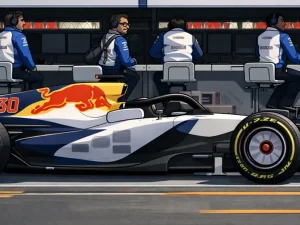
Lando Norris didn’t need a stopwatch to tell him Wednesday mattered. The first time he rolled out of the McLaren garage at Barcelona with a big, bold “1” on the nose, the new era suddenly stopped being an abstract talking point and became something you could hear, see and feel.
“It was just nice to be back, nice to see a number one on my car, pretty cool and pretty surreal still,” Norris said, describing a moment that, for all the winter noise about 2026, still landed with the weight it should. A reigning champion, in a brand-new ruleset, driving a car that — by his own admission — had effectively only just been bolted together.
McLaren joined the behind-closed-doors running at the Circuit de Catalunya on the third day of the five-day shakedown, having sat out the opening two days to buy itself more time with the MCL40. Norris ended his first shift with 77 laps on the board, totalling 358.589km that the team labelled “productive” — which is as close as you’ll get to a public verdict from a test nobody’s meant to see.
Unofficial timing, inevitably, did the rounds anyway. Norris was pegged as third quickest, behind Mercedes duo Kimi Antonelli and George Russell, and reportedly just under a second away. Take that for what it is: a paddock parlour game with no context, no fuel loads and no clear run plans. What’s more revealing is what Norris chose to talk about after stepping out.
His early read on the 2026 cars was blunt in the way drivers tend to be when they’re still translating sensation into language. Less corner speed, more punch in a straight line — and a different kind of workload behind the wheel.
“It’s pretty different,” he said. “I think it’s just a bit of a step slower in terms of cornering speeds. In terms of like acceleration and straight-line speed it probably feels quicker than it did last year. You get to 340, 350, quite a bit quicker than we did in previous years.”
That one line neatly captures the balancing act F1 has engineered for itself in 2026. The cars are shorter and lighter, active aerodynamics is now part of the day job, and the power units are built around an even split between electrical and internal combustion power. The sport spent much of last year batting away claims about 400km/h headline numbers; Norris’s “340, 350” isn’t a manifesto, but it is a clean piece of driver evidence that the straight-line performance is going to feel lively — and that the corners may look a touch less brutal than what we’ve become used to.
What Norris also flagged, without dressing it up, is that the complexity hasn’t disappeared. It’s just moved. With the new power unit and energy management demands, the challenge isn’t only how hard you can lean on the tyres through a fast corner — it’s how cleanly you can put a lap together while juggling new systems, new behaviours and new compromises.
“You have a bit more to understand from the battery, the power unit, all of those things are in some ways more complicated and just different,” he said. “And whenever something’s different, it always takes a bit of time to figure out the best way to look at it, to manage it, to use it.”
That’s the subtext of McLaren’s decision to delay its first appearance until Wednesday. In the old days, you’d have called it a nervous wait. In modern F1, it’s more often a calculated one — extra build time, extra checks, fewer early teething headaches. Norris made it sound like a borderline just-in-time operation anyway: “It’s literally not been built until this morning,” he said, underlining just how tight the turnaround can get when teams are trying to hit the track with something fundamentally new.
The day itself, he insisted, wasn’t about hero laps. It was about learning the car’s language.
“Today was really just a first understanding of the whole car… going through the manual of everything,” Norris explained. “A productive day, but it was one about really just figuring everything out, ensure things are working as they should.”
As ever in Barcelona, there’s a caveat: the place is a familiar measuring stick, but the conditions are rarely representative of where the season actually starts. Norris referenced that, too, pointing out that what McLaren learns in Spain won’t map perfectly onto Bahrain or Melbourne. Still, every lap counts when you’re trying to understand how these cars behave across the range — especially with weather potentially shifting the track through the remainder of the shakedown.
If there’s a broader takeaway from Norris’s first run, it’s that 2026 isn’t just going to be a question of who’s built the fastest car. It’s going to be about who’s most fluent in what these cars demand — from energy deployment to active aero to the kind of corner entries you can and can’t get away with when the grip picture has changed.
For now, Norris at least sounded like someone enjoying the first chapter of that puzzle, even if he was careful not to oversell it.
“Different feelings,” he said. “Of course, still feels like a McLaren, but yeah, still feels powerful. So it feels like a Formula One car, which is the most important thing.”
Oscar Piastri will take over driving duties for McLaren on Thursday, as the team continues to rack up the unglamorous mileage that decides far more of the season than any leaked timing sheet ever will.
A special day for the team, seeing our MCL40 rollout for the first time 🥹#McLarenF1|#F1🧡pic.twitter.com/ck4Lg8C4TH
— McLaren (@McLarenF1)January 28, 2026