Kimi Antonelli hasn’t even reached the stage of talking up lap times yet, but he’s already pushing back on one of the pre-season assumptions doing the rounds in the paddock: that Formula 1’s 2026 reset will automatically blow the field apart.
Fresh from early running with Mercedes at Barcelona’s low-key shakedown week, the Italian reckons the grid is unlikely to fracture into the familiar “haves and have-nots” some are predicting. The sport’s last big rules cycle ended with a steady convergence as teams learned, copied, and optimised their way towards the same performance windows. Conventional wisdom says a brand-new set of regulations should reopen those gaps. Antonelli’s instinct, at least from what he’s seeing in the pitlane and on-track, is that it might not play out so dramatically.
“The car feels nice, we still have a lot of running and learning to do, but it was good to see it out on track,” Antonelli said via Mercedes’ official channels. “All the cars look really nice and they are quick. I don’t think the gaps on the grid will be as big as people think, we will have some close fights.”
It’s worth treating any week-one read of the competitive order with the caution it deserves — nobody is here to show their hand, and Barcelona in this context is about system checks, correlation and mileage. But Antonelli’s comment is less about where Mercedes sits and more about a broader sense that the baseline level of these new cars looks high across the board.
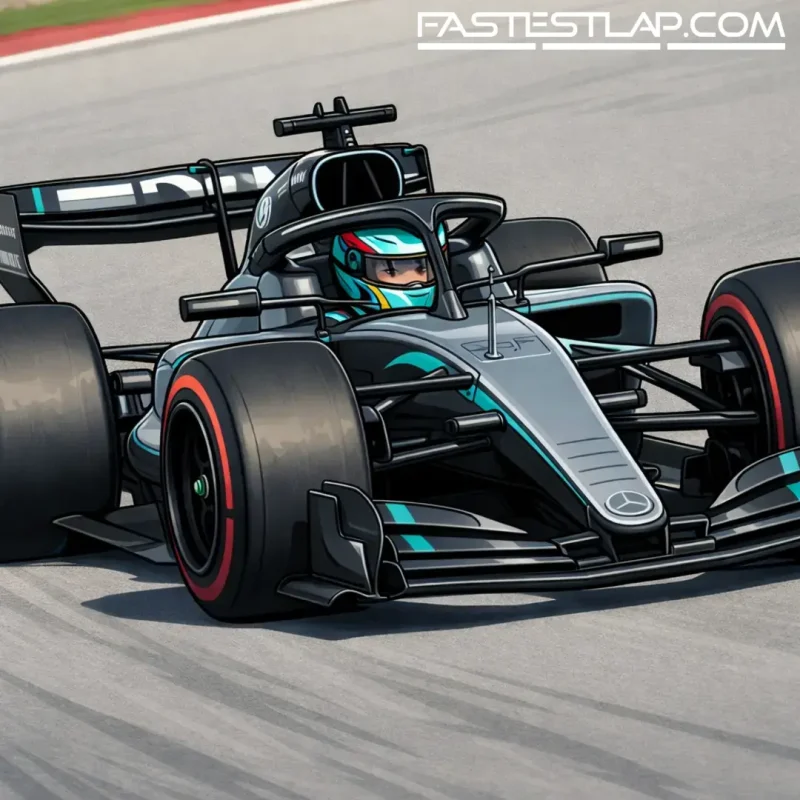
Mercedes’ W17, at least, appears to have ticked the first box you want to tick this early: it runs. The team has logged heavy mileage across the opening days, with unofficial lap counts suggesting it cleared 150 laps on Monday and backed that up with another three-figure day on Wednesday. In a condensed pre-season window, boring reliability is a weapon — not because it wins headlines, but because it buys engineers time to focus on performance rather than firefighting.
And Antonelli’s point about closeness isn’t just a vague “everything looks fast” soundbite. He’s specifically nodding at where the learning curve lives in 2026 machinery: energy deployment and battery management.
“It will take time for everyone to understand, particularly with the battery management, but once we start racing it will all get very exciting,” he added.
That line, more than the “gaps” prediction, is the interesting one. In previous eras, understanding tyre behaviour or aero sensitivity tended to separate teams. This time, Antonelli is flagging the driver-and-systems layer as an early differentiator — the stuff that doesn’t always show up in testing timesheets but absolutely shows up when you’re trying to execute a stint in traffic with the wrong end of the deployment cycle. If the cars are broadly similar in raw potential, the messy reality of harvesting, spending, and timing that energy is where weekends can be won or binned.
For Antonelli personally, 2026 also arrives with the small but significant advantage of familiarity. This is his second season in F1, and he’s talking like someone who’s already learned how punishing the calendar can be when you’re trying to improve while simply staying upright physically and mentally.
He said he spent the off-season reflecting on 2025 and working with a psychologist to dissect what worked and what didn’t — a refreshingly frank window into how teams and drivers now treat performance as something built as much away from the circuit as on it.
“I used the break to reflect on the season just gone,” Antonelli explained. “I did a few sessions with my psychologist, we looked back and understood what went well and what went wrong in 2025, and that helped to set some goals for this year. The Kimi of 2026 is more prepared.”
There’s a pragmatic edge to his approach too. Rather than the usual pre-season noise about “pushing harder than ever”, Antonelli is focused on managing energy, reducing unnecessary travel, and targeting specific physical gains — cardio in particular — as he anticipates the grind of hotter races.
“Looking at the calendar, we will try and maximise the days at home to recharge and avoid extra travelling,” he said. “We want to make sure I am always at 100% energy to maximise my performance in the car. A lot of that will come from the cardio side, we are happy with the strength, but now we want to start working on the cardio, it will really help in those hotter races.”
That’s the sort of detail you tend to hear from drivers once they’ve been through a season and realised F1 isn’t a series of 24 isolated sprints; it’s a long, continuous campaign where marginal fatigue becomes real performance loss. If 2026 does produce a tighter grid, the margins will be even less forgiving — and “being there every weekend” becomes a competitive advantage in itself.
Barcelona won’t give us a pecking order, and Antonelli isn’t pretending it will. But his early read is a useful counterweight to the easy narrative that a regulation overhaul automatically creates a multi-second spread. The cars are new, the tools are different, and the details — especially the energy side — may end up deciding more than the big concepts.
If Antonelli’s right, 2026 won’t be about waiting for the field to reconverge. It’ll be about who can hit the ground running while everyone else is still working out where the lap time actually lives.