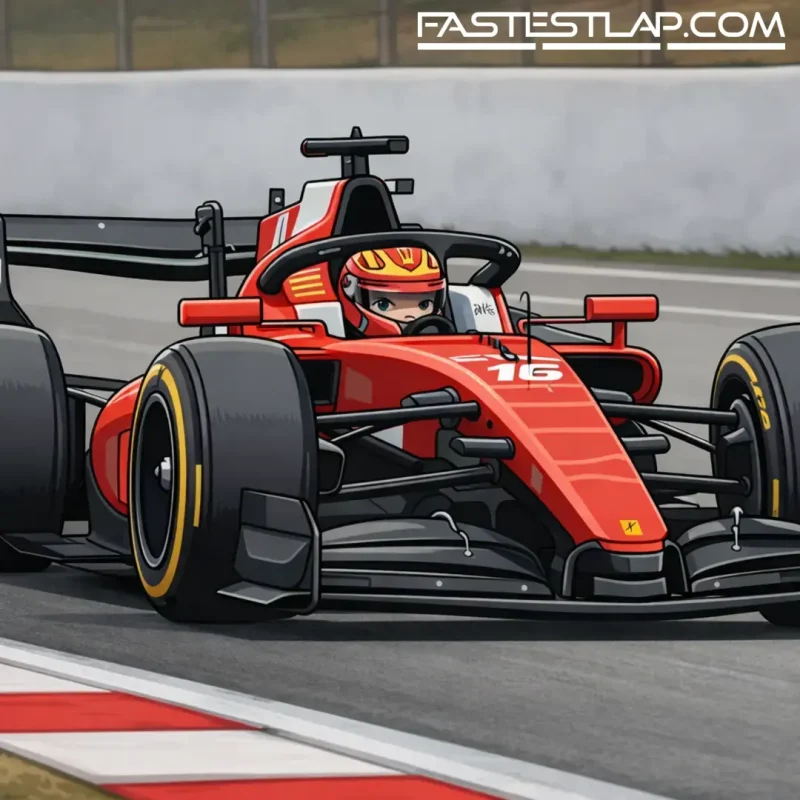
Ferrari has come out of Barcelona with exactly what it asked for: laps, data, and a clearer picture of just how many new variables the 2026 rule set has dumped onto everyone’s desks. But even as the SF-26 ticks through its mileage targets, Fred Vasseur isn’t pretending the stopwatch can be ignored for much longer — especially with Mercedes already flashing something that looks uncomfortably close to a benchmark.
The five-day Circuit de Catalunya shakedown format has created its usual rhythm. Early running is about systems checks and correlation, while the final day tends to be when teams let the leash out a little and see what’s there. Mercedes did precisely that on its third and final day, with George Russell dipping into the 1m16s courtesy of a 1:16.445, and rookie team-mate Kimi Antonelli also sharpening up late in the week.
Ferrari, running on Days Two, Four and Five, has played a different hand so far: keep the car circulating, pile on the laps, and treat laptime as a secondary output rather than the main KPI. Charles Leclerc’s best from the first two Ferrari days was a 1:18.223, before he returned on Friday morning, put another 79 laps on the board, and brought the pace up to a 1:16.653. That’s a sizeable step in isolation, but still leaves the red car behind the Mercedes reference — and Vasseur knows the luxury of saying “it’s only testing” doesn’t last forever.
“Yeah, for sure that it’s an important milestone to be able to run, to put mileage and so, but at the end of the day, we’ll have to keep in mind that performance at one stage will become crucial,” Vasseur said. “But the target was to be able to accumulate mileage, and we did that.”
It’s an interesting admission because it cuts against the default pre-season script. Team principals typically keep the messaging glued to reliability and learning right up until the first qualifying session of the year. Vasseur’s version is a touch more candid: mileage is the currency right now, but Ferrari is fully aware that the real scoreboard is already on the wall — and a rival has started writing numbers on it.
Part of that urgency is baked into what 2026 actually demands. These cars aren’t simply evolutions; they’re new platforms with new power units, new energy management priorities, and new operational headaches. Ferrari’s programme in Spain reflects that reality. Leclerc and Lewis Hamilton both logged race-distance days on Thursday — 83 laps for Leclerc, 87 for Hamilton — on top of the wet running from Tuesday (63 and 53 laps respectively). It’s not glamorous work, but it’s the kind that stops you discovering a cooling limitation, a software gremlin, or a deployment oddity when points are on the line.
“This is important for the team, for the reliability, to accumulate mileage, to learn about the car,” Vasseur said. “It’s a huge challenge for everybody and the more mileage you are doing, more you are learning.”
If the lap times have created an external narrative, the more meaningful subplot is what’s happening behind the telemetry screens. Vasseur repeatedly returned to the complexity of energy deployment — and he’s right to flag it. With the new engines running on a 50/50 split between electrical and combustion power, plus the operational layers of boost mode and overtake mode, teams are effectively learning a new language of performance. It’s not just about outright power; it’s about when you can access it, for how long, and what it costs you three corners later.
“You have tons of topics to scan on the car, from mechanical to engine – energy deployment is a big talk for everybody,” Vasseur said. “It means that you have to scan every single parameter, and it’s taking time, and the best way to do it is to stay on track.”
That’s the quiet subtext to Ferrari’s “mileage first” approach. It’s not only about proving the SF-26 can run; it’s about teaching the team how to extract a lap from a package where the lap is now a product of choreography as much as raw grip. In that context, Leclerc’s jump to a mid-1m16 is less of a statement and more of a sign Ferrari can turn the dial when it wants to — albeit not yet to Mercedes’ setting.
Vasseur even allowed himself a rare moment of humour when asked if Ferrari could have done more in Spain. “I think we can’t do more,” he said, laughing. “At one stage, you have to stop to refuel. It would have been difficult to do more.”
Ferrari wraps up its Barcelona running on Friday and then the proper work begins: two three-day tests in Bahrain, the last meaningful preparation before the sport’s new-era cars finally roll out for first practice in Melbourne on 6 March. That’s when the conversation shifts, inevitably, from “learning” to “who’s quick”.
Between now and then, the paddock will keep telling itself that timesheets don’t matter. They don’t — until they do. And Vasseur, to his credit, isn’t pretending otherwise.
Out and about in Barcelona ✅💪pic.twitter.com/dtCADsuEjK
— Scuderia Ferrari HP (@ScuderiaFerrari)January 29, 2026