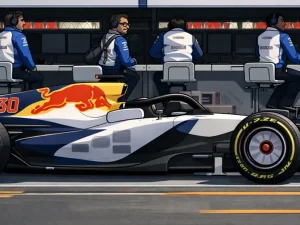
Mercedes have spent too many winters in the last few years talking about “understanding” their car. In Barcelona this week, George Russell sounded like a driver who’s simply relieved to be able to get on with his job again.
The headline from Mercedes’ first proper run with the W17 wasn’t a headline time, or even a particularly provocative long-run hint. It was the boring stuff — and in 2026, boring might be exactly what they’ve been chasing.
Russell said the team’s hefty mileage haul in Spain came with a notable absence: porpoising. For a squad that was among the worst affected when the ground-effect era bit hardest, that matters. Under the new rules, with the balance of downforce generation moved back towards aero surfaces above the car rather than living and dying by how close you can slam the floor to the tarmac, the bouncing that used to dominate driver debriefs has, at least on this evidence, stopped being part of Mercedes’ daily vocabulary.
“I think this was a very positive test, to be honest,” Russell said at the end of the team’s three-day allocation. “We had lots of mileage on the car, which was the main focus of the test.
“The car’s feeling nice to drive. No major issues, no porpoising — which is pretty good news for all of us, it’ll save us a few years on the back. So, all in all, a decent few days.”
That quip about “saving a few years” lands because everyone in the paddock remembers what those cars did to drivers — the physical hammering down the straights, the sparks showering from the plank as teams played chicken with ride height, and the sense that you were one setup step away from turning the cockpit into a chiropractor’s waiting room. Teams learned to manage it, sometimes circuit by circuit, sometimes by accepting compromises elsewhere. But it never truly went away as a talking point until the regulations did something about it.
Mercedes’ numbers in Barcelona were eye-catching in their own right. Between Russell and Kimi Antonelli, the team logged more than 500 laps across its running — and, crucially, it did it without the sort of stop-start gremlins that can derail a new car programme before it’s even begun. The W17 was consistently in circulation, with three-figure lap counts on each of Mercedes’ days, and both drivers featuring towards the top end of the timesheets during the test.
You can feel the temptation, in late-January testing, to turn that into a verdict. Russell wouldn’t.
He stressed that reliability and drivability are only the entry ticket — not the prize — especially when the competitive picture is still hidden behind varying programmes, fuel loads and early-spec parts. Mercedes have, effectively, proved the car works. They haven’t proved what that work is worth.
“The car so far has been working well, but it’s not about how well it works, it’s about how quick it goes around the track — and we don’t really have an indication of that at the moment,” Russell said. “We’re sort of in a reasonably good place, but I’m sure things are going to change a lot between now and the next Bahrain test, and I’m sure people will be bringing upgrades to the car. So still, very, very much early days.”
That’s the right note, because pre-season testing is where optimism goes to get mugged. Barcelona is a shakedown in all but name: correlation checks, system validation, the tedious stuff that keeps you off the back foot when it’s time to start chasing lap time for real. If Mercedes have ticked that box cleanly, it’s a credit to how the team has approached the reset — and it’s also a reminder of how punishing the 2026 development race is going to be once everyone stops counting laps and starts counting tenths.
The next stage is Bahrain, where all 11 teams — including Williams — are set to run from 11-13 February. That’s the test where the paddock starts squinting a bit harder at who’s fast, who’s hiding it, and who’s already reached for the emergency solutions. It’s also where Russell’s “no porpoising” claim will face a different track surface, different wind patterns, and the kind of long straights that used to be prime bounce territory.
For Mercedes, though, the psychological value of this week shouldn’t be underestimated. When a driver says the car is “nice to drive” in January, it doesn’t win you a championship — but it does change the tone of everything that follows. A stable platform, a calm cockpit, and a programme that runs to plan are the foundations of a proper pre-season. Mercedes, at least, have started 2026 like a team that finally has those basics back under control.