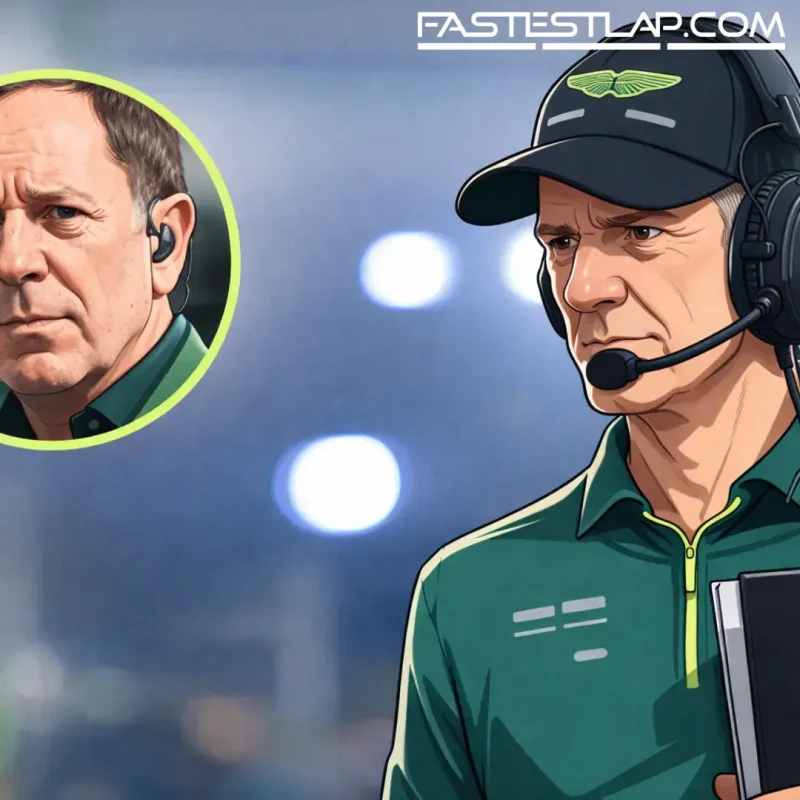
Martin Brundle’s been around this paddock long enough to know when a straight answer contains a warning label. And after a chat with Aston Martin team principal Adrian Newey, the Sky F1 pundit has come away with a pretty pointed takeaway ahead of the 2026 season: Honda, Aston Martin’s new works partner, is “having to play catch up”.
That line matters because it’s not a throwaway bit of grid-walk colour. It lands in the middle of a winter where the new regulations have already started to separate the optimists from the realists, and where the value of a manufacturer power unit isn’t theoretical anymore — it’s the foundation of your whole year.
Honda itself hasn’t tried to hide that everything’s not on the intended curve. Koji Watanabe, president of Honda Racing Corporation, recently admitted that “not everything is going well” with development of the new engine. Brundle’s comment, framed explicitly as something Newey told him, effectively puts that admission into a more brutal racing translation: they’re behind and they know it.
What makes it slightly jarring is the expectation management Aston Martin has been living under since Newey arrived. Newey’s name tends to create a gravitational pull of assumptions — that a car will be clever, that problems will be solved by force of intellect, and that the team will get to where it wants to go simply because he’s in the room. Yet 2026 is designed to punish any organisation that isn’t aligned across chassis, aero philosophy and power unit integration from day one. If your engine programme is scrambling, everyone else is forced to compromise in response, whether they admit it publicly or not.
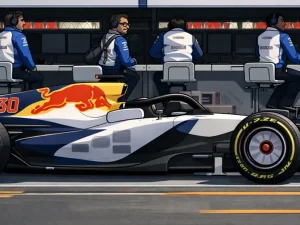
Aston Martin’s AMR26 has at least started its on-track life. The car made its debut at this week’s pre-season shakedown in Barcelona, the first proper taste of the new era after months of noise. It was also, by the standards of modern F1, a useful little reality check: a first official on-track running that featured all but one team, with Williams the only absentee.
Early testing always invites the same trap — confusing activity with performance — but the paddock still keeps score in its own way. On that front, Mercedes played the kind of hand that gets noticed. The Silver Arrows topped the lap counts both as a team and as an engine manufacturer, and they were the only outfit to clear 500 laps across the week. Zoom out and it looks even more emphatic: Mercedes-powered cars racked up 1,136 laps in total.
That doesn’t hand Mercedes any trophies in February, but it does underline a simple truth of new-reg seasons: having a car and power unit you can run, again and again, without drama is a performance parameter in itself. It accelerates everything — understanding, correlation, set-up direction, reliability work, even the mood in the garage. When one camp is logging mileage and another is openly talking about “catch up”, the competitive implications aren’t hard to sketch.
And this is where Aston Martin’s situation becomes particularly intriguing rather than merely worrying. Newey isn’t just another senior hire tasked with making a fast car. In the era of limited development time, experienced engineers aren’t simply valuable — they’re disproportionately influential, because they can cut through dead ends and anchor an organisation to a coherent plan. Former Toyota, Williams and Caterham engineer Dr Sammy Diasinos put it bluntly this week, arguing that the likes of Newey are “so much more valuable” now because they can offer clear direction.
That assessment rings true, but it comes with a catch: direction only works if the constraints are stable. If the engine side is chasing targets, timelines or reliability fixes, the chassis side is forced to design around shifting sand. Packaging, cooling, weight distribution, deployment characteristics — even if you don’t get the detail, you feel the consequences. It’s a tax on progress, and in a capped development landscape it’s a tax you don’t easily win back.
None of this means Aston Martin is doomed to spend 2026 playing defence. But it does reframe the story away from the romantic “Newey will wave a magic notebook” narrative and towards something more grounded: can Aston Martin, Honda and Newey pull in the same direction quickly enough to make the first specification of this partnership a platform rather than a limitation?
Barcelona offered hints across the grid, and the early talk has inevitably drifted towards who looks “ready”. There were winners-and-losers takes, and there were big-picture conclusions drawn from the first five days. But in the midst of all that, Brundle’s little snippet may end up being one of the more revealing lines of the week — because it speaks to the part of 2026 that doesn’t show up in glossy launch photos.
A new era doesn’t wait for anyone. If Honda really is in catch-up mode, Aston Martin will need every ounce of Newey’s famed clarity to avoid spending the opening months paying for problems it can’t fully control. Mercedes, meanwhile, has already done the simplest, most underrated thing you can do in winter: turned up, run the car, and made it look routine. In February, that’s often where the real advantage starts.