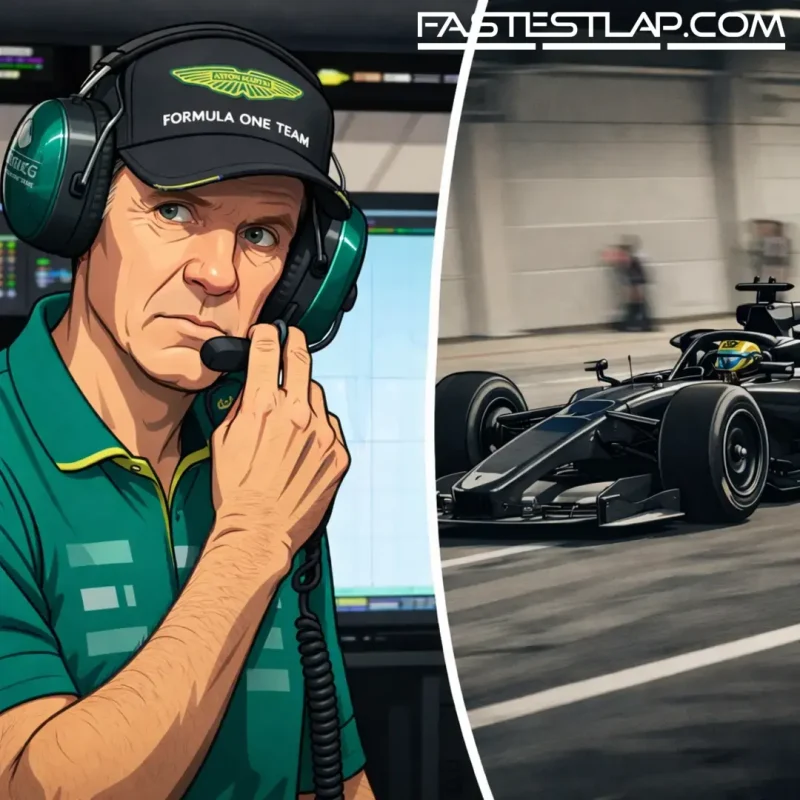
Aston Martin didn’t just turn up late at Barcelona testing with a new car. It turned up with a statement — and, in typical paddock fashion, it delivered that statement in matte black so nobody could read the fine print.
The AMR26 is the first Aston to carry Adrian Newey’s fingerprints from day one, and it arrived with the kind of geometry that makes rival engineers stop mid-sentence, squint, and start doing that casual “just taking a look” walk-by a little more often than they planned. It’s not the headline shapes — the nose that nods back to Newey’s Red Bull era, the busy sidepod surfaces, even the MP4-20-style horns — that have people properly leaning in. It’s what Aston’s done with the suspension at both ends.
Bernie Collins, formerly Aston Martin’s strategy chief and now watching from the outside with the freedom to be candid, summed up the scale of the job just to get the thing running: a new Honda power unit alliance in 2026, a new gearbox, and a team building its own gearbox again after “many, many years”. That’s a heavy integration lift in any season, never mind the first year of a new rules cycle where the whole grid is still finding its feet.
“What a mammoth undertaking to get that car out,” Collins said on Sky F1, pointing out that the AMR26 only emerged late on day four and ran again into the fifth and final day.
The lack of paint? In this context it’s less a fashion choice than a shield. A dark, unadorned car is simply harder to read in motion — and when you’re trying to get correlation runs done without handing out free screenshots to your competitors, you take every little edge you can.
Collins also made the obvious point about test pace: it didn’t look quick on the timing screens, but nobody serious is drawing performance conclusions from that alone. Between conservative engine modes, gearbox caution and planned programmes, lap times this early can be theatre. The meaningful work, as she put it, is gathering the aero data that dictates what direction the car takes before Bahrain.
Still, the AMR26’s talking points are not subtle, even through the camouflage. The front suspension, in particular, has become a magnet for speculation. Technical analyst Matthew Somerfield described a “multi-link wishbone arrangement” with the upper rear leg positioned lower and further back on the chassis than anything we’re used to seeing.
On paper, that sounds like a small packaging note. In reality it’s the kind of decision that can ripple through everything: airflow to key aero surfaces, how the car manages load through heave and roll, and how sensitive the platform becomes as speed rises and the floor and bodywork start doing the heavy lifting.
Collins framed it in a way that will resonate with anyone who’s spent time listening to drivers complain about a car that “just won’t sit down” in the corner. Suspension’s first job is still to keep the tyres in contact with the road. Drivers want feel, stability, predictability — the “what happens when I turn in?” confidence that doesn’t show up in CFD.
But, Collins argued, Newey’s instincts pull him toward aerodynamic outcomes: position the suspension in a way that either creates downforce directly, cleans up airflow, or reduces drag. The risk is that the mechanical side ends up being forced into compromises that other designers might simply refuse to accept.
That tension — aero ambition versus mechanical compliance — is where Newey’s reputation has always lived. When it works, it looks like genius and everyone else looks like they were playing it safe. When it doesn’t, you can end up with a car that has speed in it but asks too much of the tyres and the driver to access it.
And it isn’t only the front end that’s raising eyebrows. Sky F1’s Ted Kravitz drew attention to the rear, specifically the way Aston has mounted the top element of the rear suspension wishbone in relation to the rear wing support structure.
Collins explained why that matters. Conventionally, rear suspension wishbones mount to the gearbox — it’s a stiff structural member, it’s strong, and it’s the established way of doing things because it solves a lot of problems at once. Aston, though, appears to be pushing that architecture, using the rear wing pillar area as a mounting point in a way that’s unusual and, crucially, technically demanding.
The engineering challenge is obvious: you need the rear wing pillar strong enough to take suspension loads, but light enough to not wreck your weight targets and aero efficiency. The aerodynamic opportunity is just as obvious: elevate that member, influence the airflow higher up, and potentially repurpose it as an aerodynamic device — Collins likened it to the old “monkey seat” era where teams sought extra downforce with a lower element in that region.
In other words, it’s not just suspension. It’s suspension doing double-duty as an aero tool — and doing it in a place on the car where small changes can produce big downstream consequences.
Aston Martin’s decision to debut the AMR26 late in Barcelona, with a livery designed to hide rather than show, fits the broader picture. This is a team stepping into 2026 with a huge amount changing at once, and a designer who has never been known for incrementalism. If Newey thinks there’s performance in unconventional geometry, he’ll go hunting for it, even if it makes life harder in other departments.
The next steps will be telling. Aston Martin will be back for the first official pre-season test in Bahrain on 11-13 February, then again on 18-20 February, before the season begins in Melbourne on 8 March. Bahrain will provide the first proper chance to see whether this ambitious suspension philosophy is the foundation of something fast — or simply the kind of brave idea that needs a few painful iterations before it makes sense.
For now, the AMR26 has achieved something valuable before a race has even started: it has people talking about Aston Martin’s engineering choices, not just its driver line-up. In a grid packed with smart designers and cautious concepts, sometimes the most powerful early-season currency is doubt — planted in your rivals’ minds — about whether you’ve seen something they haven’t.