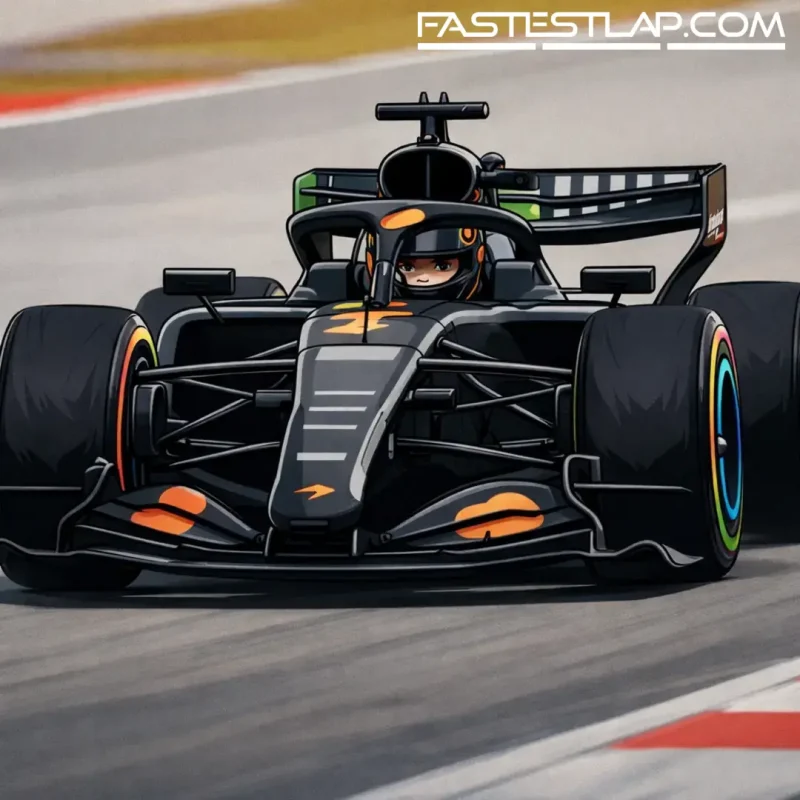
Oscar Piastri has come away from McLaren’s Barcelona shakedown sounding less like a driver chasing headlines and more like one taking stock of an unfamiliar landscape — and that might be the most encouraging takeaway for Woking.
After three closed-door days at the Circuit de Barcelona-Catalunya, McLaren has mileage on the board and, crucially, a clearer picture of where the new MCL40 bites back. Piastri’s summary was blunt: the team now has a better handle on the car’s “problems” and “limitations” ahead of the first proper pre-season test in Bahrain on 11 February.
That matters because 2026 isn’t a year where you can simply “unlock” a few tenths by Friday afternoon. The reset — shorter and lighter cars, active aerodynamics, a shift away from the ground-effect concept of the previous era, and power units rebalanced to a 50/50 split between combustion and electrical power on fully sustainable fuel — has changed what the job even is. Early running is as much about learning how to extract performance as it is about finding it.
McLaren elected to use the final three of the five available days in Spain, with 10 of the 11 teams taking part. Lando Norris, the reigning world champion, opened proceedings with 76 laps before handing the car over to Piastri. The Australian’s Thursday was compromised when a fuel system issue restricted him to 48 laps.
McLaren technical director of performance Mark Temple didn’t sugar-coat it at the time, admitting the team had to pull the car apart to properly trace the fault.
“We discovered a fuel system problem, which meant we haven’t been able to do all the running we would like,” Temple said. “The car is very complex, so we decided to bring the car back into the garage and strip it down to fully understand where the problem is coming from, ahead of tomorrow’s running.”
Even with that interruption, McLaren banked 291 laps across the test. Norris ended up third on the unofficial combined times with a 1:16.594 — two tenths shy of Lewis Hamilton’s Ferrari benchmark. Piastri was 1.1s adrift, but he wasn’t pretending that told the real story.
Instead, he framed Barcelona as a first proper feel for how a 2026 car behaves when you start prodding it: different configurations, different approaches, and a rapidly growing list of questions — especially with the power unit.
“I feel like I got into a pretty good rhythm and was able to start to feel what the car is actually like, which was nice,” Piastri said. “Tried a few things already to see how we can improve it, and stuff like that.
“But yeah, just trying to run it in different configurations and stuff like that, to see what it’s like for race weekend.”
If there was a theme in his comments, it was adaptation. Not dramatic, not doom-laden — just the acknowledgement that some of the instincts built over the last cycle won’t transfer cleanly.
“Still definitely a lot to learn, especially on the power unit side of things. Just how you get the most of it and how you go the fastest, basically,” he added. “So still plenty of things to learn there [about the engine]. But I think we’ve kind of understood some of the problems, some of the limitations.
“Some of the things are just different compared to last year – both on the power unit and the car.”
Perhaps the most telling line was the one that will resonate with anyone who’s watched drivers recalibrate after a regulation change: the downforce isn’t there in the same way.
“Obviously the car itself, it’s got a lot less downforce than what we had last year as well,” Piastri said. “So getting used to that and how that feel has been the biggest thing we’ve started to get ourselves into.”
That’s not just a driving note; it’s a philosophical one. Less downforce and active aero shifts the performance envelope. It changes how you approach corner entry, how you lean on the rear in long turns, how you manage tyres, and how you decide what “good balance” even means when the car can behave differently depending on mode and phase. It’s why those 291 laps matter more than any single headline time.
Piastri also flagged the breadth of the 2026 workload: McLaren’s own car development running alongside the learning curve of the Mercedes HPP power unit package, with drivers feeding back not just on lap time feel but on behaviour, deployment and how to consistently access performance.
“The main thing for Mercedes HPP is trying to understand the power unit as well, and we’re trying to help them,” he said. “Any information that they can get from Lando and I, is very helpful, but even just running the power unit is very helpful for them.
“So there are a lot of things going on at once, but everyone has got slightly different priorities, but they’re trying to make us all as quick as possible.”
For McLaren, the subtext is reassuring. Problems in January are part of the deal; discovering them early — and understanding them — is the point. With Bahrain now in sight, Piastri’s read is that Barcelona has given McLaren something more valuable than a flattering timesheet: a map of what needs fixing, and enough familiarity with the MCL40’s character to start pushing in the right direction.