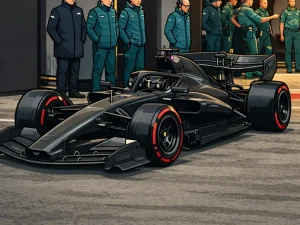
McLaren’s been talking about 2027 for a while now, but this week it finally did the one thing that makes any new racing programme feel real: it let people hear it.
A short teaser released on social media offered the first proper taste of the twin‑turbo V6 that will power McLaren’s as‑yet‑unnamed Hypercar when the Woking marque enters the World Endurance Championship’s top class in 2027. It’s a small clip, but it’s also a deliberate statement — the project isn’t a rendering, a press-release promise, or a hospitality package. There’s an engine on a dyno doing the unglamorous hard miles that decide whether a Le Mans dream survives past the first night stint.
McLaren’s caption did some heavy lifting too: the “purpose-built” V6 is said to be deep into long runs on the dyno after completing its initial test phase, and it’s already logged “first laps of Le Mans”. The team also couldn’t resist a little theatre when a fan asked if this was the engine at full song. McLaren’s answer: not quite — and they’ll “leave you wanting more”.
Our WEC Hypercar is alive! 🔉
The purpose-built McLaren V6 twin turbo-charged engine is completing long-runs on the dyno, having finished the initial test phase and its first laps of Le Mans.
We couldn’t leave you waiting to hear it…pic.twitter.com/5irHpCRVYu
— McLaren Endurance Racing (@MCLEndurance)January 27, 2026
That’s the public-facing side. Underneath it, the programme is taking shape in a way that should make rivals pay attention — not because of hype, but because of the structure.
McLaren will race in WEC as McLaren United AS, the identity reflecting its tie-up with United Autosports, the team co-founded by McLaren CEO Zak Brown. James Barclay, formerly Jaguar’s team principal in Formula E, is in charge. Mikkel Jensen has already been confirmed as the first driver signing. The chassis will be built by Dallara, while the engine is being designed and developed in-house by McLaren — a crucial detail in a category where customer solutions can be competitive, but factory control is often the difference between “present” and “dangerous”.
It also frames McLaren’s return to Le Mans with a bit more weight. This is a manufacturer that still trades on 1995 — when it won the Le Mans 24 Hours — and the WEC grid it’s aiming at in 2027 will include familiar names from the F1 world: Ferrari, Aston Martin, Alpine and Cadillac among them. For a company already living at the sharp end of global motorsport, the attraction is obvious. Le Mans offers a different kind of credibility: not just speed, but resilience, systems, and the ability to execute when the track is dark and the margins are human.
And then there’s the part that still feels faintly surreal even by modern motorsport standards: one of these cars has already been sold.
At the end of 2025, in an auction held during the Abu Dhabi Grand Prix weekend, McLaren put three future machines under the hammer: its 2027 WEC Hypercar, its 2026 Formula 1 car, and a 2026-spec McLaren IndyCar. The Hypercar went for $7,598,750, more than a year before it will even race. The IndyCar sold for $848,750, while the 2026 F1 car fetched $11,480,000. Combined, the three sales totalled $19,927,500.
The buyer of the Hypercar won’t actually take delivery until the first quarter of 2028, and McLaren’s made a point of leaning into the romance of ownership: the new owner’s name will be inscribed on the chassis tag, and they’ll receive a dedicated book documenting that chassis’ on-track history. There’s also a race suit from one of McLaren’s 2027 WEC drivers included, plus hospitality experiences spanning the 2026 Le Mans 24 Hours, the Monaco Grand Prix and the Indianapolis 500, WEC hospitality for every round in 2027, and a private tour of the McLaren Technology Centre.
The F1 car buyer is on a similar timeline — delivery in the first quarter of 2028 — with McLaren providing a showcar of its 2025 title-winning MCL39 in the meantime. The 2026 car itself, the MCL40, has already made its on-track debut in a shakedown in Barcelona.
All of which adds an interesting layer to the engine teaser. In 2026, teams don’t just reveal machines; they market ecosystems. McLaren’s WEC effort is being built as a product as much as a race programme: Dallara expertise, an in-house V6, a team structure with United Autosports embedded, and a carefully controlled drip-feed of milestones designed to keep the project present long before it’s on the grid.
But the truth is, none of that matters if the fundamentals aren’t right — if it can’t run for hours without complaint, if the performance window is too narrow, if the system integration doesn’t work when the car’s heat-soaked at 3am.
So yes, it’s only a sound clip. Yet it lands because it suggests the boring, brutal work has started — and because McLaren is confident enough to let you hear the heartbeat before it shows you the whole animal.