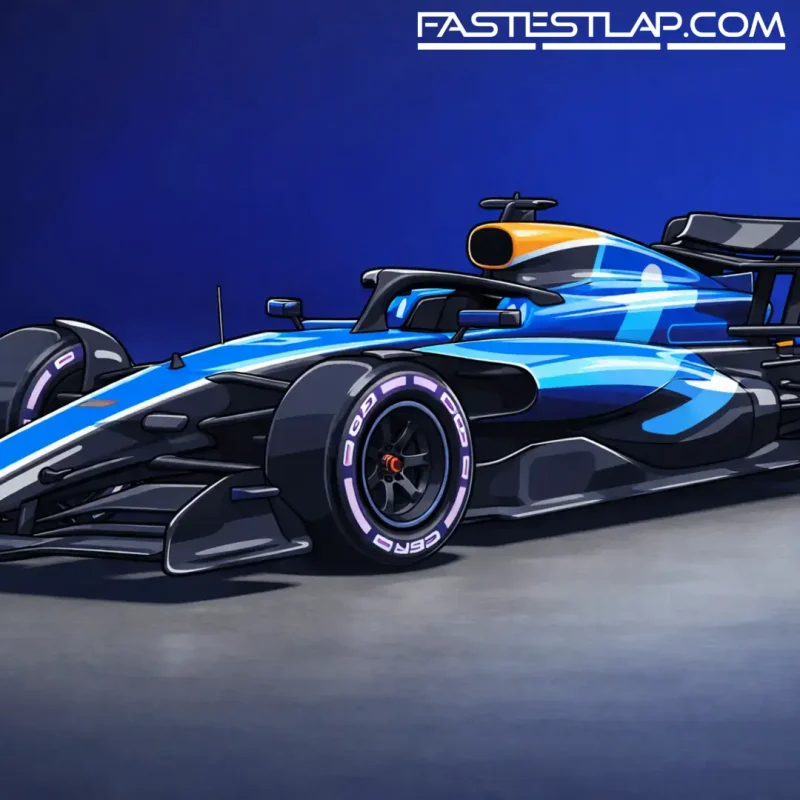
Williams has taken the sting out of one of the more persistent paddock whispers of the early 2026 build-up by putting a number on the FW48’s mass — and, crucially, giving everyone something concrete to argue about rather than the usual launch-season guesswork.
The Grove team confirmed its new car weighs 772.4kg, following Tuesday’s FW48 reveal. In a winter where the new minimum weight has been set at 768kg, that lands Williams 4.4kg over the line on paper. Not ideal, obviously, but it’s also nowhere near the “boat anchor” narrative that started doing the rounds after Williams was the only outfit to miss last week’s five-day shakedown in Spain because of what it called “delays in the FW48 programme”.
Put alongside Mercedes’ own admission that its W17 currently sits at 772kg, the Williams figure looks less like a crisis and more like the sort of early-cycle reality teams tend to live with before the first serious weight-loss parts arrive. The difference between the two cars, at least in these published numbers, is 0.4kg — a margin that’s basically trivia at this stage.
James Vowles, speaking on Tuesday, wasn’t biting on any suggestion that the weight figure alone tells you whether Williams has compromised itself before the season’s even begun — particularly given the team hasn’t run the car in public yet.
“In terms of weight, until there’s two race cars built in the correct specification going forward, it’s hard to comment on that one,” Vowles said. And when pressed on whether weight would stop Williams being competitive: “No one knows – and I really do mean no one – what the pecking order is, especially ourselves as we haven’t been on track, so it’s hard for me to answer that question.”
That’s not just PR fog. Weight in February can be a slippery subject because what teams mean by “the car weighs X” isn’t always identical: are we talking a representative build, a true race-ready spec, ballast included, or a measured figure that still has easy savings sitting in non-performance-critical pieces? Williams’ point in publishing the number is clear, though — the FW48 isn’t wildly out of range versus at least one benchmarked rival, and the idea that missing Spain automatically equals a severely overweight car doesn’t survive first contact with the data.
Vowles also reiterated the line he took last week: that any serious conclusions will have to wait until Bahrain, when the car is together in a proper test environment and instrumented as it will be when decisions become harder and trade-offs more painful.
“There’s no knowledge of the weight until we get to Bahrain in terms of understanding where it is,” he said. “There’s not a single person who will truly know it. It’s impossible to know it, because you need the car together with sensors in the right form and that doesn’t exist today.”
Still, Williams isn’t pretending weight is irrelevant. Vowles acknowledged that if Bahrain reveals the team has missed its target, the response will be decisive: “If we end up being over the weight target, then from that point on it’ll be an aggressive programme to get it off.”
That line — “aggressive programme” — is the one that matters. The new regulation cycle has a habit of producing overweight cars early, and the teams that react quickest tend to be the ones that stop the issue becoming a season-long handbrake. Everyone in F1 remembers how quickly a weight problem can go from inconvenient to corrosive: it shapes design priorities, dictates upgrade sequencing, and can even force teams into awkward compromises on stiffness, cooling or reliability as they try to claw back kilos without breaking things.
It’s also a reminder that, while being over the limit is never a positive, it’s not always fatal. Red Bull’s first ground-effect car in 2022 began life overweight and still won both championships that year, with Max Verstappen racking up a then-record 15 wins. Christian Horner later explained the scale of Red Bull’s progress in shedding mass across seasons, saying the team managed to take 20kg out of the car from one year to the next. The lesson isn’t that weight doesn’t matter — it does — but that strong fundamentals can carry you while you diet, and that the best teams treat weight reduction as a development stream, not a one-off fix.
For Williams, the context is slightly different. Missing the Spain shakedown has already cost it mileage and, with it, some early validation of the FW48’s systems and correlation. That’s where the damage can mount: when you’re chasing basic run plans while others are already experimenting with set-up directions and early concepts. Which is why Vowles is so keen to swat away the idea that the absence automatically signals a fundamental design failure.
The other notable piece of Tuesday’s launch is simply continuity in the cockpit. Carlos Sainz and Alex Albon will race for Williams again in 2026, and if there’s one thing you’d want while the team navigates a new rule set — weight targets included — it’s stable, high-quality feedback and internal reference points.
The FW48’s 772.4kg figure won’t end the debate. If anything, it sharpens it: it tells you Williams is not alone in carrying early-cycle heft, but it also sets a public baseline the team will now be judged against as the pre-season moves to Bahrain. If the car turns up there still heavy and still late, the questions will get louder. If the weight starts dropping and the run plan looks calm, this will be remembered as a February panic that didn’t travel.
For now, Williams has done the smart thing: put a number out, take away the mystery, and let Bahrain decide whether this was ever more than paddock noise.