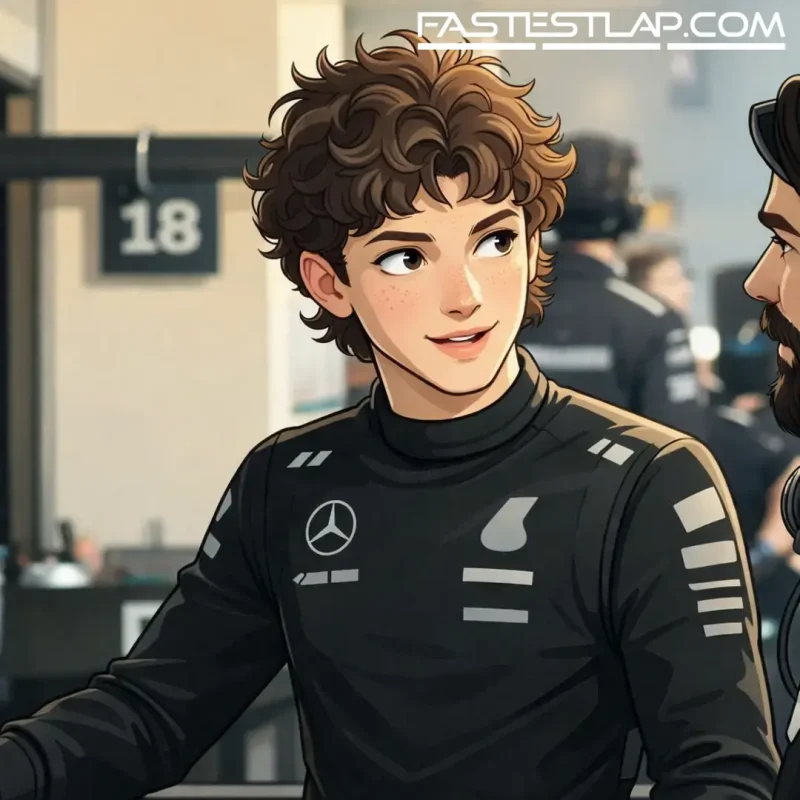
Kimi Antonelli isn’t pretending 2026 will be decided purely by who’s got the prettiest aero map or the bravest braking points. In Mercedes’ rookie-turned-reference-point, the swing factor is going to be invisible to most of the grandstands and painfully obvious on the timing screens: how well teams and drivers manage the battery.
With Formula 1’s new power-unit era leaning into a genuine 50-50 split between internal combustion and electrical energy, the sport is stepping into a world where the lap is no longer just “engine mode plus ERS button”. The battery becomes the lap. And Antonelli’s view is that the teams who turn deployment into a repeatable, track-specific routine — in qualifying and across a stint — will be the ones who look like they’ve found time that others simply can’t.
“I think the biggest element will be on the power unit side and obviously with the battery,” Antonelli explained, underlining how much of the performance chase is shifting from hardware headlines to the detail work behind the scenes. In his mind, this isn’t just about harvesting and dumping energy; it’s about the quality of the software logic and the confidence the driver has in what the car will give him, lap after lap.
That’s where Mercedes’ structure matters. Antonelli specifically pointed to the need for tight integration with HPP, because 2026’s workload lives in those grey areas where driver feel and engineering intent overlap. The battery’s increased role means you’re effectively calibrating a lap: where you release energy, how aggressively you do it, what the car feels like when it comes in, and what that does to the next straight, the next braking zone, the next corner entry. Get it right and the car looks alive; get it wrong and you can make a decent package look flat-footed.
“What I mean is race and qualifying as well,” Antonelli said, stressing that the same principles apply on Saturday and Sunday — with different consequences. Qualifying is obvious: you can ruin a lap before you’ve even reached Turn 1 if the deployment sequence doesn’t match what you need down the opening straight. But race management is where the regulation change could really start to distort what we’re used to reading as “pace”.
Antonelli’s emphasis on consistency is telling. There’s a strain of thought in the paddock that the early 2026 formbook will be as much about repeatability as it is about ultimate peak. If you can’t trust the deployment to be the same “every lap and every run you make”, as he put it, you’re constantly driving around the uncertainty — and that bleeds time, tyre life, and ultimately race options.
It also changes the conversation between the cockpit and the pit wall. The easy cliché is that engineers will “tell the driver what to do”, but the reality looks messier and more collaborative: the driver has to understand what the car can realistically deliver and when, and the engineer has to build a plan that survives changing traffic, changing tyre states, and the usual compromises of racing. Antonelli hinted at that chess match when he spoke about creating room to manoeuvre — having different deployment profiles available so you can “try something different” mid-race if the situation demands it.
That theme was echoed by Haas team boss Ayao Komatsu, who’s been blunt about how punishing energy mismanagement could be under the new rules. Asked what the time loss might look like when a driver gets deployment wrong, Komatsu didn’t reach for a comfortable, marginal number.
“If it were only a tenth, I’d be happy,” he said with a smile — which, in paddock language, is basically a warning label.
Komatsu’s point wasn’t just that mistakes will hurt, but that they’ll be conspicuous. Fans won’t need a deep dive into telemetry overlays to spot it. If someone opens a qualifying lap down the pit straight and the car simply doesn’t accelerate the way it should, the diagnosis will be immediate: the lap’s been compromised before it’s properly begun.
He also made the more interesting point — and one that teams won’t love advertising — that this is an area where you can’t neatly separate the driver from the engineers. The best solutions won’t come from a single department. Drivers and engineers will have to work in a more “integrated” way than before, Komatsu argued, because the car’s performance is increasingly the product of a shared system rather than a set of isolated components.
That’s why Antonelli’s comments land. In recent seasons, the on-track narrative has often been dominated by who has the better platform — and then, within that, who extracts the most. In 2026, extraction could look different. The standout performances may belong to the pairings — driver plus race engineer plus power-unit team — who can turn deployment into something nearly boring in its reliability. No surprises, no sudden flat spots, no “we’ll look at the data” post-mortems after a lap that never had a chance.
And if Komatsu’s right about how visible early inconsistencies will be, expect the first proper qualifying simulations of the season to become a bit of a public audit. Everyone will talk about the new cars’ handling traits, the balance shifts, the tyre prep. But the paddock will also be watching for the telltale sign of a team that hasn’t yet taught its car — and driver — how to spend its electrical budget properly.
The irony of the 2026 revolution is that it might produce a very old-school separator: execution. Not the glamorous kind, either. The methodical kind. The teams who can nail their deployment playbook for each circuit, and give their drivers something consistent to lean on, could build an advantage that doesn’t show up in one spectacular corner — but in the relentless, repeatable way a lap is put together.