Ferrari’s winter has had that familiar Maranello feel to it: not a single silver-bullet announcement, just a steady tightening of bolts ahead of the biggest regulatory reset in a generation. The latest addition is Guillaume Dezoteux, who has arrived from Racing Bulls to take up the role of head of performance operations as Ferrari ramps up for 2026.
Dezoteux starts this week at the team’s Maranello base, ending an 18-year spell within the Red Bull family in Faenza. In a LinkedIn post confirming his departure, he signed off with a note of thanks to his former colleagues and a nod to what’s coming for them too — “the new car and the brand-new power unit” — which underlines how clean a slate 2026 is proving across the paddock.
Ferrari has confirmed Dezoteux is now in place, and the appointment is a meaningful one because it speaks to where the Scuderia believes the next performance differentiators will sit. “Performance operations” isn’t a flashy title, but it’s the kind of job that quietly shapes whether a team repeatedly extracts what it has, or leaves points on the table through execution, correlation and repeatability.
He joins a technical structure led by Loïc Serra, Ferrari’s technical director, with Dezoteux reporting into the trackside side of the organisation through Matteo Togninalli, the head of trackside engineering. Alongside sporting director Diego Ioverno, Togninalli is at the heart of Ferrari’s weekend decision-making and on-the-fly problem-solving — precisely the environment where a vehicle performance specialist can pay for himself.
It’s also a fairly unmistakable clue about Ferrari’s mindset for 2026: the Scuderia doesn’t want to simply build a quick car and hope it behaves. It wants systems, people and processes that make performance repeatable from Friday to Sunday, circuit to circuit, with fewer of those head-scratching swings that have characterised too many Ferrari campaigns in recent years.
The timing is no accident, either. The 2026 ruleset is already forcing teams to rethink how they map out development and how they blend factory work with what they learn at the track. There’s no hiding place in a reset — and it’s notable Ferrari is strengthening the track-performance spine of the organisation rather than just piling more resource into pure design.
Dezoteux’s arrival is one strand of a broader pattern. Ferrari has also been busy locking in partners that sit right on the pressure points of a new-era car: braking systems, turbo hardware, and wheels — all areas where marginal gains quickly stop being marginal when the regulations shift.
On the braking side, Ferrari has extended its long-standing relationship with Brembo. The deal elevates Brembo to a technical partner role across multiple programmes, not just Formula 1. That includes Ferrari’s Hypercar effort in the World Endurance Championship, with Brembo supplying complete braking systems — hydraulic and friction components included — for top-tier competition.
Ferrari’s statement on the renewal leaned on the expected language of innovation and quality, but there’s a practical undercurrent here: 2026 is set to reframe the balance between outright performance and controllability. Brakes are one of the few places where driver confidence can be won or lost within a handful of laps, and in a fresh technical era, stability from a trusted supplier matters.
Then there’s the power unit detail Ferrari wanted on the record: Garrett Motion will continue supplying the turbo systems that will be fitted to Ferrari’s 2026 engine. Garrett has been partnered with Ferrari since 2014, the dawn of the hybrid turbo V6 era, and team boss Fred Vasseur made a point of linking continuity with ambition.
“Garrett has been a trusted partner for many years, and their technology has consistently supported us in achieving our goals,” Vasseur said. “As we prepare for the significant technical challenge of the 2026 regulations, we are pleased to continue this collaboration and to rely on Garrett’s expertise as we enter the next chapter of Formula 1.”
Finally, Ferrari has confirmed a multi-year agreement with BBS for its Formula 1 wheels. That move is more significant than it would’ve been a few seasons ago because the supplier landscape is changing again: after the 2022–2025 period in which BBS was the sole wheel supplier for the grid, the 2026 regulations reopen the door to teams choosing their own. Ferrari opting for BBS forged magnesium wheels effectively resumes a partnership that goes back to 1992, and the team’s wording emphasised joint development, advanced forging tech, and quality control — all the unglamorous essentials that decide whether you win on Sunday or retire with a failure that never makes the highlight reel.
Put together, it paints a picture of Ferrari preparing for 2026 in a very Ferrari way — anchored in technical heritage, but with a sharper appreciation that championships are won by organisations that execute as well as they innovate.
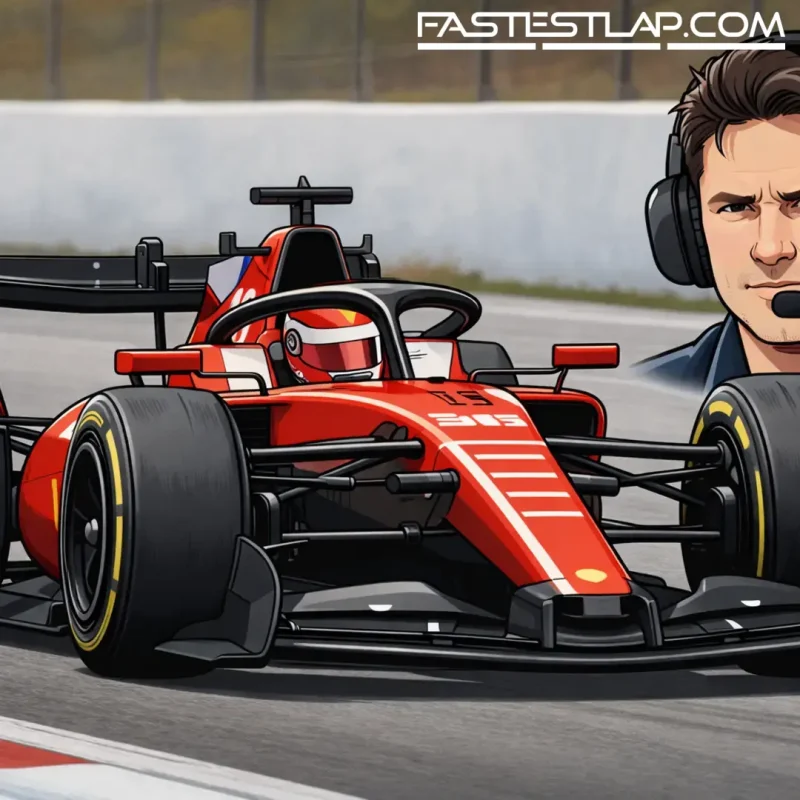
Charles Leclerc’s presence at the Barcelona shakedown only adds to that sense of transition. Testing mileage is one thing; building the internal framework that turns data into lap time, and lap time into points, is another. By bringing in Dezoteux and doubling down on key technical partnerships, Ferrari is making it clear it wants the new era to be defined less by headline-grabbing swings and more by the kind of hard, repeatable competence that the best teams make look boring.
In 2026, “boring” might be exactly what Ferrari’s been chasing.