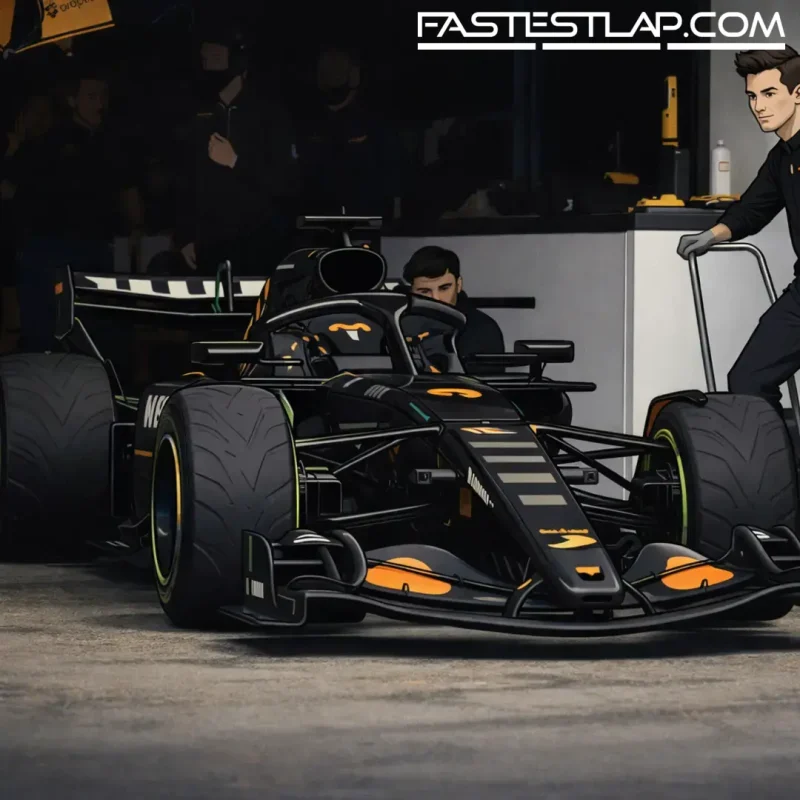
Lando Norris didn’t need Barcelona’s behind-closed-doors shakedown to remind him how quickly a fresh set of regulations can scramble the pecking order — but it helped. With the first proper running of the all-new 2026 cars now on the board, the reigning world champion sounded notably unfazed by the inevitable early paddock noise: yes, someone else might have nailed something clever, and no, that isn’t a reason to panic.
“If you look at others, see what other great minds have come up with, what ideas they’ve come up with, see how you can learn from it, incorporate it, avoid it — whatever it may be,” Norris said during the Barcelona running. “You always have to be willing to accept that sometimes people can do a better job and you want to learn from them.”
That’s the level-headed response you’d expect from a driver who knows how these cycles go. New rules don’t just reshape cars; they reshape mindsets. The 2026 package — shorter and lighter cars, active aerodynamics with moveable front and rear wings, and a new era of energy management emphasis — is designed to reward adaptability as much as outright speed. If there’s a theme emerging already, it’s that the teams are not merely interpreting the rulebook differently, they’re prioritising different problems.
Even in a test where lap times should come with heavy caveats, the first public glimpses of design direction have been enough to set the technical chatter rolling. Ferrari’s front wing pillar concept is the sort of solution that gets rival aero groups reaching for printouts. Aston Martin has arrived with suspension choices that will have photographers lying on the pitlane floor for the next month. Mercedes, meanwhile, has managed to make even a small-looking detail — a vane on the W17’s footplane — feel like a question the rest of the grid needs to answer.
And then there’s the power unit storyline, which already has the scent of a season-long subplot. Five manufacturers will supply the 11 teams in 2026, and early talk in the paddock has centred on reports that Mercedes and Red Bull Powertrains may have found a way to exploit how the regulations define compression ratio measurement. The nominal figure is set at 16:1 in “ambient” conditions under FIA wording, with claims that the operating ratio rises once the engine is running — a difference said to be worth around 15bhp, or as much as four-tenths per lap.
Whether that particular theory survives sustained scrutiny is almost beside the point at this stage. What matters is the pattern: in a new formula, everyone is hunting for edges, and the first batch of cars has made it clear those edges won’t all look the same. Norris’ response — accept it, learn from it, chase it down — is the only sane way to approach the opening phase of a reset.
McLaren’s own start in Barcelona was solid without being headline-grabbing. The team ended the shakedown with the third-fastest time, Norris sitting 0.25s off Lewis Hamilton, with George Russell in between. Useful data, decent baseline, but nothing that will decide anything in February — and McLaren knows it.
Next comes the Bahrain test from 11–13 February, Norris’ second proper outing in the MCL40, before the teams return to Sakhir later in the month and then head to Melbourne for the season-opening weekend, with FP1 scheduled for 6 March. There’s still plenty of mileage — and plenty of confusion — to come. Norris expects as much, particularly given how much driver technique is now tied to system management.
Asked whether the opening race weekend could be “a little bit wilder” than the norm, Norris didn’t hesitate. “I would say so,” he said. “There’s still places on the track where you can still do quite a few different things. And it might be that the systems learn and the calculations work out for everyone… and everyone’s lifting in the same places and doing same things.
“There’s more chances nowadays, especially at the beginning of the show, where you might have people saving a bit more in one half of the track and deploying more on the other half of the track, another team doing vice versa.”
That’s the part worth underlining. In the early rounds, the racing may be shaped less by pure aerodynamic proximity and more by who understands the new trade-offs first — where to harvest, where to spend, how aggressively to use the moveable aero, and how to disguise intent in battle. It’s not hard to imagine a Melbourne where two cars running similar lap time have arrived there via completely different energy maps, creating messy, opportunistic moments that feel unfamiliar in a sport that’s become increasingly optimised.
Norris isn’t pretending it’s straightforward. “It’s hard to give a proper answer, because I don’t think we’ve done enough and enough different tracks to understand everything properly,” he said. “Because it’s not simple.”
That last line is the tell. The quickest teams in 2026 won’t just be the ones with the sharpest wind-tunnel correlation; they’ll be the ones that can turn complexity into routine the fastest — and keep doing it when rivals inevitably copy, protest, or iterate. Norris sounds comfortable with that reality. If anything, he’s framing the new season as an exercise in response time.
McLaren may or may not have started this regulation set-up with the absolute best car. Norris isn’t claiming they have. He’s simply reminding the paddock — and perhaps a few fans who expect the champion to look invincible from day one — that the first week of a new era is always a mirror: it shows you what you didn’t think of. The job now is to decide how quickly you can stop seeing it in someone else’s garage and start seeing it on your own.