George Russell might be getting talked up as the obvious early favourite for 2026, but he’s not buying into the neat pre-season narrative. What’s stood out to him after Formula 1’s first proper taste of the new era in Barcelona isn’t just that Mercedes looked tidy — it’s that the opposition, particularly on the power unit side, looks far more ready than plenty of people expected.
Barcelona’s closed-doors shakedown, held from 26-30 January, was the grid’s first collective run with the radically revised 2026 machinery: smaller and lighter cars, active aerodynamics, and power units split 50/50 between electric and biofuel. It was also, in a way, the sport’s first stress test of the talking points that have dominated the paddock for months — especially the idea that new or reworked engine programmes would inevitably trip over their own shoelaces early on.
So far, that hasn’t happened.
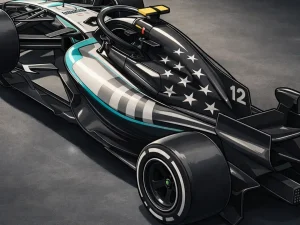
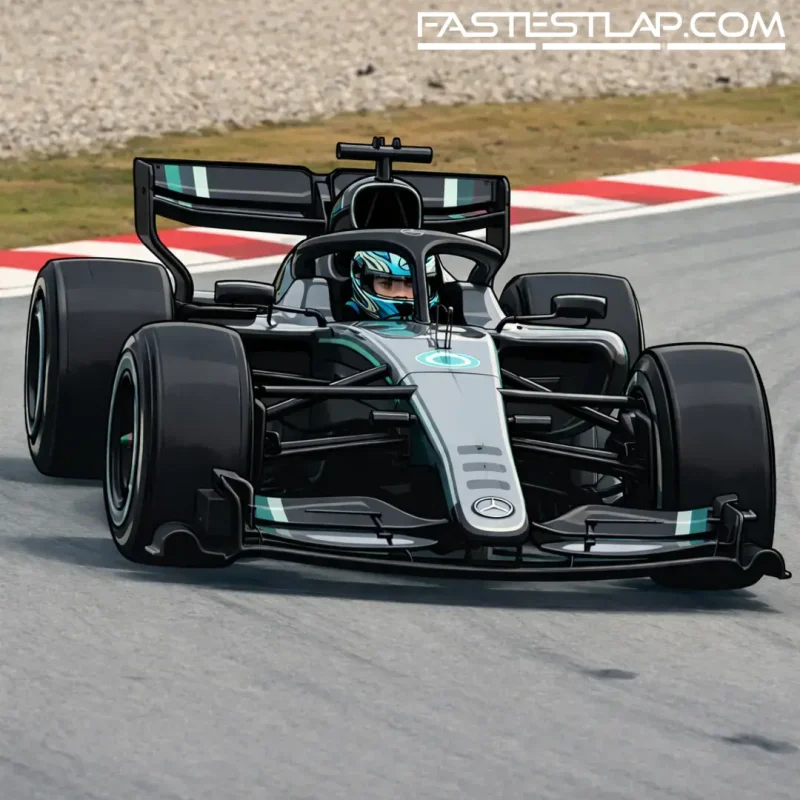
Mercedes emerged from the test with a strong body of work. The team is believed to have logged the most mileage of anyone, with an unofficial tally of around 500 laps, and the word around the paddock is that the W17’s three days of running looked slick and controlled. That’s exactly the sort of start that feeds the hype around Brackley and Brixworth whenever the rules reset.
But Russell’s takeaway was more nuanced than “we’re quick”. Asked about the running in Spain, he sounded more intrigued — and perhaps slightly wary — at how competent some of Mercedes’ rivals appeared to be right out of the box.
“I think on the power unit side, there’s some impressive things from some of our competitors, and that’s quite surprising, to be honest,” Russell said. “So yeah, well done to them.
“But obviously, three days into a 24-race season, so you don’t want to judge too much into that.
“But I think a lot of people anticipated the new power unit suppliers to be sort of struggling and whatnot, and they’ve sort of had a good test as well. So, that’s good for them, but for us, time will tell.”
That’s the key point: 2026 was always meant to create opportunity through disruption, yet the early signs suggest the disruption might be less chaotic than advertised — at least in terms of basic reliability and functionality. That’s particularly relevant when you consider who’s arriving with fresh hardware and freshly built structures.
Mercedes is one of five power unit manufacturers on the 2026 grid, alongside Ferrari, Honda, Red Bull Ford and Audi. Both Red Bull Ford and Audi are new works operations for this ruleset, and the expectation from many outside the engine bubble was that one or both would be plagued by stoppages in the early days.
Instead, the initial chatter from Barcelona was that Red Bull Ford ran without obvious setbacks, while Audi’s programme progressed cleanly once a few early teething issues with the R26 car were addressed. If that picture holds, it matters — because it means the competitive order is more likely to be shaped by performance and development direction than by the blunt instrument of who can simply keep the thing running.
Ferrari and Mercedes, meanwhile, appeared to get through the week without drama, while Aston Martin didn’t rack up enough mileage to draw firm conclusions on Honda’s true state of readiness. Even so, the broader pattern is hard to miss: the first contact with the new power unit regulations didn’t produce the expected trail of smoke and red flags.
For Russell, it reframes what the early part of the season might look like. If the “new guys” aren’t bogged down in reliability triage, they can spend their time chasing lap time, efficiency and driveability — the sort of gains that can move you from midfield to podium contention under stable running conditions. And if multiple manufacturers start the year with credible platforms, Mercedes won’t be able to rely on the traditional early-season advantage that sometimes comes from being the least troubled in a new cycle.
None of that means Mercedes can’t still be the benchmark. If anything, the Barcelona mileage suggests the team has prepared properly and has a car that can do the basics — long runs, systems checks, steady iteration — without collapsing into a garage rebuild. That’s often what separates the sharp programmes from the ones already on the back foot.
But Russell’s comments also feel like a subtle reminder not to mistake “most laps” for “best car”, and not to confuse a smooth shakedown with a settled pecking order. Barcelona, by design, was limited in what it could reveal: it wasn’t open to the media, the running was private, and the day-to-day objectives will have varied wildly up and down the pitlane.
The first real reference points arrive in Bahrain, where F1 will hold two official pre-season tests on 11-13 and 18-20 February. And then it’s straight into the furnace: a 24-race season that begins with the Australian Grand Prix on 8 March.
Russell, for his part, seems ready to stop dealing in hypotheticals.
“I’m looking forward to Bahrain,” he said, “but just looking forward to going racing now, to be honest, and sort of really see where we all shake out.”
That might be the most telling line of the lot. The expectation outside Mercedes is that Russell should lead the charge in this new era; the reality inside it is that the grid may be arriving more prepared — and more dangerous — than the pre-season storyline would like to admit.