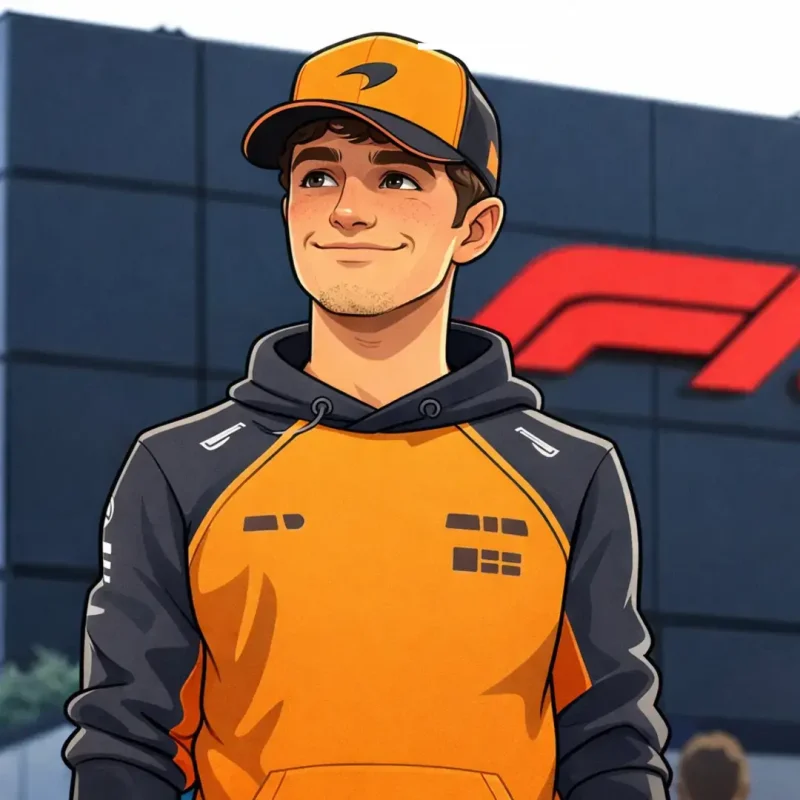
Lando Norris has barely had time to sit down in a 2026 car, yet he’s already pointing to the same uneasy truth most of the paddock is circling: the new rules might scramble the details, but they’re unlikely to rewrite the cast list overnight.
Yes, he expects “chaos” — and he sounds like he means it in the most literal, race-engineer sense of the word. But when it comes to who will actually front-run once the dust settles, Norris is leaning toward continuity. In his view, the four teams that have set the pace in recent seasons are still the most likely to start this new era ahead of the pack.
“We’ve just done a couple days literally,” Norris said, “so I still expect you to see the top four teams at the front and then potentially a bit of a gap to some of the others.”
It’s a pragmatic take, not a romantic one. The scale of the 2026 reset has fuelled plenty of hopeful whispers — the sort you always hear when the sport turns the page — but Norris isn’t biting on the idea that the competitive order will conveniently collapse. If anything, his message is that the big teams’ advantages don’t vanish just because the rulebook changes: the resources, the processes, the depth of development and correlation, the ability to course-correct quickly… those are still the fundamentals.
That doesn’t mean he’s dismissing the midfield’s chances of causing problems. Quite the opposite. Norris name-checked how close some of the chasing teams have been in recent years, and he made a point of it — Williams getting near the sharp end, Alpine popping up, Haas having weekends where it looked far better than expected. The implication was clear: don’t confuse “top four likely remain top four” with “everyone else is irrelevant”.
Because the kind of season he’s describing is one where the pecking order might still be recognisable, but the weekly plot is messier — and for once, the mess isn’t just about tyres or safety cars. It’s about how these new cars are driven, managed, and “spent”.
Norris believes the big variable early on will be energy deployment and how aggressively drivers and teams choose to use it. With the battery contributing a far larger chunk of the overall performance picture — he cited it as producing 50 percent of the car’s power — the margins won’t just come from aero efficiency or mechanical grip. They’ll come from judgement calls made at 300kph: when to deploy, when to hold back, and how to avoid turning a brilliant lap or a brave overtake into a self-inflicted performance cliff two corners later.
“There’s a different level of processing that’s needed for the cars this year in order to understand how to use the battery, how to use the PU in all the best ways which will create, probably at times, more chaos,” he said. “More like ‘oh, how’s he done that?’ And used more battery and then he pays the price for that, and there’s going to be more chaos, in a way.”
That’s the most interesting part of Norris’s read on 2026 — not the forecast that the front remains crowded with the same familiar names, but that the racing itself might become less predictable because the drivers’ toolkits are changing. In the early phase of a new formula, everyone is learning in public. The first few months tend to be full of odd-looking compromises, sudden swings in competitiveness, and teams arriving with upgrades that transform a car’s behaviour from one weekend to the next.
Norris expects that development churn to be relentless this year. New wings, new floors, new bits everywhere, constantly — and he admitted there’s something almost enjoyable about that from behind the wheel, even if it adds another layer of complexity to a sport that hardly needed it.
“It’s cool for us, even as drivers, to get to see we’ve got a new front wing, a new rear wing, new floor, whatever it might be,” he said. “That’s a cool thing for us, but that means this year, because you’re going to be learning so much, you just want to keep pushing the whole way.”
The subtext is that “chaos” won’t be a one-off early-season novelty. It’ll be baked into the championship until teams converge on the same answers — and even then, the best answers will still depend on who can execute them under pressure. Energy management isn’t just a technical department problem anymore; it’s an in-cockpit problem, lap after lap, restart after restart, while defending and attacking.
For McLaren, and for Norris as the reigning world champion, the mindset is pretty straightforward: don’t get distracted by the noise of a new era. The goal isn’t to “survive” 2026. It’s to impose themselves on it.
And if Norris is right, the biggest shake-up this season may not be which logos are at the front — but how, and why, they end up there on any given Sunday.