Pierre Gasly was grinning when he said it, which is usually your first clue that a driver’s about to point at something genuinely awkward without sounding like he’s complaining.
“Make sure you’re sat in front of the TV in Australia,” he joked in Bahrain, because the opening moments of the 2026 season “could be one that everybody remembers”. The punchline, of course, is that even the people doing the launches aren’t entirely sure what it’s going to look like once five red lights go out for real.
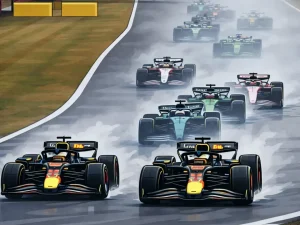
The sport’s all-new 2026 cars have turned something F1 has largely got on top of in recent years — consistent standing starts — into a fresh area of uncertainty. The concern isn’t that drivers have forgotten how to do them. It’s that the power units now ask different questions at the exact moment you can least afford hesitation: the hit of torque, how the turbo comes in, and how cleanly the car responds when you finally commit to throttle.
A big part of the new reality is the altered relationship between the electrical side and the internal combustion engine. With the regulations shifting the balance heavily towards electrical deployment, the way power is delivered off the line is no longer a straightforward evolution of what everyone had been refining. Teams can model it, drivers can practise it, but there’s still a “feel” element you only really learn when you’re boxed in by 19 other cars and a wall arriving at Turn 1.
Then there’s the mechanical process of it all. Starts now take longer to build into the window drivers want — a period where revs are held to generate turbo boost — and the removal of the MGU-H has stripped away a tool that previously helped smooth the transition as the turbocharger, engine and MGU-K did their handover dance. That smoothing matters when you’re trying to find grip at low speed with millimetres of pedal travel, and when any delay or spike can turn a clean getaway into wheelspin, bogging, or the sort of stutter that invites chaos behind.
It’s also where the paddock’s safety and fairness worries have come from. If getting everything primed takes longer, what happens for the cars further back in the grid? The concern is that not everyone has the same amount of time — or the same clean conditions — to get their systems into the sweet spot. And if that becomes a lottery, the sport’s going to have a problem on its hands very quickly.
Gasly didn’t dress it up. Asked what the new starts might change this season, he admitted: “It is definitely going to be more tricky than it used to be.”
He’s also realistic about how quickly Formula 1 tends to swallow these problems. Give teams a few weeks of data and a few thousand practice launches, and the procedure will look a lot less exotic. If the FIA needs to tweak something, it can — and historically it does, fast, when a visible sporting issue is brewing.
“I think it’s something which, in the space of a couple of weeks or months, we’re all going to figure out how to make it in a simpler way,” Gasly said. “But as it stands now, after only two weeks of testing, we can see that it’s not going to be easy in Australia.”
Still, what came through most strongly in Bahrain wasn’t a driver fretting about his getaway. It was a driver looking at the size of the overall job list and filing starts somewhere below “make sure we actually finish”.
As simple as that sounds, it’s a telling shift. Reliability talk in modern F1 usually belongs to the backmarkers, or to those awkward early-rules months that everyone tries to forget. But 2026 is a clean-sheet era: hugely revised cars, complex power unit control, and plenty of systems that behave perfectly in simulation right up until the first time you subject them to a full race distance, changing track conditions and genuine pressure.
“That’s why I think in Australia, just in terms of reliability and getting to the end of the race, is going to be challenge number one and priority number one,” Gasly said. “As simple as it sounds… these cars are extremely complex.”
And that’s the interesting subtext behind his light-hearted warning about Melbourne’s start: it isn’t just that Turn 1 might be spicy. It’s that the grid is heading into the opener still in the phase where you don’t fully know what you don’t know.
The field gets more time to iron out the early creases with another three days of pre-season running in Bahrain from 18-20 February, before the championship begins at Albert Park on 6-8 March. But if Gasly’s smile is anything to go by, nobody in the pitlane is expecting the first start of the new era to be tidy, predictable, and instantly “solved”.
It might be memorable. Just not necessarily in the way teams would prefer.