Red Bull is trying to swat away the notion it’s performed a late political pirouette in Formula 1’s fast-heating compression ratio dispute, insisting its position hasn’t shifted at all — and that it’s simply backing what it considers a “fair” framework as the sport barrels towards the 2026 season opener in Australia.
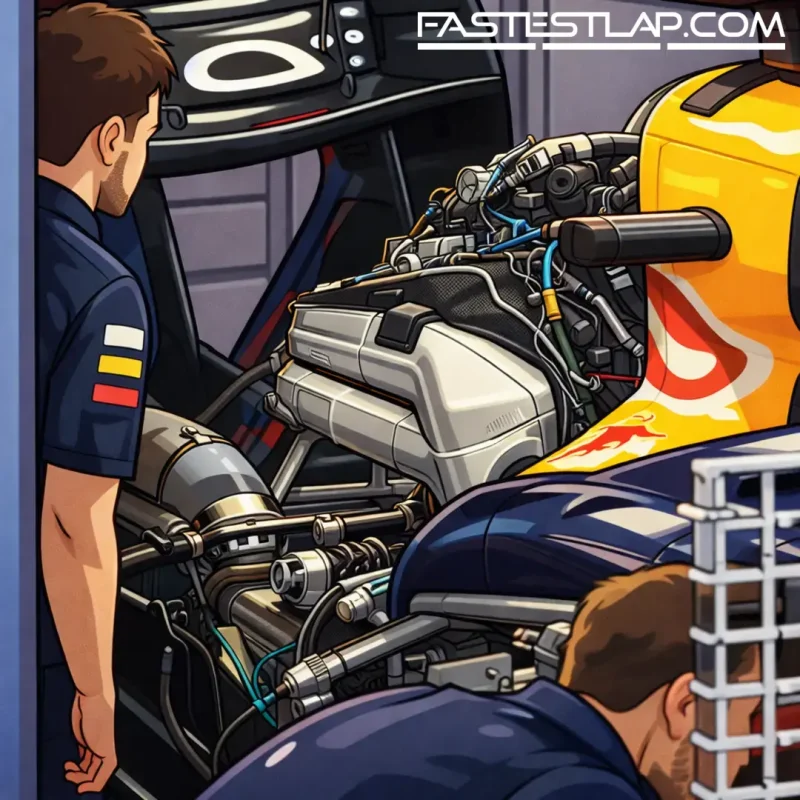
The row sits right at the centre of the new power unit regulations and, inevitably, has become the paddock’s favourite pre-season obsession. The specific flashpoint is a small but loaded piece of wording in the rules governing compression ratio, with the limit now set at 16.0. Article C5.4.3 states that no cylinder may exceed that geometric compression ratio, but adds that the procedure to measure it will be detailed by each power unit manufacturer and executed at “ambient” temperature, subject to FIA approval and included in the homologation dossier.
That “ambient” reference has opened the door to what rivals believe is a performance play. Mercedes is said to have found a way to effectively run a higher ratio — reported as 18:0 — while still satisfying a 16:0 geometric reading when the engine is assessed under hot operating conditions. Early noise in the paddock suggested Red Bull-Ford had also spotted the same opening, before the story evolved into a picture of Mercedes standing alone versus Ferrari, Audi, Honda and Red Bull in what’s been dubbed, with varying levels of seriousness, the “gang of four”.
It matters because of timing and governance. Mercedes High Performance Powertrains supplies not only the works team but also McLaren, Williams and Alpine, and it now faces the prospect of a crucial supermajority vote when the Power Unit Advisory Committee meets again. The direction of travel, as understood in the paddock, is a push to redefine how the measurement is taken — effectively allowing the compression ratio to be assessed at hotter temperatures. If that change lands, Mercedes could be forced into late engine rework with the Australian Grand Prix looming, FP1 scheduled for March 6.
That’s the context in which Red Bull technical director Pierre Waché was asked in Bahrain about claims his team had moved from being a fellow beneficiary to a vocal supporter of clamping the loophole shut.
“Now, I think we are just following what the FIA says, to be honest,” Waché told media. “We just vote as a PU manufacturer to what we think should be fair for the system, and after the governance system, we choose what it will be.
“I think I’m not sure we changed our mind. We just follow the process on our side. As a newcomer, we just want to be fair with the system and follow all the elements.”
It’s a carefully chosen answer, and not just because Red Bull Powertrains-Ford is still building credibility as a manufacturer in its own right. There’s a wider piece of paddock reality here: nobody wants to be painted as the team lobbying to blunt a rival’s advantage while quietly exploiting the same trick themselves, and nobody wants to be the outlier if the FIA decides “ambient” has become too elastic a concept to police.
Pressed on the spicier version of the story — that Red Bull had supposedly cooled on the idea because it couldn’t “quite” make it work in practice — Waché didn’t bite. He leaned into uncertainty, and into the familiar wall teams erect when they’re asked to discuss another manufacturer’s engine.
“I think I don’t know what the others are doing,” he said. “I don’t know what they are doing, seriously. I don’t know if it’s true or not. At the moment, it’s just a rumour.
“And if I was trying to put in place a system that is fair for everybody in the different operations… But, yeah, I’m not expert on engines, and I don’t know what they are doing.”
That last line will raise eyebrows given Waché’s role, but it also lands as a deliberate deflection: Red Bull doesn’t need to claim technical authority over the combustion detail to justify a governance stance. The team’s public argument is simpler — that it wants a level playing field, and the FIA process should decide what that looks like.
Behind the scenes, though, the stakes are obvious. If the performance swing being whispered about — up to four tenths — is even remotely in the ballpark, then this isn’t a semantic squabble. It’s an early-season competitive lever, the sort that can define development directions and force uncomfortable compromises before a car has turned a wheel in anger.
And this is where the political subtext gets interesting. Red Bull is entering 2026 not just as a front-running team, but as a manufacturer with something to protect: its credibility, its relationship with Ford, and the perception that it can play the rulebook as well as anyone without leaning on a friendly interpretation. In that sense, Waché’s insistence that Red Bull hasn’t “changed sides” reads less like a denial and more like a message to the room: don’t confuse self-interest with instability. The team wants the regulation written and enforced in a way that can’t be bent into an arms race over test conditions.
Mercedes, meanwhile, is at risk of becoming isolated not because it’s broken a rule — the whole point is that it hasn’t, at least not on the text as written — but because it may have used the grey space more effectively than everybody else. F1 has never been kind to that kind of asymmetry when it appears too early and too sharply.
The next PUAC meeting, and whether a supermajority coalesces around redefining the measurement baseline, is now one of the key moments of the pre-season. Not because it will settle who built the best engine, but because it will show how the sport intends to handle cleverness in its new era: reward it, regulate it, or — as is so often the case — try to do both at once.