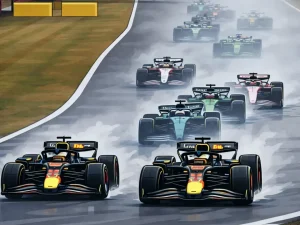
Bahrain testing has barely begun and already the 2026 rule reset has found its first proper flashpoint: not lap time, not porpoising, not even reliability — but the most basic part of racing a Grand Prix car. Getting it off the line.
With the new power units now running a 50/50 split between electric and combustion power, the paddock’s early conversations have sounded less like the usual February hype and more like a debate about what Formula 1 is supposed to feel like. Slower cornering, punchier acceleration, and a much heavier reliance on harvesting and deployment have pushed energy management from “important” to “structural”. And when you build a car around energy maths, it has a habit of showing up in the worst possible place: the start.
The immediate problem teams are wrestling with is the removal of the MGU-H. In the previous era it masked turbo lag and helped drivers consistently hit the launch window. Without it, the cars take longer to settle into that sweet spot, and the variability from run to run looks like it could become a defining feature of 2026 — in a way nobody particularly wants. There’s already talk that the F1 Commission may have to discuss changes to the start procedure, with safety now being mentioned openly rather than as a theoretical concern.
Max Verstappen has been the highest-profile voice to throw cold water on the direction of travel. In Bahrain he described the driving as “management”, and the criticism cut deeper than the usual new-regulations grumbling. “The feeling is not very F1-like,” he said, arguing it’s closer to “Formula E on steroids”, and adding that as a driver he wants to run flat-out — something he doesn’t feel these cars currently allow.
That line landed because it’s tapping into a wider anxiety: that the sport may have engineered itself into a narrow corridor where the cars are technically fascinating, but emotionally harder to connect with in the raw, instinctive way F1 has always traded on. And if Verstappen’s complaint is about feel, two prominent outsiders have attacked the rules from another angle entirely — calling the design fundamentally wrong.
Lucas di Grassi, a former F1 driver and now a Formula E mainstay, didn’t mince his words when asked about what he’s seen from the 2026 package so far. He branded the hybrid rules “extremely badly designed”, placing the blame not on the concept of hybridisation but on the regulations and the decision-making behind them.
“It’s the rules which are decided by the FIA, and some people within the FIA who decided the rules [who are at fault],” di Grassi argued. “I don’t know the logic behind those rules, but there are very weird rules.”
His point, essentially, is that the framework itself is producing unintended consequences: cars that can be slow in certain phases, “sometimes not very efficient”, and — the one that will really worry F1 — not always “very raceable”. In other words, the complaints aren’t just drivers being drivers; they’re symptoms of a rule set that may have overreached in how tightly it’s tried to steer performance through energy constraints.
Dan Ticktum took it even further, questioning whether the new engine rules align with the idea of F1 as a sport rather than an engineering exercise that’s drifted into a compromise nobody asked for.
“If I’m being brutally honest, I think F1 – it should be a sport,” he said. And then he went straight for the romantic vision many fans still hold onto: “They want to see a massive, great V12 screaming… massive cars that are a bit more difficult to drive.”
Ticktum’s critique wasn’t really a nostalgia rant so much as a complaint about “middle ground” thinking — a sense that the regulations are trying to be too many things at once, and in doing so risk pleasing no one. The sport is pushing hard on sustainability and electrical power, while also trying to retain the identity of the fastest, most prestigious single-seater category. In testing, at least, that tension is visible.
Di Grassi’s most provocative claim, though, is what comes next — and it’s where the political edge creeps in. He believes Formula E is on a trajectory to become the quicker category “in a couple of years”, depending on how its future Gen4.5 and Gen5 cars develop. He even painted a scenario in which the question of “best drivers” becomes messy if the faster car isn’t the one wearing F1 branding.
“What happens when Formula E is way faster than F1?” he asked. “Will the best drivers in the world drive Formula E?”
It’s a deliberately uncomfortable framing, because speed has always been F1’s ultimate trump card in the motorsport ecosystem. Di Grassi went as far as to suggest Formula E could end up “two-three-four-five seconds faster than F1” at Monaco in a future cycle, pointing to four-wheel drive and traction control as performance multipliers.
Whether that prediction holds is almost beside the point. What matters is that, in the first week of 2026 testing, the conversation has already shifted from “who’s quick?” to “what have we built?” When the starts are inconsistent, when drivers are talking about the cars feeling alien, and when prominent figures are calling the rules “weird”, the sport has a credibility problem to manage — not with casual viewers, but with its own ecosystem.
And if the F1 Commission really does have to step in to tweak how a Grand Prix start works because the cars can’t reliably do the basics, that won’t just be a technical footnote. It’ll be an admission that the new era needs patching before the first five lights even go out in Australia.